

























































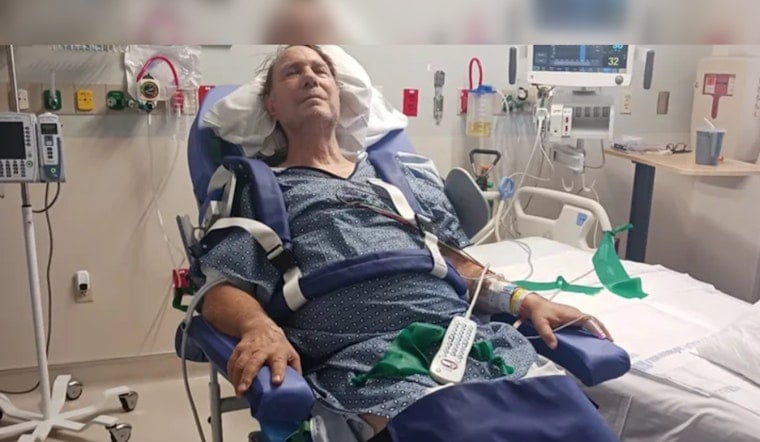
A 72-year-old Bullhead City man is scheduled to lose his right leg above the knee after a fall during a walk left him lying unconscious in 120-degree desert heat for more than an hour, suffering second- and third-degree burns across his body. Grant Siler dropped an 80-pound cinderblock on his foot, then fell during the walk, according to his family. A passing woman found him unconscious in the desert, poured water on him, helped revive him, and called 911.
The account, gathered from Siler's daughter Heather Crook and Stephanie Anderson, was first reported by FOX 10 Phoenix. Crook, who is also a nurse, said her father walked nearly a mile into the desert wilderness before he fell. He did not take Tylenol after dropping the cinderblock on his foot, and family members say Siler is the type of person who typically gets up and walks off an injury. This time was different. “He's hurting really bad,” Crook told the station.
By the time paramedics reached him, Siler had developed heat stroke, a core body temperature exceeding 105 degrees, and multiple organ shock, per the same account. His right leg was damaged too severely by the hot ground to heal, and surgeons in Las Vegas have scheduled an above-knee amputation for Monday, August 31.
Why Ground Contact Turns Deadly in Desert Heat
The physical mechanism behind Siler's injuries is well documented in burn medicine. A 2020 study published in the Journal of Burn Care and Research and cited by The Farmer's Dog found that when ambient air temperatures reach 120 degrees in desert climates, asphalt can rise to 166 degrees and porous rock to 170 degrees, hot enough to inflict second-degree burns within two seconds of contact. Once Siler lost consciousness and could no longer move off the superheated ground, prolonged exposure turned a fall into a life-threatening burn injury on top of the heat stroke itself.
Clinical research from the Diane & Bruce Halle Arizona Burn Center at Valleywise Health, published in June 2023, shows just how severe these injuries tend to become: 33 percent of summer contact burn patients require ICU admission, 70 percent of those ICU patients need mechanical ventilation, and victims average two surgeries during a 16-day hospital stay. A separate five-year retrospective study by UNLV School of Medicine surgeons, published in the Journal of Burn Care & Research in September 2020, found that just over half of admitted pavement burn patients required surgical excision of damaged tissue, more than a third needed skin grafts, and elevated core body temperature significantly raised both 30-day mortality risk and ICU stay length, a pattern consistent with the organ shock and extreme body temperature Siler experienced.
Transported 100 Miles for Specialized Burn Care
Siler was taken to a burn intensive care unit in Las Vegas, roughly 100 miles from Bullhead City. Mohave County has no dedicated burn ICU of its own, so critically burned patients are routinely sent to University Medical Center's Lions Burn Care Center, Nevada's only American Burn Association-verified burn center and the primary burn trauma facility for Southern Nevada, Mohave County, parts of Utah, and Southern California, according to a 2020 Las Vegas Perspective report.
That facility has been strained this summer. The Nevada Current reported in July that the center admitted 22 patients for severe pavement burns in June alone, double the 10 admitted the same month a year earlier, a trend detailed by the Las Vegas Sun. Older adults appear especially vulnerable to these injuries: a 2021 report from the Arizona Burn Center at Valleywise Health found that 38 percent of patients admitted for extreme heat contact burns during summer heat waves were adults aged 60 or older.
Siler's case echoes another documented in the Southwest. Fast Company reported in July 2024 that 62-year-old Phoenix resident Ron Falk suffered a heat stroke collapse onto hot asphalt that resulted in an above-knee amputation of his right leg and extensive skin grafting, a case that mirrors the trajectory now facing Siler.
Family Faces Mounting Costs, Daily Three-Hour Commute
Siler's wife, Vicki, has continued working while commuting three hours round-trip each day to visit him at the Nevada hospital. The family, who moved to Bullhead City in 1988, is bracing for expenses tied to specialized home medical equipment, prosthetics, and renovations to make their home wheelchair accessible. A community fundraiser is close to reaching its initial $6,000 goal, according to the FOX 10 Phoenix report. Crook, who lives next door to her parents, described her father as someone who had recently rebuilt a block wall in her backyard, a detail underscoring how active he was before the fall.
A Region Grappling With Extreme Heat
Bullhead City regularly sees summer temperatures above 115 degrees and holds an all-time record high of 126 degrees, set in June 1984, according to the Western Regional Climate Center. The National Weather Service issues Excessive Heat Warnings when temperatures pose major-to-extreme health risks, prompting desert municipalities like Bullhead City to open public cooling centers for vulnerable residents, as reported by the Associated Press.
Statewide, the picture has shown some improvement. The Arizona Governor's Office reported in May that preliminary health department data showed heat-related deaths in Arizona dropped to 667 in 2025 from a record 997 in 2024, following the rollout of the state's first Extreme Heat Preparedness Plan. Even so, cases like Siler's illustrate how quickly a routine walk in triple-digit heat can turn catastrophic once someone can no longer get off the ground on their own.





