

























































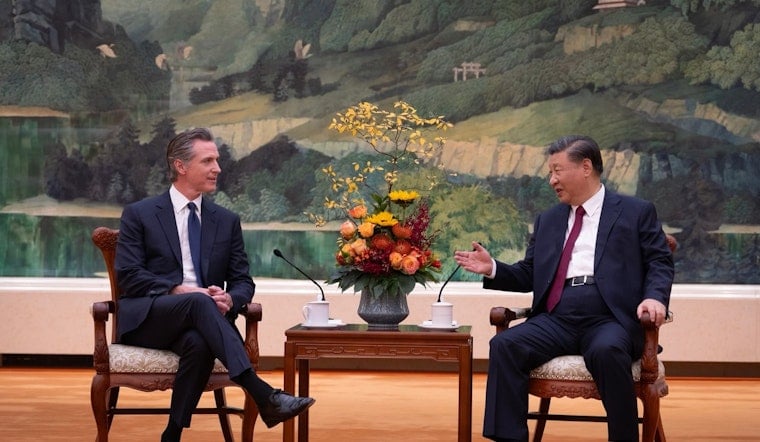
Four congressional Republicans sent a letter Wednesday to the U.S. Attorney General and Secretary of State demanding a federal investigation into California's decade-plus web of climate agreements with Chinese government entities, arguing Governor Gavin Newsom is continuing a pattern of subnational diplomacy that may violate the U.S. Constitution. Senators Rick Scott, Mike Lee, and Marsha Blackburn, joined by Representative Young Kim, want the Department of Justice and State Department to examine whether California's memorandums of understanding with Chinese ministries, university research partnerships, and procurement contracts cross the line separating state authority from federal foreign-policy power.
The letter, addressed to Attorney General Todd Blanche and Secretary of State Marco Rubio, was announced in a press release from Senator Rick Scott's office. As reported by the Tampa Free Press, the lawmakers wrote that Newsom is likely violating the Constitution and serving as China's “useful pawn,” framing the state's climate diplomacy as an end-run around federal supremacy over foreign affairs. The four argue that California's bilateral engagements with Beijing bypass federal authority, and their petition specifically asks the DOJ and State Department to examine potential Foreign Agents Registration Act compliance among program-affiliated individuals, according to the same report.
A Legal Fight Rooted in a 2013 Handshake
The controversy traces back well before Newsom's tenure. California's formal climate collaboration with Beijing began in September 2013, when then-Governor Jerry Brown signed a memorandum of understanding with China's National Development and Reform Commission covering carbon trading, clean energy markets, and zero-emission vehicle deployment, per historical reporting from CalMatters. Brown later co-founded the California-China Climate Institute alongside former Chinese climate envoy Xie Zhenhua, an institute that started as a University of California, Berkeley initiative in 2019 before the state legislature codified it into law.
That codification came through Assembly Bill 39, which Newsom signed in September 2021, formally tasking the California-China Climate Institute with shaping subnational climate policy and partnering with Tsinghua University in Beijing, according to a state legislative committee analysis. A year earlier, in September 2014, UC Davis's Institute of Transportation Studies entered a five-year agreement with the China Automotive Technology and Research Center to form the China-U.S. Zero-Emission Vehicle Policy Lab, with advisory input from the California Air Resources Board, per background from UC Davis's own transportation research center.
Newsom's 2023 China Tour Under Renewed Scrutiny
Newsom's own trip to China looms large in the current complaint. In October 2023, the governor spent a week touring six Chinese cities, meeting President Xi Jinping and signing five subnational memorandums of understanding on clean energy and environmental protection, according to a statement from the Office of Governor Gavin Newsom. Newsom defended the trip at the time as necessary subnational diplomacy meant to keep global climate dialogue open, the governor's office said. Hoodline previously reported on the donor-funded roots of that trip, which relied partly on private foundation money and behested payments.
There is an economic backdrop to why California keeps returning to the table with Chinese partners. California's regulatory mandate to phase out new gas-powered car sales by 2035 depends heavily on China, which controls the majority of global processing capacity for critical battery minerals, according to economic analysis reported by CalMatters in October 2023. That supply-chain dependency helps explain why state regulators have prioritized cooperation with Chinese manufacturers even as federal scrutiny intensifies, and it sits alongside broader friction between the state and Washington over electric vehicle policy that Hoodline has covered before.
What the Constitution Actually Requires
The legal question at the center of the dispute hinges on Article I, Section 10 of the U.S. Constitution, known as the Compact Clause, which restricts states from entering treaties or agreements with foreign powers without congressional approval. But under Supreme Court precedent set in Virginia v. Tennessee in 1893 and reaffirmed in U.S. Steel Corp. v. Multistate Tax Commission in 1978, congressional consent is only required for state agreements that increase state political power and encroach upon federal supremacy, according to the Congress.gov Constitution Annotated. Courts have historically distinguished between legally binding interstate compacts and non-binding policy declarations, a distinction California officials have leaned on to defend the legality of its MOUs.
This is not the first time federal authorities have tested that boundary against California's climate diplomacy. The federal government previously sued California in 2019 over its cross-border cap-and-trade agreement with the Canadian province of Quebec, alleging violations of the Treaty Clause, Compact Clause, and Foreign Affairs Preemption, according to legal analysis published by Lawfare. Federal judges in that case evaluated whether non-binding or regional carbon market linkages impermissibly encroach on federal foreign-policy authority, the same analysis notes.
UC Berkeley Already Faces a Separate Federal Probe
The new letter arrives as the University of California system is already under a separate cloud of federal scrutiny. In April 2025, the U.S. Department of Education opened an investigation into UC Berkeley under Section 117 of the Higher Education Act over foreign gift and contract disclosures tied to joint research ventures involving China's Tsinghua University, as reported by the Los Angeles Times. Section 117 requires higher education institutions to disclose foreign gifts or contracts valued at $250,000 or more.
The Republican lawmakers' petition goes further than seeking a disclosure review. It specifically requests that the DOJ and State Department evaluate civil litigation options against the University of California Regents and examine potential FARA compliance among program-affiliated individuals, according to the Tampa Free Press report. Congressional members also asked for a review of technology exchanges related to clean energy and vehicle software, and for a broader accounting of state procurement contracts with Chinese manufacturing firms, per the dossier of claims tied to the letter.
A Report Sets the Stage
Underpinning the lawmakers' case is a report titled Behind the Climate Curtain, published by the National Association of Scholars, which described collaborations between California officials and Chinese government entities spanning more than a decade. That report appears to have supplied much of the historical framing cited in the senators' letter, tracing California's outreach to Beijing from Brown's original 2013 agreement through Newsom's continued engagement with Chinese ministries and state-affiliated institutions.
The push for federal intervention also echoes a broader national trend of GOP-led scrutiny of Chinese influence in state and local affairs, a pattern Hoodline has tracked in other states grappling with similar concerns. Whether the Justice Department and State Department act on the senators' request, and whether any resulting inquiry reaches the constitutional questions at its core, remains to be seen.



