

























































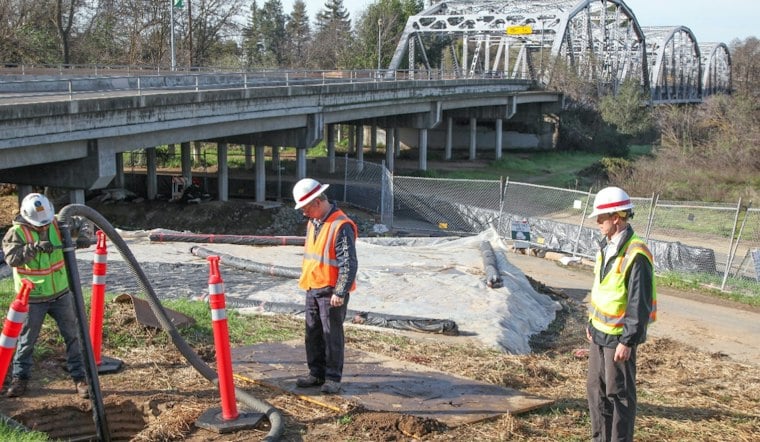
Caltrans and state and local leaders gathered near Cal Expo Wednesday morning to cut the ribbon on a $288 million rehabilitation of the American River Bridge, closing out a years-long fix to a span that had been quietly crumbling under some of the heaviest traffic in the Sacramento region. The bridge carries State Route 51, known locally as the Capital City Freeway or Business 80, across the American River between downtown Sacramento and communities to the east.
The project rehabilitated the bridge deck and reinforced its piers, addressing problems that had been building for decades, according to KCRA. The structure dates back to 1954, when it was built as two separate two-lane spans, and was widened to six lanes in 1966 using lightweight concrete that avoided the need for new in-river piers, according to the Sacramento Water Contractors Public Agency. Deck cracking and deterioration later prompted a full overhaul.
By the time Caltrans engineers took a close look, the damage was extensive. Assessments found deck cracking, concrete spalling, high chloride corrosion, and riverbed erosion severe enough to expose the bridge's steel foundation piles beneath its footings, per a presentation posted by River Park Sacramento. The presentation said deterioration could lead to emergency repairs.
A Freeway That Couldn't Afford to Shut Down
SR-51 carries heavy commuter traffic, making the rehab a balancing act: repair the bridge without shutting down one of Sacramento's busy commuter arteries.
Funding came largely through Caltrans' State Highway Operation and Protection Program, which contributed $236.8 million, with another $2.7 million in regional Active Transportation Program money earmarked specifically for the project's new bike and pedestrian path, according to a Caltrans District 3 news release. The construction work itself was carried out by American River Constructors, a joint venture between Granite Construction and California Engineering Contractors, under a $131 million parent contract using a Construction Manager/General Contractor delivery model, as reported by Construction Dive. That approach let the builders weigh in during design to help streamline environmental permitting.
New Path Links Up With the American River Trail
Beyond structural repairs, the project added a bicycle and pedestrian path across the river, complete with safety barriers, that now connects with the existing American River Trail system, per KCRA's reporting. Caltrans District 3 Director Sergio Aceves said the new path will encourage more people to get around without their cars, according to the station. Project designs also widened the bridge's superstructure and substructure by roughly 55 feet on the northbound side, a change that gave crews room to shift traffic during construction while carving out permanent space for the active transportation route, according to filings on CEQAnet.
Wednesday's ribbon-cutting, held near Cal Expo, included remarks from Kevin McCarty and state Sen. Roger Niello, per KCRA. Caltrans says the work was designed to extend the life of the bridge and protect it from erosion, preserving the river crossing that links downtown Sacramento with suburban communities to the east.
Salmon Habitat and Sleepless Nights Along the Way
Getting the project done inside the American River floodplain came with strict environmental guardrails. Permits issued by the California Department of Fish and Wildlife required habitat protection measures because construction permanently removed 0.456 acres and temporarily disturbed nearly 4.5 acres of habitat for threatened spring-run Chinook salmon. Crews relied on floating barges and dewatered cofferdams to avoid in-water work during active salmon runs, the agency's permit documents show.
Nearby residents felt the project in a different way. Multi-year overnight construction generated formal noise and vibration complaints from River Park neighbors, prompting Caltrans to step in with contractors to ease late-night disturbances, according to CBS Sacramento. The station reported that a River Park resident described work from 11 p.m. to 4 a.m.; Caltrans separately sought to avoid freeway lane closures during busy commute hours.
The final stretch of construction brought some of the most disruptive closures of the entire project. In May, crews shut down the northbound Capital City Freeway for a full 28 hours to pour and allow extended curing of a specialized polyester concrete deck overlay, according to the Caltrans District 3 release. Throughout construction, Caltrans dropped the freeway speed limit to 55 mph through the work zone and partnered with the California Highway Patrol for traffic enforcement as traffic shifted closer to the barriers, per Construction Owners.
What the Fix Doesn't Solve
For all the structural work, the rehabilitation didn't add new general-purpose vehicle lanes, a point drivers have raised amid ongoing frustration with Business 80 traffic, as discussed in a r/Sacramento thread. The rehabilitation focused on structural repairs and bike and pedestrian connections. The work is designed to extend the bridge's life and protect it from erosion, and its bike and pedestrian connections have grown, but congestion on the corridor remains an unresolved challenge.



