

























































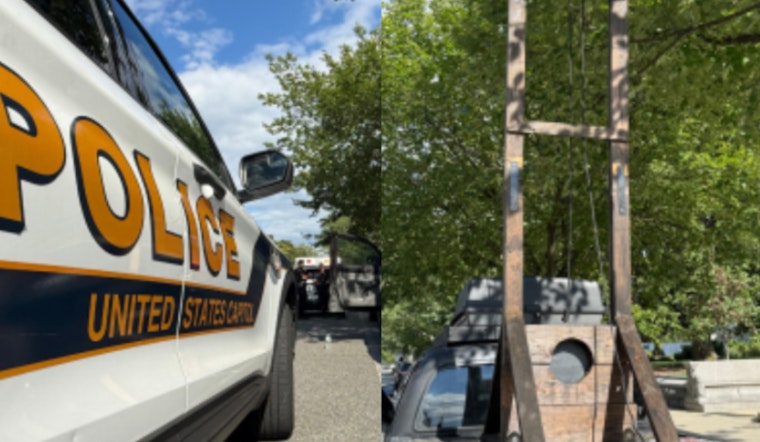
A 35-year-old man from the tiny mountain town of Julian, California was arrested Tuesday after U.S. Capitol Police spotted a guillotine sitting in the bed of his pickup truck, parked illegally just blocks from the U.S. Capitol building. Officers say the man had driven cross-country before his truck was flagged in a high-security corridor sandwiched between two of the nation's most powerful institutions.
The suspect, identified by U.S. Capitol Police as Philan-Tam-Duy Le, was taken into custody around 3 p.m. Tuesday after his truck was found parked illegally in the 100 block of East Capitol Street, according to NBC4 Washington. That stretch of road sits directly between the Capitol Building and the U.S. Supreme Court, a corridor WUSA9 notes is heavily patrolled because of its proximity to federal courtrooms and legislative chambers. Police say Le had driven from California to Washington, D.C., though what prompted the roughly 2,600-mile trip from his home in Julian remains under investigation.
Julian is a historic mountain town in eastern San Diego County, according to the San Diego Tourism Authority, putting Le's journey at nearly the width of the continent before he ended up parked steps from Congress. U.S. Capitol Police officers noticed the guillotine in the open truck bed and seized it Tuesday. Le was arrested and charged with carrying a dangerous weapon.
What D.C. Law Says About the Charge
Under D.C. Code § 22-4504, carrying a dangerous weapon outside a home or business can be charged as a misdemeanor punishable by up to a year in jail and a $1,000 fine, or escalated to a felony carrying up to five years in prison and a $5,000 fine, according to the legal resource Koehler Law. Prosecutors would need to prove the object was likely to produce death or serious bodily harm in the manner it was carried. Separately, federal law under 40 U.S.C. § 5104(e) prohibits carrying or having readily accessible dangerous weapons, bladed items, or firearms anywhere on Capitol grounds or inside Congressional buildings, a statute Hoodline previously detailed in coverage of a separate weapons arrest near the Capitol.
U.S. Capitol Police say they are investigating why Le traveled to Washington, D.C. with the guillotine in the first place. Guillotines have surfaced before as political threat symbols in the capital, including mock versions displayed during the January 6, 2021 riot at the Capitol, when crowds chanted threats against elected officials, according to the Los Angeles Times. No motive or mental-state determination has been made public, and it remains unclear whether federal prosecutors will pursue additional threat or intimidation charges beyond the dangerous-weapon count.
A Pattern of Weapons Stopped at the Capitol's Edge
Tuesday's arrest fits a pattern Capitol Police have confronted repeatedly this year. In February, officers arrested an 18-year-old carrying a loaded shotgun, tactical vest, gas mask and extra ammunition as he ran toward the Capitol's Lower West Terrace, apprehending him without injury. In July 2025, officers intercepted a driver near Senate parking carrying a bow, arrow and knives, part of updated departmental guidelines giving officers explicit discretion to confiscate non-firearm bladed and dangerous items at checkpoints. Hoodline also reported a July barricade arrest in which a driver was taken into custody after a vehicle stop triggered a lockdown outside the Capitol.
The volume of threats Capitol Police are fielding has climbed sharply. The department's Threat Assessment Section investigated a record 14,938 concerning statements, behaviors and communications directed at lawmakers, staff, families and the Capitol complex in 2025, a 58% jump from 9,474 cases the year before, according to U.S. Capitol Police. Officials have pointed to online anonymity and violent political rhetoric as primary drivers of that surge. To keep pace, the agency expanded its formal protective agreements with state and local police departments from 115 to more than 350 nationwide during 2025, a framework that allows federal reimbursement for local departments protecting lawmakers outside Washington.





