

























































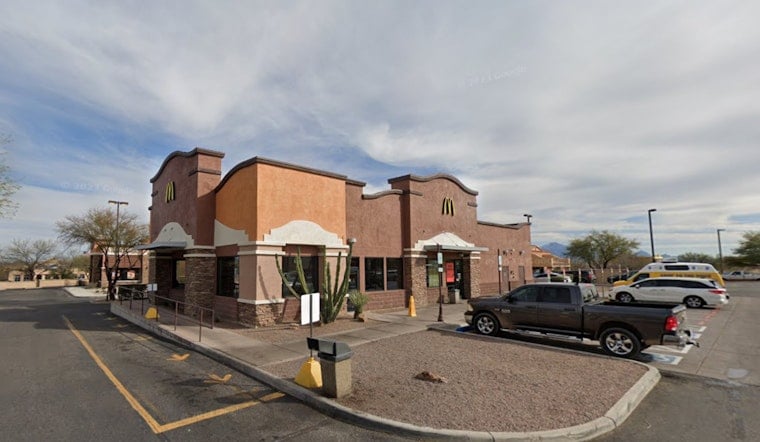
A fire alarm at the McDonald's on West Sahuarita Road on Sunday led firefighters to a carbon dioxide leak inside the building, prompting an evacuation of eight people and a hazardous materials response before the restaurant was cleared to close for repairs. One person was evaluated at the scene but refused transport to a hospital.
Santa Rita Fire District crews responded to the McDonald's at 775 W. Sahuarita Road after the automated fire alarm activated, according to KVOA. Crews located a carbon dioxide leak with elevated readings once inside, per Santa Rita Fire District, and the Sahuarita Police Department helped evacuate eight people from the restaurant. The fast response was aided by geography: the McDonald's sits directly next to Santa Rita Fire District Station 154, which houses an engine company, ambulance, rescue truck and water tender just steps from the restaurant's door.
Hazmat Crews Secure the Source and Ventilate the Building
Santa Rita Fire District called for a hazardous materials response, and crews secured the carbon dioxide source before ventilating the structure until air monitor readings returned to normal limits, the station's report notes. The district is equipped for exactly this kind of call: it maintains 13 hazardous materials technicians and runs a dedicated hazmat vehicle out of Station 155 on Campbell Avenue as part of the Pima County Regional HazMat Team, with more than 100 district firefighters holding first-responder hazmat certification. Once air quality was confirmed safe, crews cleared the building, though the McDonald's remained closed pending inspection and repair of its carbon dioxide system, and a qualified technician must inspect and repair the system before it can reopen.
Why Fast-Food CO2 Systems Carry Real Risk
Carbon dioxide is commonly stored as a compressed or liquid gas in fast-food outlets to carbonate fountain drinks, and because the gas is colorless, odorless and heavier than air, it tends to pool near floor level in poorly ventilated spaces, according to CO2 Meter. Indoor concentrations exceeding 5% by volume, or 50,000 parts per million, can displace ambient oxygen and cause rapid unconsciousness or fatal asphyxiation. Under Occupational Safety and Health Administration standards, the workplace exposure limit is 5,000 ppm over an eight-hour day, with 30,000 ppm allowed only for short 15-minute stretches and 40,000 ppm considered immediately dangerous to life and health, per the Loveland Fire Rescue Authority.
Those thresholds exist partly because of past incidents. A June 2011 liquid carbon dioxide leak from a fountain soda machine at a Phoenix McDonald's caused a pregnant employee to collapse and sickened two responding firefighters, an event that pushed Arizona fire departments toward stricter CO2 detection standards, according to the International Code Council. A separate September 2011 leak from a fast-food beverage system in Savannah, Georgia sickened 10 people and led to one fatality in a restroom after gas built up inside the structure's walls, as reported by Fire Engineering.
Fire Code Rules Behind the Automated Warning
International Fire Code Section 5307 requires that indoor CO2 beverage dispensing systems holding more than 100 pounds of gas be fitted with continuous mechanical ventilation or an emergency gas detection system that sounds an alarm at 5,000 ppm, according to Paramount Gas Products. Regional Arizona fire codes go further, mandating external fill ports, pressure relief venting directed outdoors, and annual inspections of gas detection systems on commercial beverage CO2 tanks, per the Northwest Fire District. Systems that fail those inspections must be isolated and shut down until certified technicians complete repairs.
Sunday's response also reflects a broader shift in how the district itself operates. Santa Rita Fire District previously ran as the Green Valley Fire District before rebranding after annexing the Town of Sahuarita on July 1, 2024, expanding its jurisdiction to cover both communities. The district has handled commercial gas scares in Sahuarita before: in December 2017, crews evacuated seven businesses at Sahuarita Plaza for 90 minutes following a reported gas leak before clearing the buildings.




