

























































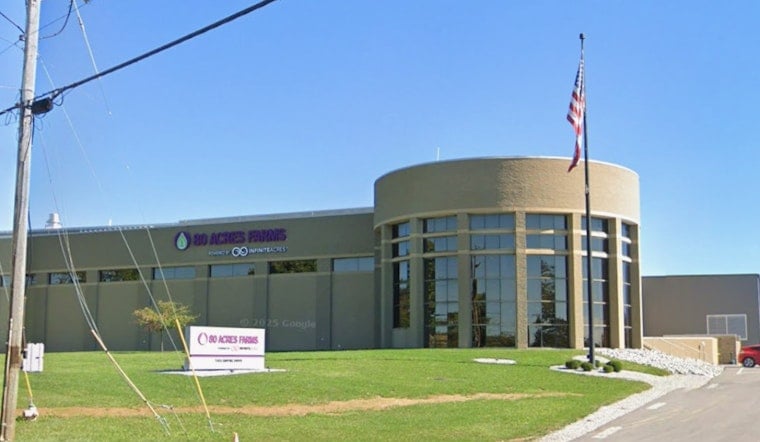
Greater Cincinnati’s 80 Acres Farms announced Monday that it will wind down operations after failing to secure enough funding to continue. The decision marks a stunning reversal for a local ag-tech company that built its name on year-round indoor produce, automation and a national retail footprint.
According to WLWT, 80 Acres produces branded salads, herbs, microgreens and tomatoes and has supplied more than 18,000 retail locations across the United States. The company expressed gratitude to employees, retail partners and communities that supported it, while CEO and co-founder Mike Zelkind said he believes the vertical-farming industry is just getting started.
Expansion Came Just Before the Emergency Brake
The reversal follows a burst of growth. In 2025, 80 Acres Farms announced $115 million in capital raises and the acquisition of Plantae Biosciences, then later unveiled a merger with Soli Organic that it said would create a major national indoor-farming network. The company also acquired three former Kalera farms in Georgia, Texas and Colorado earlier this year and said it had more than doubled its operational capabilities.
Retrenchment Had Already Reached a Virginia Facility
The broader wind-down was preceded by a facility closure in Harrisonburg, Virginia. A Virginia Works notice said the company’s Virginia Pack facility would permanently close in late July and that all employees there would be laid off, following integration work after the Soli merger. Monday’s announcement extends that retreat far beyond a single facility.
A Cincinnati-Area Ag-Tech Bet Comes Full Circle
Founded in 2015 by Mike Zelkind and Tisha Livingston, 80 Acres grew from experiments in a shipping container into a network of indoor farms built around stacked trays, hydroponics, automation and controlled lighting, according to the University of Cincinnati. Its Hamilton roots and Northern Kentucky expansion made it a prominent local example of the pitch that food could be grown closer to consumers with fewer resources and shorter supply chains. Now that pitch is colliding with the cost of keeping high-tech farms running.
Vertical Farming’s Funding Hangover Is Getting Harder to Ignore
80 Acres is not alone in facing a tougher market. FoodNavigator reported this year that vertical-farming companies have been squeezed by high energy costs, expensive infrastructure, weak demand for premium greens and venture funding that has dried up, leaving very few operators standing. The Cincinnati company’s wind-down does not settle whether indoor farming works, but it does underline how unforgiving the economics can be.
WLWT reported that 80 Acres’ products had been available through retailers and restaurants across the eastern United States, raising questions for the partners that relied on its supply. For Greater Cincinnati, the announcement is a sharp reversal for a company that only months ago was selling scale, automation and a national future; Zelkind’s belief that the industry is just beginning now reads less like a victory lap than a bet the sector still has to prove.




