

























































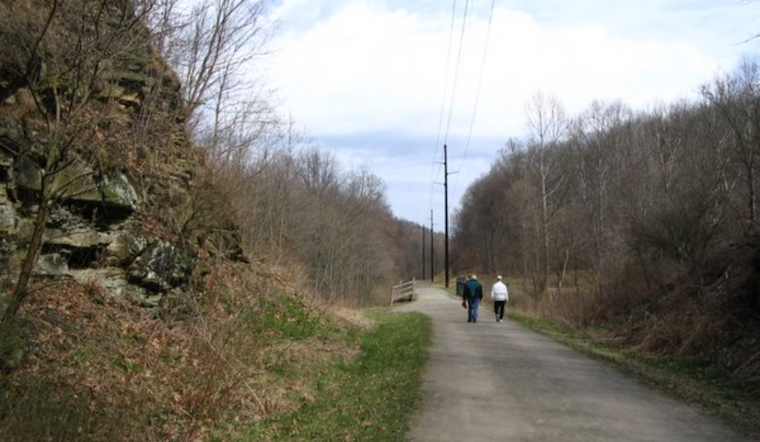
Riders on the Montour Trail have been showing up at a boarded-off tunnel mouth near mile marker 25 in Cecil Township, only to turn around and ask what happened. The 630-foot National Tunnel, the longest of the trail's three tunnels, has been closed since November after inspectors found cracks too large to ignore, and there is no quick fix or safe workaround in sight.
Paul McKeown, the National Tunnel renovation project manager, described the scene to CBS Pittsburgh, saying people are now just riding up to the tunnel and turning around, asking, “What happened?” The tunnel's center crack has shifted downward while one of its walls has shifted outward, and a Montour Trail Council crew has already removed loose concrete to keep the structure from becoming more dangerous, according to the station's report.
Julian Wolfe, president of the Montour Trail Council, told the outlet that the closure is an enormous impediment and more than just an inconvenience. That is because National Tunnel sits almost exactly at the midpoint of the more than 60-mile trail, which stretches from Coraopolis to Clairton through Allegheny and Washington counties and sees upwards of 400,000 trail uses a year, per the same account. With the tunnel shut, every traveler crossing that midpoint is cut off, and there is no designated street detour because the surrounding roads lack safe shoulders and sightlines.
A Structure Undone by Time
National Tunnel was bored in 1913 using timber supports for the Montour Railroad, which began operating in 1879, and was concrete-lined in 1928 before carrying coal freight until 1980, according to the Montour Trail Council. The Montour Trail Council acquired the rail right-of-way in 1989 and opened the tunnel to trail users in 1992. Its ceiling deteriorated after 113 years, the station reports, and the passage carries the nickname the Wet Tunnel among locals.
The tunnel took its name from the nearby National Coal Company mines that the Montour Railroad was built to serve during Western Pennsylvania's early 20th-century mining boom, according to the Rails-to-Trails Conservancy. The council, a volunteer-led nonprofit since 1989, closed the tunnel on November 11, 2025, after a late-2025 engineering inspection turned up rapid concrete ceiling deterioration and severe structural cracking near the western entrance, per the Observer-Reporter.
No Safe Detour Around the Break
To keep trail users off hazardous surrounding roads with narrow lanes and poor sightlines, the council has not designated an official street detour. Instead, per the Pittsburgh Post-Gazette, westward travelers are advised to access the trail at the McConnell Road trailhead near mile marker 24.7, while eastward travelers should use the Kurnick trailhead near mile marker 25.6.
Fixing the tunnel means more than patching cracks. The plan calls for a 295-foot steel liner along with eastern end protective netting, interior lighting, and outer portal masonry work, a comprehensive scope the council has priced at roughly $3.2 million, according to its own project documentation. That plan borrows from the council's 2023–2024 restoration of the 235-foot Greer Tunnel in Peters Township, where similar repair work two years earlier cost about $1 million to install 120 feet of galvanized steel lining, the Observer-Reporter notes.
Racing the Calendar and the Budget
Wolfe called this the council's largest infrastructure project since it built large sections of the old rail line itself, and the nonprofit is doing it without any recurring tax revenue from the federal, state, or county government. As of August, the council has raised almost one-third of the roughly $3 million needed through donations, a tally that includes a $500,000 grant from the Richard King Mellon Foundation along with more than $100,000 from council members and supporters, an anonymous $36,000 gift, and a $1,000 individual donation-matching campaign, per the council's fundraising materials.
The council has also applied for state grants to help close the remaining gap, and Wolfe told CBS Pittsburgh the group hopes to safely reopen National Tunnel by September 2027. The Montour Trail carries national significance beyond Cecil Township: it holds a federal National Recreation Trail designation as the longest suburban rail-trail in the country, according to Wikipedia, and forms part of the planned 3,700-mile Great American Rail-Trail linking Washington, D.C. to Washington State, per TrailLink. Until the steel liner goes in, though, the thousands who use the trail each year for commuting and recreation will keep hitting the same dead end at mile marker 25.





