

























































An 8-year-old boy ran across Lower Byrnes Mill Road and into a cornfield early on the morning of July 12, more than a mile from home and headed toward one of the most dangerous highways in Jefferson County. Phil Barnowski, a Cedar Hill man driving home around 5:30 a.m., stopped his vehicle when he spotted the child and called out to him. What happened next — a made-up story about a bad knee and a long conversation about Minecraft — kept the boy away from Highway 30 traffic until police arrived.
Barnowski told the child he had hurt his knee, an invented excuse to get the boy to sit down and stay close, according to KSDK. He also told the boy he was friends with the police, coaxing him close enough to talk. Once the child settled, Barnowski leaned on a subject he figured might land: Minecraft. The two talked through the popular video game in detail while Barnowski waited with him for law enforcement to arrive.
Byrnes Mill police later determined the boy is autistic and had left home without his parents' knowledge, per the station's report. Police Chief Frank T. Selvaggio said Lower Byrnes Mill Road has no shoulder or sidewalk and is dangerous for pedestrians — the same account notes it is a very narrow road with nowhere safe to walk if a car comes through. That stretch of road feeds directly toward Highway 30, and Selvaggio said Barnowski almost certainly saved the boy's life.
A Community Award for a Quiet Morning Rescue
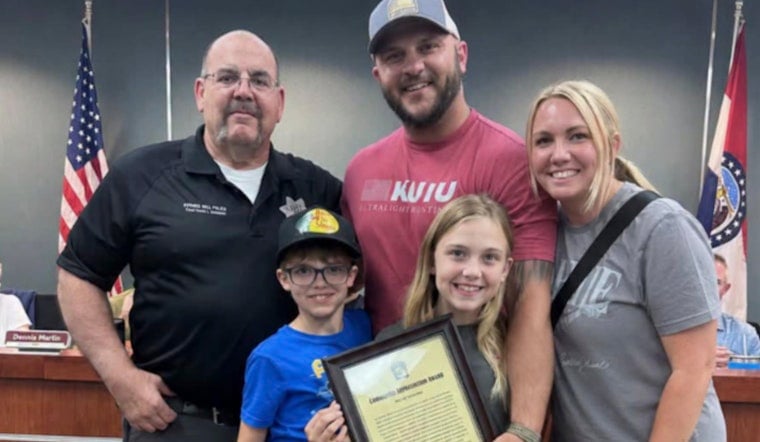
On August 5, the Byrnes Mill Police Department presented Barnowski with its Community Appreciation Award during a Board of Alderpersons meeting, recognizing him for stopping the boy from wandering into highway traffic, according to the department. Officers noted that his intervention prevented the child from attempting to cross busy state traffic. Barnowski, who serves as Vice President of IBEW Local 1439, a St. Louis-based union representing roughly 1,000 utility and municipal workers, is also known locally for competing alongside Byrnes Mill police officers in the Special Olympics Guardian Games.
The rescue unfolded on a road that leads straight into one of the region's most persistent traffic hazards. Hoodline has previously reported that the North Jefferson County Ambulance District responded to roughly 400 traffic accidents along Highway 30 in 2025 alone, with about half of those collisions causing injuries and seven resulting in deaths. State transportation records showed approximately 1,620 vehicle crashes along a 20-mile stretch of Route 30 in Jefferson County between 2016 and 2020, prompting a community town hall earlier this year where residents and first responders pressed state officials for faster safety upgrades.
Small Department, Big Reliance on Bystanders
Byrnes Mill Police Department operates with just 11 officers, a detective, a chaplain, and an administrative assistant covering a city of roughly 3,180 residents. For a department that size, a bystander like Barnowski who can de-escalate a frightened child and hold him safely away from traffic functions as a critical force multiplier while officers respond.
National data underscores why that kind of quick, calm intervention matters so much when an autistic child is involved. Research published in Pediatrics and cited by the National Autism Association indicates roughly 49% of children diagnosed with autism attempt to wander or elope from safe supervision after age 4, a rate nearly four times higher than their neurotypical siblings. The same organization's data shows traffic injuries are the second-leading cause of death in autism-related wandering incidents, at 18%, following accidental drowning at 71%.
Compounding the danger, a study published in Pediatrics and highlighted by the Child Mind Institute found that 35% of autistic children who wander are never or rarely able to verbally communicate their name, address, or phone number to a stranger. That helps explain why Barnowski could not simply ask the boy where he lived and instead had to keep him occupied and physically nearby until officers could take over.
The Jefferson County Health Department offers Project Lifesaver, a free program that equips residents prone to wandering, including children with autism, with wearable radio-frequency tracking devices at no cost to families. It remains unknown whether the boy's family participates in that program, how far he had walked before Barnowski spotted him beyond the more-than-a-mile distance covered that morning, or what specific infrastructure upgrades the state may pursue along Highway 30.



