

























































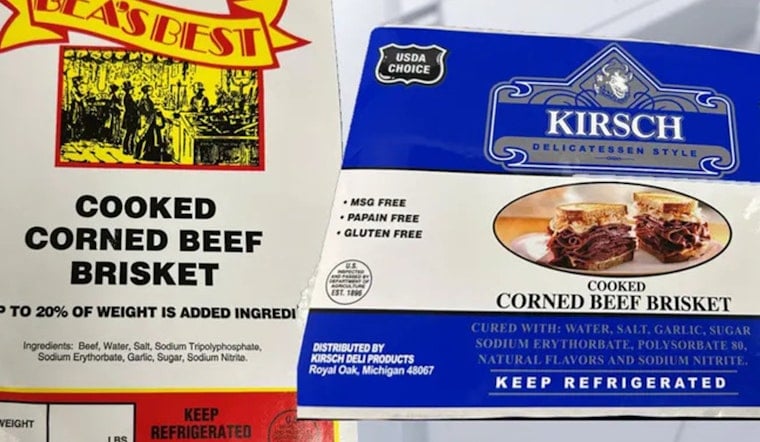
A Chicago meat processor has recalled 3,215 pounds of ready-to-eat corned beef and pastrami after federal inspectors flagged the products for possible Listeria contamination, a Class I recall that carries the government's highest risk designation. The affected products, produced on July 16, were initially shipped to foodservice distributors in Illinois, Iowa and Michigan before reaching locations nationwide.
City Foods, Inc., based in Chicago, issued the recall after the U.S. Department of Agriculture's Food Safety and Inspection Service discovered the issue during routine inspections, according to FOX 13 Seattle. FSIS categorized the recall as Class I, meaning consumption of the products carries a reasonable probability of serious adverse health consequences or death, per the agency's own recall notice. FSIS has urged both consumers and businesses not to eat or serve the recalled meat and to throw it away or return it to the place of purchase. No illnesses tied to the recalled products have been reported so far.
Why Shoppers Can't Just Check a Label
The recalled meat is not something the average grocery shopper can spot on a shelf. It was shipped in bulk 10- to 30-pound boxes exclusively to commercial foodservice accounts such as delis, caterers and nursing home kitchens, meaning end consumers eating a deli sandwich have no label, case code or establishment number to check for themselves, as the outlet Food Poison Journal explains.
The recalled products carry USDA establishment number EST. 1896 and include Bea's Best Cooked Corned Beef Brisket with case codes 18919 and packaged in 20- to 30-pound boxes of two to three pieces; Kirsch Delicatessen Style Cooked Corned Beef Brisket with case code 19751, also in 20- to 30-pound boxes; and Midamar Premium Beef Pastrami with case code 19410, packaged in 10-pound boxes containing two- to five-pound pieces. All of it carries a 60-day shelf life, meaning product from the July production run could still be sitting in commercial coolers or freezers.
How the Cleanup Actually Works
Because the meat moved through commercial channels rather than retail shelves, responsibility for pulling it from circulation falls largely on the businesses that received it and on federal oversight rather than on individual shoppers. FSIS relies on mandatory recall effectiveness checks, in which federal inspectors directly contact and audit distributors and kitchens to confirm inventory has actually been removed and destroyed, according to the agency's guidance on how FSIS recalls are enforced.
City Foods was founded in 1939 in Chicago's Back of the Yards neighborhood and ran as a local family business for decades until December 2022, when it was acquired by Quebec-based meat processor LHG Foods Inc., according to a PRWeb release announcing the deal, which marked LHG Foods' first expansion into the U.S. meat market. The company's Racine Avenue plant has reported producing roughly 500,000 pounds of meat weekly and more than $34 million in annual sales, meaning the recalled batch represents a tiny fraction of a single week's output.
Why Listeria Poses a Longer-Term Threat
Listeria monocytogenes behaves differently from most foodborne bacteria in one critical way: it keeps growing in the refrigerator. Unlike pathogens that stop multiplying in cold storage, Listeria can survive and multiply at normal refrigeration temperatures, according to the FDA, which is precisely why long-shelf-life ready-to-eat meats like corned beef and pastrami are a recurring vector for contamination.
The bacteria's incubation period compounds the problem. Symptoms of invasive listeriosis typically take one to four weeks to emerge after exposure, and can take up to 70 days to appear in pregnant women, according to health officials tracking the disease. That lag means illnesses connected to a contaminated batch can surface long after the product itself has been forgotten. Nationally, Listeria monocytogenes infects an estimated 1,250 people and causes 172 deaths annually, making it the fourth leading cause of foodborne illness fatalities in the U.S., per CDC surveillance data. CDC investigations into multistate ready-to-eat food Listeria outbreaks between 2023 and 2025 found a 100% hospitalization rate among confirmed cases, underscoring how severe invasive infections tend to be once they take hold.
Who Should Take Extra Precautions
Public health officials and clinical nutritionists advise people in high-risk categories — adults 65 and older, pregnant women, and immunocompromised individuals — to heat all ready-to-eat deli meats to an internal temperature of 165 degrees Fahrenheit before eating, according to guidance from UW Medicine. Thorough heating kills active Listeria bacteria that may be present even in refrigerated, sealed product.
For now, FSIS says no illnesses have been linked to the recalled corned beef and pastrami, and the agency's Class I classification reflects the potential severity of the hazard rather than a confirmed outbreak. Anyone who works in a commercial kitchen, deli or care facility that may have received City Foods product from the affected production run is being urged to check inventory against the listed case codes and establishment number, and to discard or return any matching product immediately.





