

























































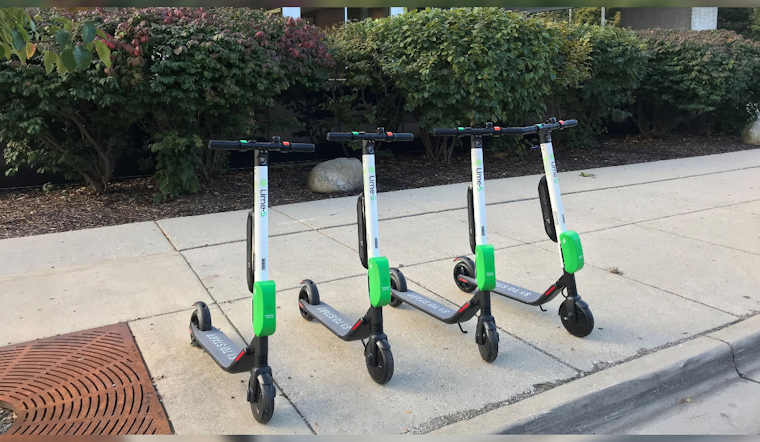
Chicago hospitals are reporting record numbers of emergency-room patients with severe injuries tied to e-scooter use, and that surge is reviving a fight over whether shared rental scooters should finally be allowed on the city's 18.5-mile Lakefront Trail. Right now they are not — even though private e-scooters are permitted on the same path.
That contradiction has caught the attention of Mayor Brandon Johnson, who said it is unfair that private e-scooters can operate along the Lakefront Trail while shared scooters cannot, according to Axios. Johnson has indicated he will consider a policy change on the issue, per the same report. Park District officials have said shared e-scooters remain prohibited on the Lakefront Trail and on the 606 due to high use and congestion, but they have not explained why private scooters get a pass while shared ones don't, Axios reports.
Lime Pushes Tech Fixes as Lobbying Resumes
Lime has lobbied the city to allow shared scooters on the Lakefront Trail in both 2023 and 2024, and company representatives are now holding active discussions with stakeholders, according to the Axios report. Lime representatives believe shared e-scooters can operate successfully and responsibly on the trail, arguing that private devices lack the congestion controls built into Lime's shared fleet. The company has proposed high-tech solutions including mandatory parking zones and slow-speed zones, and says it can slow scooters down automatically in congested areas.
That capability isn't theoretical. Shared e-scooters operating in Chicago already rely on onboard Internet-of-Things geofencing technology that can enforce slow-speed zones or cut throttle power within one second of a scooter entering a restricted area, according to City of Chicago vendor filings. Those geofence maps are stored directly on the scooter hardware rather than in the cloud, the filings show, which is meant to prevent lag when a rider crosses into a protected zone. On city streets, licensed shared scooters are already capped at 15 mph — just 10 mph for a rider's first trip — and are barred from operating between midnight and 5 a.m. under Chicago Department of Transportation rules.
Lakefront Alders Signal Openness, Survey Cited by Lime
Some lakefront alders, including Leni Manaa-Hoppenworth, have said they are open to allowing shared e-scooters on the trail, per Axios. Survey respondents cited in data provided by Lime favored opening the Lakefront Trail to e-scooters, though the prior push for that change failed to gain momentum. Chicago's shared e-scooter program has been a significant piece of the city's transportation network since launching permanently in May 2022, logging more than 6 million trips last year alone, per Axios.
That program was also built with equity goals in mind: operators must keep at least half of their active fleets deployed in designated equity priority areas on the West and South Sides, according to background from the City of Chicago, since shared scooters often serve as first- and last-mile transit links near CTA rail lines in lower-income neighborhoods. Advocates say that equity mission is part of why banning shared scooters from a major recreational corridor like the lakefront strikes some officials as inconsistent.
Street Crashes Add Urgency to the Debate
The stakes extend beyond the trail itself. Chicago has stopped recording e-scooter accidents separately in recent years, Axios reports, making it harder to track the scope of the problem even as shared e-scooter and car collisions have become both a safety and an equity issue. In April, a woman riding a scooter died after being struck by an SUV on South King Drive in Chicago's Douglas neighborhood scooter crash, another fatal collision involving a light motorized vehicle on city streets. Micromobility advocates argue off-street paths like the Lakefront Trail actually protect riders from car traffic, while opponents worry that adding shared scooters would simply shift the danger into an already crowded shared space — a tension underscored by last month's Lakefront Throwdown incident near North Avenue Beach, where cyclists clashed amid overcrowding on the trail.
The trail was not always this congested by design. The Chicago Park District completed a $12 million separation project in December 2018, funded largely by billionaire Ken Griffin, that split the corridor into an 18-mile bike path and a separate pedestrian path to ease crowding among the roughly 100,000 people who used the trail on peak summer days. Whether adding shared e-scooters into that mix would undo those safety gains — or simply give riders a safer alternative to city streets — is the question now facing park officials.
Rising Injuries Push Statewide Rules Toward 2027
The debate is unfolding against a backdrop of rising injury data. A U.S. Consumer Product Safety Commission report released in April documented 533 total deaths and an estimated 698,500 emergency department visits nationwide involving micromobility devices between 2017 and 2024, with e-scooters alone accounting for roughly 380,000 emergency visits and 206 fatalities. Emergency room clinicians at Ann and Robert H. Lurie Children's Hospital of Chicago have reported treating a rising volume of youth trauma cases and severe fractures from micromobility crashes, prompting medical leaders to join state officials in June to back new statewide safety guardrails, according to Capitol City Now.
A Johns Hopkins Children's Center study published in March analyzed 2,117 pediatric e-scooter emergency visits nationwide from 2020 to 2024 and found children under 18 made up 45% of total injuries, with boys accounting for 70.7% of youth cases and adolescents ages 11 to 14 representing 38.3%, according to Johns Hopkins Medicine. Researchers pointed to lower helmet usage and less-developed motor judgment as factors putting young teens at higher risk.
Illinois lawmakers approved Senate Bill 3484 in May, spearheaded by Secretary of State Alexi Giannoulias, establishing statewide micromobility rules that take effect January 1, 2027, prohibiting high-speed electric scooters and e-bikes from operating on sidewalks and bike paths if they exceed local speed limits or 28 mph, according to Capitol News Illinois. Meanwhile, Chicago police issued just 57 citations for riding bicycles or scooters on city sidewalks through late June, a 73% drop from the same period in 2025 despite ongoing complaints about riders on footpaths, per WLS-TV. Officials have said enforcing sidewalk bans remains difficult for departments with limited personnel, leaving the Lakefront Trail question to hinge less on enforcement capacity and more on whether City Hall decides shared scooters belong there at all.





