

























































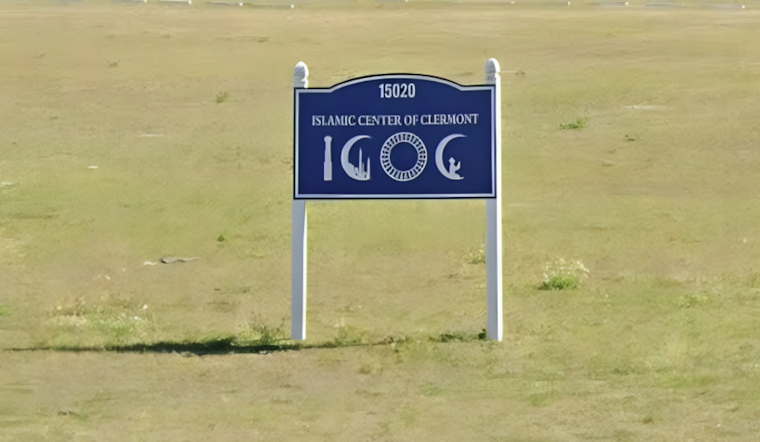
A rezoning request that would let the Islamic Center of Clermont build two new worship halls and a cul-de-sac on Hancock Road has drawn an online petition and a string of neighbors warning that the area's narrow, two-lane roads can't absorb more traffic. Lake County commissioners are set to vote on the request on September 1, and the outcome could hinge as much on federal religious-liberty law as on local traffic engineering.
The Lake County Planning and Zoning Board has already advanced a request to rezone land adjacent to the Islamic Center's property at 15106 Johns Lake Road, according to WFTV. The center is asking to rezone 3.69 acres from an agriculture district to a community facility district so it can repurpose existing structures at the Hancock Road site, add two new Islamic worship halls, and build a new cul-de-sac. The Islamic Center has said its religious use has outgrown its current location and needs room to expand, per the station's report.
County records list the request as Case Number PZ2025-352, filed by representative Jimmy D. Crawford on behalf of property owner Islamic Center of Clermont, Inc., with the parcel tracked under Alternate Key 1734002 in unincorporated Clermont, according to Lake County Planning and Zoning Board records. The same site already serves as headquarters for the Clermont Food Pantry, which operates in partnership with Second Harvest Food Bank of Central Florida to deliver groceries to Lake County residents regardless of faith or income, according to the Clermont Food Pantry.
Neighbors Point to Hancock Road Bottleneck
Jacqueline Harp, who lives immediately adjacent to the Islamic Center property and has called Clermont home for more than three decades, told WFTV her concern centers on the building itself and its impact on residents nearby. She listed traffic, property values, noise and lighting as her chief worries, and said she already experiences congestion on the road during peak hours.
Andy Kaisrlik, who moved to Clermont in 1989, shares those traffic concerns about Hancock Road, which has just one lane in each direction. He said his wife's trip home from downtown Clermont, a distance of only 2.5 to 3 miles, can take 20 to 30 minutes, and he believes the expansion should wait until Hancock Road is widened. Neighbors have also pointed to Johns Lake Road as a route they say may not handle the added activity.
An online petition launched in June on openPetition is addressed directly to Lake County District 2 Commissioner Sean Parks, urging him to block the agricultural rezoning near Lost Lake and Hancock Road, according to the openPetition campaign. Parks represents the district where the property sits, making him the direct target of the localized opposition effort.
Traffic Study Finds Only a Modest Increase
A Lake County transportation assessment found the expansion would generate three additional afternoon peak-hour trips and would still maintain an acceptable traffic level, per WFTV's reporting. The official development application would also require a minimum 50-foot landscape buffer and a noise assessment. The Islamic Center did not respond to a request for comment from Channel 9 before the station's news deadline.
This is not the congregation's first run-in with county zoning. Lake County commissioners denied an earlier request from the Islamic Center of Clermont in April 2012, when residents raised similar concerns over traffic, noise and neighborhood compatibility for a proposed 5-acre joint recreation and worship facility that would have included a 25,000-square-foot building and 199 parking spaces, according to a report at the time from Walid Shoebat. As of 2020, more than 3,400 people in Lake County practiced Islam.
Federal Law Limits County's Options
Any denial commissioners might consider would run into the federal Religious Land Use and Institutionalized Persons Act, which bars local zoning authorities from imposing a substantial burden on religious exercise unless justified by a compelling government interest, according to the U.S. Department of Justice. Federal precedent in the 11th U.S. Circuit Court of Appeals further holds, under RLUIPA's Equal Terms provision, that local zoning codes cannot treat religious assemblies less favorably than non-religious assemblies such as private clubs or meeting halls, according to Bilzin Sumberg. Equal Terms claims do not require proof of a substantial burden, meaning commissioners face legal exposure even if the county cites purely secular concerns like traffic.
The dispute is unfolding against a backdrop of explosive growth across South Lake County. Clermont's population reached an estimated 54,663 in 2026, a 26.25% jump from the 43,021 residents counted in the 2020 Census, making it the most populous city in Lake County, according to World Population Review. Countywide, Lake County's population grew to an estimated 456,068 in 2025, with 10.7% of residents foreign-born as of 2024, per Data USA.
That growth has strained infrastructure elsewhere in the county too. Lake County commissioners voted unanimously in July to draft a one-year moratorium on new data center developments in unincorporated areas, a step Hoodline reported was driven by concerns over heavy water and electricity usage. County data also shows Lake County workers already face an average commute of 30.2 minutes, with a 77.6% homeownership rate, helping explain why residents are wary of any new peak-hour traffic on roads like Hancock Road, per Data USA.
Commissioners are scheduled to take up the Islamic Center's rezoning request on September 1. Whether they can condition or deny the application on traffic and infrastructure grounds without triggering a federal Equal Terms challenge remains an open question heading into the vote.



