

























































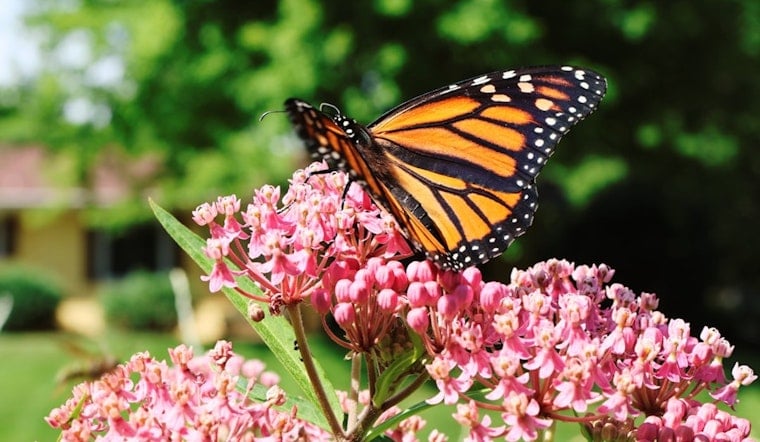
Nets in hand, volunteers across mid-Missouri will spend the coming weeks chasing down monarch butterflies, gluing a tiny numbered tag to a hind wing, and letting them go — all in the name of tracking one of nature's great journeys. The Missouri Conservation Corps has scheduled a series of butterfly tagging sessions in September, timed to catch the monarchs as they pass through on their annual migration to Mexico.
The sessions will be held September 19, 21 and 28 at Bonnie View Nature Center in Columbia, with an additional session September 26 at Big Muddy National Wildlife Refuge in Boonville, according to KOMU 8. No registration is required, and participants can stay for as long as they choose. The Missouri Conservation Corps has also scheduled a Monarch Migration Family Day at the Katy Depot in Boonville, which will include hiking and a migration game designed for families, per the same report.
How the Tagging Actually Works
Tagging itself is simple in concept but precise in execution: volunteers catch a butterfly, record information about it, and place a uniquely coded, weatherproof sticker on a lower hind wing cell — a placement designed to minimize impact on the insect's flight, per KOMU 8. The technique traces back to 1992, when Dr. Orley “Chip” Taylor founded the Monarch Watch citizen-science program at the University of Kansas specifically to track individual butterflies without impeding their flight, according to The Lawrence Times.
Laura Semken, a Missouri Conservation Corps naturalist, is coordinating the local events and can be reached at [email protected] with questions, KOMU 8 reports. When a tagged butterfly is recaptured elsewhere, its location can be reported to researchers, who then connect the original tagging site with the recapture point to build out migration data. Tamra Reall explained that this process is how researchers piece together the monarchs' flight paths across the continent, according to the station's report.
Monarchs bound for Mexico are among the butterflies volunteers will seek during the fall migration, per KOMU 8. Missouri typically produces several broods of monarchs each summer before the fall generation begins its long flight south. Adult monarch sightings in the state tend to peak around September 27, while Monarch Watch estimates the core of the migratory wave actually passes Missouri's latitude a bit earlier, around September 22, according to MyWild — which helps explain why the local sessions are clustered across mid-to-late September, when the migration is at its heaviest.
A City That Has Built Habitat for Nearly a Decade
Columbia has pollinator-conservation efforts, and the city continues to reevaluate and improve those efforts, per KOMU 8. The city continues its pollinator work and collaborates with the Missouri Conservation Corps on volunteer tagging efforts. Mayor Barbara Buffaloe proclaimed May 2026 as Monarch Butterfly Month in Columbia. The city signed the National Wildlife Federation's Mayors' Monarch Pledge in 2016, formally committing to expand native pollinator habitat and public outreach, according to the National Wildlife Federation.
Columbia isn't alone in that commitment. Eric Hempel said the monarch symbolizes the broader importance of making space for the pollinators that food systems rely on, KOMU 8 reports, and Columbia continues to hold community education events built around that idea.
Why the Butterflies Still Need the Help
Native plantings are a critical piece of the conservation puzzle long before any butterfly reaches a tagging table. The stakes behind that groundwork are steep: eastern migratory monarch populations have declined, amid agricultural herbicide use, breeding-habitat loss and extreme weather.
There was encouraging news out of Mexico this year. Eastern migratory monarchs occupied more forest during the 2025-2026 hibernation season than during the winter before, according to the World Wildlife Fund. Even so, conservation concerns remain. Federal protection is also part of the broader conservation discussion.
That regulatory limbo is part of why community-driven efforts like Missouri's tagging sessions carry weight beyond the classroom. Monarch conservation groups rely on volunteers to gather the tagging data that feeds larger research efforts, and organizers say the sessions demonstrate that conservation is accessible to people of any age. Public participation in these events, KOMU 8 notes, also raises broader awareness of the monarch's declining numbers — one small, hands-on piece of a migration that spans an entire continent.





