

























































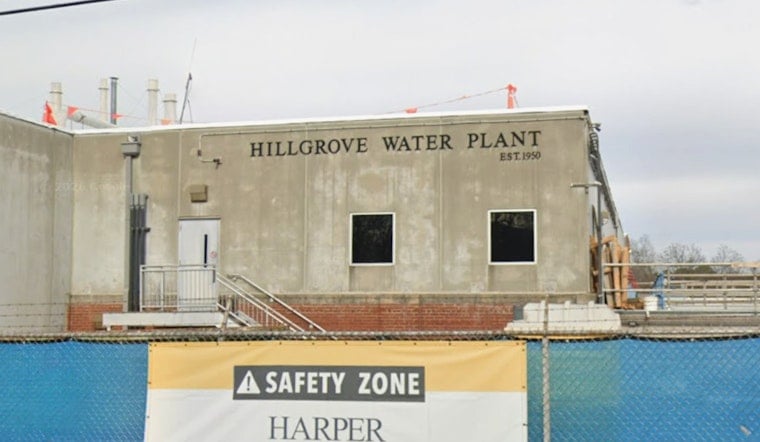
Concord has finished an $18 million filtration upgrade at its Hillgrove Water Treatment Plant designed to strip PFAS, the so-called forever chemicals, out of the drinking water that flows to homes across the city and several neighboring communities. The three-year construction project wrapped up this summer, and city officials say the new system is now fully operational and running five years ahead of the federal government's compliance deadline.
The upgrade centers on four granular activated carbon vessels that filter approximately 4 million gallons of water daily, according to WBTV. The GAC system serves as the final step in Hillgrove's overall filtration process, and the project was funded through customer water rates rather than a separate tax increase, per the same report. Concord Water Resources Director Jeff Corley said the project reflects the city's broader commitment to infrastructure and water quality, adding that preliminary data from water passing through the system has been extremely positive.
PFAS, short for per- and polyfluoroalkyl substances, are man-made chemicals that don't break down in the environment, earning them the forever chemicals nickname. They've been linked to cancer and birth defects, and a U.S. Environmental Protection Agency report had previously found that local drinking water contained PFAS levels at more than twice the agency's limits, the station's report notes. Elizabeth Jensen, research director at the Center for Planetary Health at Atrium Health, has said drinking water is one of the primary exposure routes for PFAS.
How the Carbon System Actually Works
Granular activated carbon filtration works by physically adsorbing PFAS and other organic contaminants onto porous carbon granules, an approach the U.S. Environmental Protection Agency notes carries lower installation and waste-disposal costs than alternative technologies like reverse osmosis or ion exchange resins. Engineering firm CDM Smith designed the upgrade specifically to route roughly 4 million gallons per day through GAC filtration, out of Hillgrove's total treatment capacity of 12 million gallons daily.
The timing lines up with a shifting federal regulatory picture. In May, the EPA proposed extending the compliance deadline for maximum contaminant levels of PFOA and PFOS, set at 4 parts per trillion, from 2029 to 2031 for qualifying utilities, while also moving to rescind national limits for four other PFAS compounds. Concord's completed system already positions the city five years ahead of that extended deadline, according to WBTV. North Carolina has also enacted its own 2L groundwater standards that took effect in late 2025, setting health-based limits for PFOA, PFOS, and GenX in groundwater statewide, per Pace Analytical.
Early Results and a Long Road of Testing Ahead
Initial testing in July found no detectable PFAS in water processed through Hillgrove's new GAC vessels, according to the Cabarrus Compass. But utility officials cautioned that results could fluctuate because Hillgrove blends raw water from multiple reservoirs, including Lake Fisher, where PFOS has previously been detected, and Lake Howell, where no PFAS has been found, with the mix shifting depending on drought conditions. Water officials say they need about a year of operation to get a comprehensive read on the system's long-term performance and will continue monthly testing in the meantime, per WBTV.
Concord draws its municipal supply from six sources across three reservoirs — Lake Concord, Lake Fisher, and Lake Don T. Howell — and supplements that with water purchased from Kannapolis, Albemarle, and Charlotte, according to the City of Concord. That network extends beyond city limits: the Town of Mount Pleasant shut down its own water treatment plant and now purchases finished drinking water directly from Concord's system, making Hillgrove's performance a regional concern rather than a purely local one.
Where PFAS Comes From in the First Place
State regulators have flagged several potential contamination sources in Cabarrus County, including industrial waste streams and landfills such as the BFI Charlotte Motor Speedway Landfill in Concord, along with historic use of firefighting foams, according to the North Carolina Department of Environmental Quality. Statewide, North Carolina has nearly 2,000 public community water systems serving 9.3 million residents, and state environmental studies indicate that 87% to 98% of the total PFAS entering municipal wastewater treatment facilities is ultimately discharged back into surface waters, the department has found. That statistic underscores why filtration at the tap, while effective at reducing household exposure, doesn't resolve the broader upstream question of how PFAS enters regional waterways in the first place.
Health researchers have connected elevated PFAS blood levels to increased risks of kidney cancer, testicular cancer, liver damage, and immune dysfunction, according to the Marin & Murphy Law Firm, which has tracked drinking water as a major nationwide contributor to human PFAS exposure. For now, Concord officials are treating the Hillgrove upgrade as a milestone rather than a finish line, with monthly testing set to continue as the city builds out a fuller picture of how the new carbon filtration performs across changing seasons and water sources.





