

























































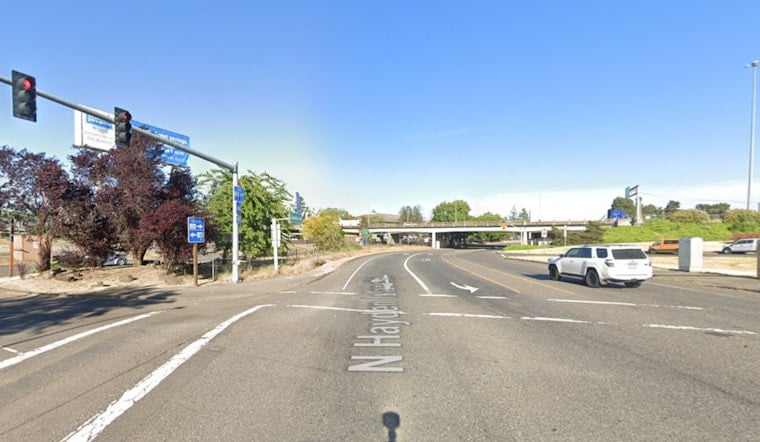
A tanker truck leaking a corrosive chemical forced the closure of North Center Avenue on Hayden Island Monday morning, cutting off one of just three public roads on the island near the Interstate 5 interchange. Portland Fire & Rescue responded to the hazardous materials spill near North Center Avenue and Hayden Island Drive, where a placard on the truck indicated it was carrying a corrosive substance.
According to KATU, the tanker has a 34,000-gallon capacity and was experiencing a free-flowing leak of acid from the back of the truck, per reporting attributed to KATU reporter Mike Warner. Separately, KGW reported an estimated spill volume of upwards of 100 gallons, leaving the two initial estimates of the leak's actual size unresolved. Fire officials closed North Center Avenue to all traffic while the response unfolded, and the Oregon Department of Transportation and the Portland Bureau of Transportation responded with large amounts of absorbent material to contain the corrosive liquid.
Why a Single Road Closure Hits So Hard
The closure is more disruptive than it might sound elsewhere in Portland. North Center Avenue, North Hayden Island Drive, and North Tomahawk Island Drive are the only three public roads on the island, meaning a blockage on any one of them directly chokes off access to local businesses, according to a Washington State Department of Transportation planning study. Most of the island's other roadways are private access drives maintained by commercial developments, the same study notes.
That access matters because Hayden Island is home to roughly 2,155 permanent residents and 238 active businesses employing nearly 3,000 people near the Jantzen Beach retail corridor, per the WSDOT study, with the population swelling further during summer boating season. The island sits between the Columbia River and North Portland Harbor, and its position adjacent to the I-5 interchange means any incident near the corridor also draws attention from regional freight planners, since the crossing carries heavy interstate commercial traffic between Portland and Vancouver, according to Clark County Today.
Identifying the Chemical Before It Can Be Cleaned Up
ODOT and PBOT plan to abate the spill once the material is formally identified, per KATU's reporting. That identification work typically falls to Portland Fire & Rescue's Station 7 in Mill Park, which houses the agency's State of Oregon Regional Hazardous Materials Team and is certified to handle chemical emergencies across Portland and Columbia County, according to the Portland Fire & Rescue website. The specialized unit operates dedicated hazmat apparatus and air monitoring equipment built for exactly this kind of unknown-substance response.
Before that citywide unit arrives, initial coverage on Hayden Island typically falls to Station 17, a boathouse station at 848 N. Tomahawk Island Drive that guards more than 100 miles of waterfront and local floating home moorages, per Portland Fire & Rescue. The truck's corrosive placard offered first responders an early clue about what they were dealing with even before a full chemical identification was made. Federal rules under 49 CFR § 173.136 define Class 8 corrosive materials as substances capable of causing irreversible destruction of human skin tissue on contact, or of corroding steel or aluminum at a rate exceeding 6.25 millimeters per year, according to the eCFR. Commercial vehicles carrying more than 1,001 pounds of Class 8 material, or hauling corrosive liquids in bulk containers, are legally required to display those placards under U.S. Department of Transportation motor carrier safety rules enforced by the Federal Motor Carrier Safety Administration.
Reporting Rules and Waterway Concerns
Oregon law sets a low bar for when a spill must be reported to state regulators. Under Oregon Administrative Rules (OAR 340-142-0040), any hazardous material release meeting federal reportable quantities, or any land spill of oil exceeding 42 gallons, must be reported immediately to the Oregon Emergency Response System, with the Oregon Department of Environmental Quality overseeing response and remediation, according to the Oregon Secretary of State's rules.
Hayden Island's location between two waterways also raises the stakes for any land-based chemical leak. The EPA's Northwest Area Contingency Plan lays out multi-agency response protocols linking Portland Fire & Rescue, the Vancouver Fire Department, and Oregon DEQ specifically to protect the Columbia River and North Portland Harbor during hazardous material releases, according to the U.S. Environmental Protection Agency. Whether any of the corrosive liquid reached stormwater drains leading to either waterway had not been addressed in available reporting as of Monday.
Several open questions remain unresolved, including the exact identity of the chemical, the official containment status of the leak, and a timeline for reopening North Center Avenue to traffic. This is not the first time Hayden Island's emergency responders have been tested this year: Hoodline previously covered a mobile home blaze and hotel roof scare on the island earlier this year, both of which drew Portland Fire & Rescue crews to the same tight network of roads now affected by Monday's spill.





