

























































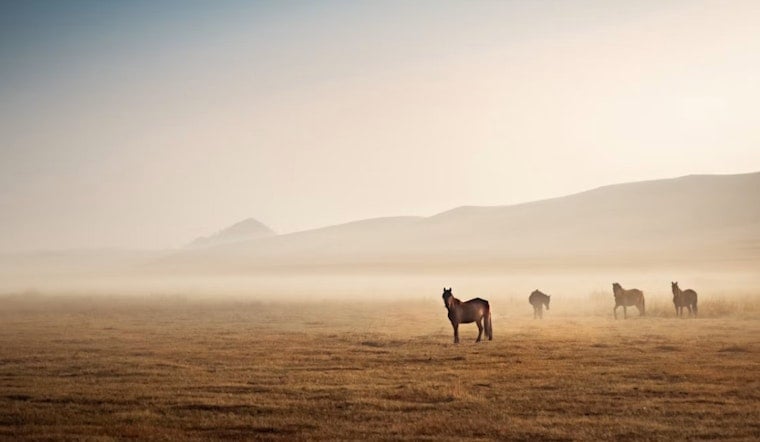
On a drought-parched mesa in Costilla County, roughly 150 wild horses gather each day at a century-old reservoir for water that keeps growing scarcer. Unlike the mustangs roaming Colorado's federally managed rangelands, these horses have no legal protection at all — they are not recognized as wild under U.S. law, and if sold, they can become private property immediately, with no barrier to a kill pen or a bullet.
That legal void is what has kept 78-year-old Judy Barnes fighting for the herd for nearly 30 years, according to the Denver Gazette. “I won't leave the horses ever. I love them,” Barnes told the paper. She has personally helped a mare struck on a highway and its foal, and this year alone she says ten horses have been hit by vehicles. Barnes also pays thousands of dollars out of pocket for water hauls to keep the animals alive through the region's extreme drought.
A Herd With No Legal Home
Wild Horse Mesa, also called San Pedro Mesa, spans roughly 75 square miles south of San Luis — Colorado's oldest town, founded in 1851 — and supports an estimated 150 free-roaming horses split into about nine bands, according to the Conejos County Citizen. The mesa was home to about 25 residents until 2025, per the Denver Gazette's reporting. The horses graze mostly on private land, and because the 1971 Wild Free-Roaming Horses and Burros Act applies only to designated federal Herd Management Areas, they are classified as unmanaged strays rather than protected wild horses — leaving them without federal funding, oversight, or the law's basic safeguards.
That gap means the animals face conflict with ranchers and commercial livestock operations, and they are not shielded by private ownership rules the way domestic horses are. The Gazette reports that once one of these horses is sold, it becomes private property immediately and could legally be loaded onto a truck bound for a slaughterhouse or shot outright, with no repercussions — a stark contrast to federally managed herds, where the Bureau of Land Management prohibits horses from ending up in kill pens or slaughterhouses.
Drought, Traffic and a Reservoir Under Strain
The herds gather at Sanchez Reservoir, on the mesa's eastern side, for water. Completed in 1913 as what was then the world's fifth-largest earth-and-stone dam, the reservoir now anchors a 2,000-acre state wildlife area, according to a property listing from LandForSaleStore. With the San Luis Valley in extreme drought this year, the horses also seek out the Rio Grande and other water sources across the valley, per the Gazette's account.
Traffic collisions have compounded the danger. Shirley Romero Otero told the Gazette that a family member hit a horse three times and totaled their car twice. Costilla County's own institutional stability has also come into question: a Colorado grand jury indicted five Costilla County Sheriff's Office personnel, including former Sheriff Danny Sanchez, on felony charges — among them abuse of a corpse — for allegedly placing human skeletal remains found in the Wild Horse Mesa area into a paper grocery bag and leaving them unsecured, as The Colorado Sun reported in March. Hoodline previously covered the discovery in a mystery bones case from the same remote corner of the county.
A Deep History, and a Modern Reckoning
The horses' presence in the valley traces back centuries. Local historian Nick Saenz said the first modern horse in the San Luis Valley could have arrived with the 1598 Oñate expedition, per his account to the Gazette. Spanish forces left behind many horses during their 1680 retreat, after Pueblo people organized a coordinated revolt that year — and a 2023 scientific study found that horse populations likely spread across the continent faster than European exploration itself, according to the same Gazette report. Equus, the horse genus, actually originated in North America before modern horses returned to the continent aboard Spanish ships.
That folklore runs deep in Colorado culture. Sculptor Luis Jiménez's 32-foot “Blue Mustang” sculpture at Denver International Airport, nicknamed Blucifer, was partly inspired by a San Luis Valley legend of a mythical blue stallion, according to the Denver Gazette's separate 2019 report. Jiménez died in 2006 when a 9,000-pound section of the sculpture fell on him in his studio.
State Steps In, But Not Here
Colorado's government has moved aggressively on wild horse policy elsewhere in the state. State lawmakers enacted Senate Bill 23-275 in May 2023, allocating $1.5 million to the Colorado Department of Agriculture to establish the Wild Horse Working Group and fund non-lethal management tools like fertility darting, according to Morning Ag Clips. The working group has promoted fertility darting as an alternative to roundups, and by December 2024 the state had allocated $100,000 to train eight USDA Wildlife Services personnel into two-person darting teams targeting at least 425 horses across Colorado's four federal Herd Management Areas in 2025, per the Bureau of Land Management. Fertility darting works by temporarily making a mare unable to carry a foal.
In February 2025, Governor Jared Polis proclaimed March as Horse Protection Month in Colorado — the first such proclamation by any U.S. state — while backing House Bill 25-1283 to create a permanent Wild Horse Advisory Committee, according to the American Wild Horse Conservation. That momentum traces back partly to a deadly 2022 equine influenza outbreak at a federal holding facility in Cañon City that killed 145 wild horses and sparked public outcry. But those state programs are built around the four federally recognized Herd Management Areas — Little Bookcliffs, Piceance-East Douglas, Sand Wash Basin and Spring Creek Basin — leaving private-land herds like those on Wild Horse Mesa to rely almost entirely on volunteers like Barnes and fragile access to private property.
Federal Roundups Continue Elsewhere
The disparity is especially visible this month. Federal contractors began a monthlong operation in August 2026 to remove 1,011 wild horses from northwestern Colorado's Piceance-East Douglas and West Douglas areas, where officials reported populations were 345 percent above sustainable capacity, as Hoodline reported in its coverage of the Rangely-area gather. That roundup represents about 60 percent of Colorado's managed wild horse population, and half of the state's Herd Management Areas exceeded BLM's own population targets in 2025. Horses removed through such operations can be adopted, sold, or placed into long-term holding, and adopted horses have their titles transferred to the new owner after one year.
Not every managed herd faces the same pressure. TJ Holmes has protected and managed the Spring Basin herd, now numbering 75 horses, for two decades, and that herd has not been rounded up since 2011; Holmes has instead introduced mares from other Colorado herds to strengthen its gene pool. Cindy Wright, another advocate quoted by the Gazette, said wild horse advocates must cooperate with other Colorado public-land interests, warning that failure to find a workable solution risks losing everything. Barnes, for her part, opposes any BLM intervention on the mesa, telling the paper she believes the agency simply wants to dispose of the horses — even as her own cabin was destroyed in 2025 by an explosion triggered by a carbon monoxide leak, a loss that has not slowed her water hauls or her nightly checks on the herd.





