

























































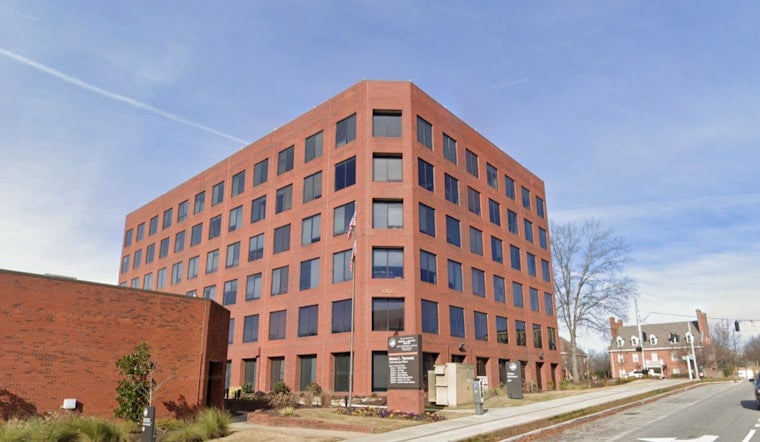
DeKalb County commissioners are weighing a new noise ordinance that would cap daytime sound from leaf blowers, mowers and trimmers at 65 decibels, but the measure has stalled amid disagreement over how officers would actually prove a violation. The proposal would replace the county's current “plainly audible” standard, which relies on an officer's own judgment, with hard sound-level readings requiring specialized meters county staff say are too costly and complicated to deploy.
The measure, formally known as County File # 2025-0015, has been on the DeKalb County Commission's agenda but a vote will likely be delayed pending a committee recommendation, according to WSB-TV. Commissioner Ted Terry, who authored the ordinance, said officials have been discussing changes to the county's noise rules for more than two years and that the goal is to preserve neighborhood peace while creating regulations that can actually be enforced. Terry has also questioned whether plainly audible violations can be proven or challenged under the county's current approach, a concern the station reports is central to the debate.
Under the draft legislation, daytime sound levels in residential areas would be capped at 65 decibels from 7 a.m. to 11 p.m., dropping to 60 decibels overnight, according to county filings reviewed by DeKalb County Government. An ordinance committee is preparing a recommendation that could further amend the restrictions based on time of day, per the same WSB-TV report.
Why Enforcement, Not Noise, Is the Sticking Point
The plan would require homeowners and landscapers alike to lean more heavily on quieter electric equipment, but doing so runs into a real legal constraint: Georgia's 2023 LEAF Act (House Bill 374) bars local governments from banning gas-powered leaf blowers outright or regulating them more harshly than electric models, according to the Georgia State University Law Review. That is why DeKalb's proposal is built around uniform decibel limits applied to all noise sources rather than a targeted gas-equipment ban.
During an August 11 meeting of the county's Planning, Economic Development and Community Services Committee, staff and code compliance representatives urged commissioners to keep the subjective plainly audible standard rather than switch to decibel readings, citing the cost of purchasing meters and the burden of keeping them calibrated, according to Citizen Portal. Dekalb police and code enforcement officers would need those meters to enforce the new standard, per WSB-TV's reporting, which is precisely the expense that has county staff pushing back.
Landscapers Warn Electric Gear Can't Keep Up
Rob Schlitz, who uses a small gas-powered backpack blower for some landscaping jobs, opposes the proposed restrictions, arguing electric equipment is less powerful, less durable, and saddled with cords, batteries or charging stations that gas tools don't need, WSB-TV reports. To soften that economic impact, commissioners Terry and Michelle Long Spears co-sponsored a companion measure in April 2025, County File # 2025-0017, which would create an Electric Landscape Maintenance Device Rebate Program to subsidize electric blowers, mowers and trimmers for residents and businesses, according to filings from DeKalb County Government. That rebate resolution was deferred alongside the noise ordinance for further committee review.
How Neighboring Cities Already Handle the Noise
DeKalb wouldn't be blazing a new trail if it adopts decibel limits. The City of Decatur, which sits inside DeKalb County, already enacted an updated noise ordinance that took effect in July 2025, capping daytime noise at 65 decibels and restricting landscape equipment use between 9 p.m. and 7 a.m. on weekdays and 5 p.m. and 9 a.m. on weekends, according to the City of Decatur. Atlanta takes a different tack, prohibiting motorized landscape equipment within 300 feet of any residential district between 8 p.m. and 8 a.m., per the city's municipal noise code as compiled by Local Noise Laws.
The push to curb gas leaf blower noise isn't confined to metro Atlanta. Hoodline previously reported that Lexington enforced a full gas leaf blower ban in Massachusetts in March, while Montgomery County, Maryland instituted a $500 fine for operating gas blowers starting in July 2025, according to a comparison published by The Regulatory Review.
The Health Case Behind the Push
Public health data helps explain why commissioners have kept pursuing the ordinance despite the enforcement disputes. A study published in PubMed Central found that gas-powered leaf blowers produce low-frequency sound waves that exceed World Health Organization daytime noise guidelines of 55 decibels up to 800 feet from the operator, because those lower-pitched waves travel farther and pass more easily through walls and windows. Separately, guidance from the Centers for Disease Control and Prevention and NIOSH, cited by Sustainable Woodstock, notes that gas blowers routinely produce 80 to 115 decibels, with operator exposure exceeding 100 decibels — loud enough to cause permanent hearing damage within 15 minutes without protection.
There's also an air-quality argument in the mix. Emissions testing by Edmunds found that running a two-stroke gas-powered leaf blower for 30 minutes generates roughly the same hydrocarbon emissions as driving a full-size pickup truck for nearly 3,900 miles, according to a summary published by Media Borough. For now, though, DeKalb's ordinance remains stuck in committee, with commissioners waiting on a recommendation before scheduling a final vote.





