

























































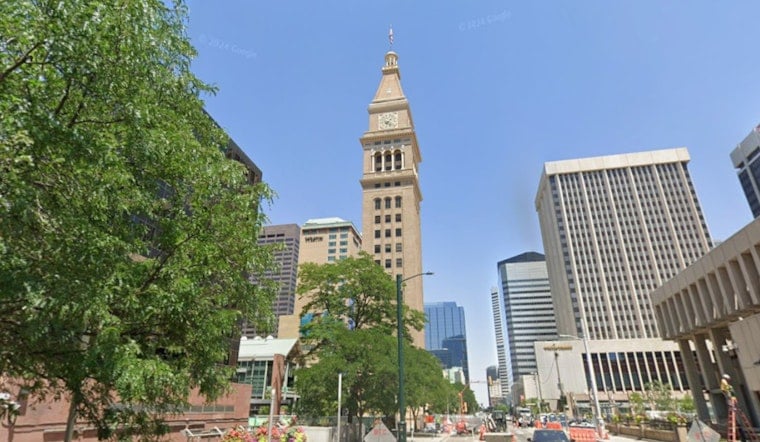
Downtown Denver's 325-foot Daniels & Fisher Tower has a new party trick: anyone with a smartphone and ten bucks can now change the color of its lights from anywhere in the world. Tech entrepreneur Danny Newman launched the app this week, turning the century-old clock tower at 16th Street and Arapahoe into an interactive, crowd-funded light installation.
The app lets users pick from an array of colors and animations to project onto the tower, according to The Denver Post. Five minutes of control costs $10, while a full dusk-to-dawn takeover runs $200. The lighting system had shifted from manual operation to remote control accessible from anywhere in the world, with the required technology enabling the app-based system installed after last year's upgrade to the tower's lights.
Newman told the paper he got the idea for the project after recalling watching friends control the Empire State Building's lights in New York. He's not new to Denver preservation projects — Newman purchased the top five floors of the Daniels & Fisher Clocktower for $2.5 million in 2018, giving him a personal financial stake in the landmark years before he thought to put its lights in the public's hands, according to the Denver Westword.
A Preservationist With a Growing Portfolio
Newman is also the owner of My Brother's Bar, having acquired the tavern with his family in 2017 to preserve what has operated continuously since 1873, per Patch. His broader preservation résumé includes acquiring the Mercury Café, advocating to save Casa Bonita, and organizing an investor group last year in an attempt to buy and redevelop the historic Zuni Steam Plant, as reported by The Denver Gazette.
Fundraising proceeds from the tower-lighting app go to Historic Denver, a local preservation nonprofit, after maintenance costs are covered. Newman serves on Historic Denver's board and leads the fundraising effort to light the tower himself. Historic Denver was officially incorporated in December 1970 after citizens organized to rescue the 1889 home of Titanic survivor Margaret “Molly” Brown from demolition, according to the Molly Brown House Museum.
The Tower's Long Road From Retail Anchor to Landmark
Completed in 1911 and designed by architect Frederick Sterner, the Daniels & Fisher Tower was modeled after St. Mark's Campanile in Venice and stood as the tallest structure west of the Mississippi River when it was finished, according to Wikipedia. The tower features four illuminated clock faces measuring 16 feet in diameter, positioned 250 feet above 16th Street.
The original Daniels & Fisher department store operated on the site until 1958, when the company merged with the May Company to form May D&F and relocated to Courthouse Square. The tower was listed on the National Register of Historic Places on December 3, 1969, which enabled preservationists to save it from demolition during Denver's 1970s Skyline Urban Renewal Project — even as public outcry could not stop the attached department store itself from being razed in 1971.
Lighting Up a Corridor Still Finding Its Footing
The app's debut comes as downtown Denver works to rebuild foot traffic along the 16th Street corridor. The city completed a three-and-a-half-year, $176.7 million revitalization of the 13-block 16th Street Mall pedestrian corridor last October, according to the Downtown Denver Partnership. That corridor itself carries its own design pedigree: the original mall opened in 1982 under a plan by architect I.M. Pei and landscape firm OLIN, featuring a diamond-patterned granite paver surface inspired by Navajo weaving and diamondback rattlesnake skin.
Hoodline has tracked the corridor's uneven recovery in recent months, from a twisting new tower design nearby to shifts in retail, leasing disputes, and vacant office space along the mall. Newman's lighting app offers a smaller-scale, community-funded bet that interactive public art can help draw people back downtown, even as larger redevelopment questions along 16th Street remain unresolved.





