

























































Twenty-two rare photogravures by Edward S. Curtis are leaving Denver Public Library's vaults for the first time in more than 80 years, headed to a Greenwood Village gallery for an exhibition opening Friday, August 15. The Museum of Outdoor Arts will display the historic prints alongside more than 100 fine-art photographs from contemporary artists as part of a show called Viewfinders: A Colorado Photography Exhibition, running through September 23.
The loan marks a rare public outing for materials that Denver Public Library normally keeps locked away. As reported by the Denver Gazette, Emily Grace King, who joined DPL as its first art and exhibits curator for special collections and archives in 2024, said the library's Special Collections and Archives rarely loans collection materials to other venues. King also said the Curtis photogravures must be seen in person to fully appreciate the technique, since the delicate tonal work simply doesn't translate to a screen.
Curtis created the 22 exhibited images between 1907 and 1930 while photographing members of 80 Native American tribes across North America, work that became his sprawling 20-volume series The North American Indian. The project's scale was staggering from the start: financier J.P. Morgan put up $75,000 in 1906 expecting a five-year effort, but Curtis instead spent 24 years on the undertaking, according to the Curtis Legacy Foundation, and he ended up bankrupt and largely forgotten by the time he finished in 1930.
A Collection Almost No One Gets to See
Of the 500 sets originally planned, only 272 complete 20-volume editions were ever published, containing 2,234 photogravure plates in total, per Christie's. Fewer than 200 full sets are accounted for today, and individual complete sets have sold at auction for as much as $2.9 million. Denver Public Library holds one of those complete sets, one of just 23 signed by Theodore Roosevelt and one of only 51 signed by Curtis himself, encompassing volumes 1 through 20 along with 20 boxes of prints or plates, according to the Denver Gazette's report.
The library's Curtis collection was accessioned on March 24, 1933, and it's normally stored in locked vaults with compact shelving and cold conditions to protect the fragile paper. Brian Trembath, who has worked as acquisition librarian for DPL Special Collections and Archives for 12 years and at the library for 19 years overall, has helped oversee the material. Outside of loans like this one, the public can view unframed Curtis prints only by appointment in the Mullen Manuscript Room, though the library has also digitized the prints for worldwide access.
What Photogravure Actually Is
Photogravure is an intaglio printmaking process developed in the 19th century: light-sensitive chemicals etch an image into a copper plate, ink is applied to the recessed areas, and paper is compressed against the plate to transfer the image, according to the Portland Museum of Art. The technique allowed for fine gradients of sepia tone that rivaled oil paintings when Curtis was working in the early 20th century, which is part of why King insists these images need to be seen in person rather than reproduced.
Curtis' own history is tangled up with Denver. He spent time in the city in the early 1930s, and beyond still photography, he documented Native American songs and stories on wax cylinders. Author Timothy Egan explored that history in his 2012 biography Short Nights of the Shadow Catcher, which traces how Curtis was inspired in part by a depiction of the 1862 mass execution of 38 Dakota men in Mankato, Minnesota.
Contemporary Colorado Photographers Round Out the Show
Viewfinders isn't only about Curtis. The exhibition features work from eight contemporary Colorado photographers, including Scottish photographer David Yarrow, whose fine-art wildlife and Western narrative photography has helped him contribute more than $30 million to charitable causes. Salida-based photographer Lars Leber, who has more than half a million online followers and won the Denver Gazette's Best of the Springs Fine Art Photography Award for eight consecutive years between 2015 and 2022, is showing Rocky Mountain landscape and Milky Way astrophotography.
Other contributors include Roger Good, who printed 20 black-and-white photographs after visiting more than 50 small Colorado towns during the pandemic; Andrew Beckham, who delivered seven black-and-white photographs; and Edie Winograde, who brought five works depicting rural Colorado. The Museum of Outdoor Arts funded the matting and framing costs for the Curtis prints specifically for this show.
Where and When to See It
The Museum of Outdoor Arts, founded in 1981 by real estate developer John W. Madden Jr., his wife Marjorie P. Madden, and their daughter Cynthia Madden Leitner, also owns the adjacent 18,000-capacity Fiddler's Green Amphitheatre, operated in partnership with AEG Presents, according to the Museum of Outdoor Arts. In 2022, the museum relocated its administrative headquarters to Marjorie Park, a 2.1-acre outdoor sculpture garden with more than 40 permanent artworks and a custom labyrinth centerpiece.
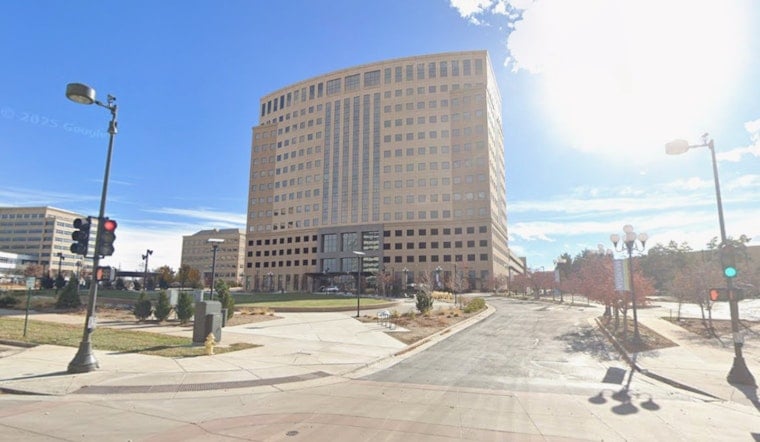
Viewfinders opens with a public reception from 5 to 8 p.m. on Friday, August 15, at the Madden Gallery, 6363 S. Fiddlers Green Circle, Suite 110, in Greenwood Village. The reception is free but requires an RSVP for tickets. The 10,000-square-foot gallery is wheelchair accessible and sits about half a mile from the Orchard Station light rail stop, and it offers complimentary admission and free parking Tuesdays through Fridays from 10 a.m. to 4 p.m.
The exhibition's August opening lands during Colorado's 150th anniversary of statehood, marked on August 1, and alongside the United States' 250th anniversary, according to History Colorado. Denver Public Library, which recorded more than 2.7 million in-person visits and circulated more than 2.1 million items systemwide in 2025, reopened its Central Library in late 2024 following a four-year, $60 million renovation that upgraded security for its Special Collections and Archives, per CBS News. Viewfinders runs through September 23.





