

























































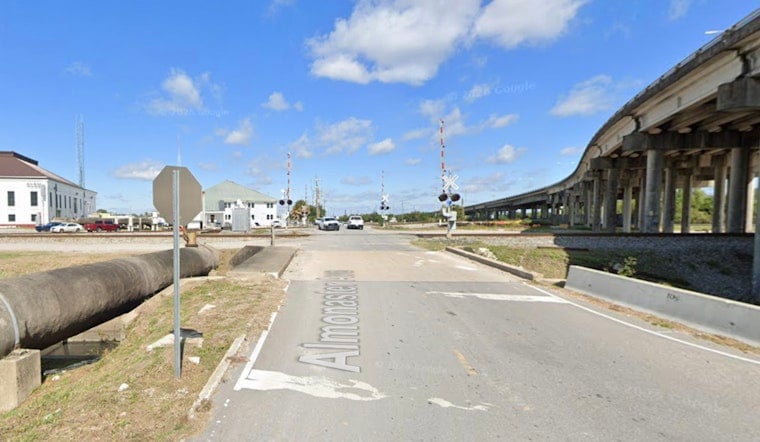
Crews working on a federal flood control project have started round-the-clock construction at the railroad crossing near Florida and Almonaster avenues in New Orleans' Desire neighborhood, digging tunnels underneath the tracks that will run 24 hours a day, seven days a week. The work is part of the decades-old Southeast Louisiana Urban Flood Control Project, known as SELA, and residents living closest to it are already logging complaints about dust, noise, and what they describe as a lack of response from the city.
According to WDSU, a U.S. Army Corps of Engineers spokesperson announced at an open house meeting on Thursday that crews would start working through the night at one of the SELA construction sites. Resident Paul Peters told the station that construction dust coats his car even after he washes it, and that he has reached out to the City of New Orleans for help with the dust and with a dead-end barricade near his home that he says has been tied to a police chase that ended in his driveway. As of the station's report, the city had not responded to his request.
Jack-and-Bore Method Chosen to Spare Rail Lines
The nighttime work relies on a trenchless engineering technique called jack-and-bore, in which crews dig pits on both sides of the tracks and push steel casings through the earth to install underground drainage infrastructure beneath active railroad crossings, according to the U.S. Army Corps of Engineers. The method will proceed in four two-month phases through summer 2027. Project manager Joshua Abadie said permanent railroad tracks along Florida Avenue will be temporarily moved to accommodate the work, per the WDSU report.
Ricky Boyett, a Corps spokesperson, said construction trucks will still be restricted to daytime hours because they are very loud, but that the nighttime work itself will primarily use generators and hand-digging rather than heavy trucks. Neighbors closest to the generators will hear noise similar in volume to a living room television, Boyett said, according to the same WDSU account. He added that SELA gives floodwater a place to go so Sewerage and Water Board pumps can remove it from the city.
A Decade of Work Along Florida Avenue, With Years Still to Go
Construction has continued along Florida Avenue for about a decade, and the current phase in the Desire neighborhood is slated to continue until 2029, per WDSU's reporting. The Corps has said the 24-hour, seven-day-a-week schedule will end next summer if weather cooperates, since delays could push the timeline further. The Corps leads SELA in partnership with the Sewerage and Water Board of New Orleans and other local and state agencies, and the program aims to reduce flood risks across Jefferson, St. Tammany, and Orleans parishes.
The current Desire-area work stems from a $51.5 million construction contract the Corps awarded in September 2025 to St. Rose-based contractor M.R. Pittman Group, LLC, according to a U.S. Army Corps of Engineers news release. That contract covers trenchless boring, pile driving, and retaining wall construction beneath the rail lines. The broader Florida Avenue Canal Phase 4 project stretches from St. Ferdinand Street to the Peoples Avenue Triangle and includes subsurface pipe installation and street resurfacing on nearby Desire-area streets such as Treasure, Benefit, and Abundance, per the Sewerage and Water Board of New Orleans, with stormwater ultimately routed to Drainage Pump Station 19.
Built for a 10-Year Rain, Not a Hurricane Surge
SELA's internal drainage projects are engineered to handle a 10-year rainfall event, defined in the New Orleans area as roughly nine inches of rain falling within 24 hours, the Corps has said. That distinction matters locally: SELA addresses street-level ponding from heavy downpours, not the kind of storm surge that levees and floodwalls are built to hold back. Congress originally authorized the SELA program through the Water Resources Development Act of 1996, after torrential May 1995 downpours flooded Orleans and Jefferson parishes, and the program has received more than $2 billion in federal funding since work began following Hurricane Katrina, according to WDSU.
The financial arrangement behind that funding shifted in November 2024, when the Corps approved an interest relief agreement delivering an estimated $68 million in savings to Louisiana's Coastal Protection and Restoration Authority to reinvest in regional flood reduction. SELA's non-federal costs are repaid over a 30-year schedule. Under longstanding administrative agreements described by the Louisiana Weekly, it is the Sewerage and Water Board, not the Corps, that holds legal responsibility for settling resident property damage claims tied to SELA construction, with those settlement payments factored into the city's local cost-share match.
Frustration Compounds Amid a Wider Maintenance Backlog
The 24-hour schedule lands in a neighborhood already wary of how the city's infrastructure agencies communicate with residents. Hoodline reported earlier this month that the Sewerage and Water Board has just $4.6 million allocated for catch-basin cleaning against an estimated $25 million to $40 million needed annually to service the city's more than 76,000 basins, a shortfall that has pushed some residents to clean street drains themselves even as multimillion-dollar federal projects like SELA move forward nearby.
The city has tried to ease some of the confusion over overlapping construction. In July, officials launched a centralized interactive map dashboard combining Department of Public Works and Sewerage and Water Board work orders so residents can track utility projects block by block, updated weekly. That effort followed a separate incident in April, when a 54-inch sewer force main broke in the Industrial Canal near Florida Avenue after a vessel strike, prompting emergency containment work and public safety warnings near the same corridor where SELA crews are now digging around the clock.
For now, residents with concerns about the Desire-area construction can reach the SELA construction impact hotline at 877-427-0345. Corps personnel have said they aim to minimize disturbances during the work, even as the project's timeline stretches years into the future.





