

























































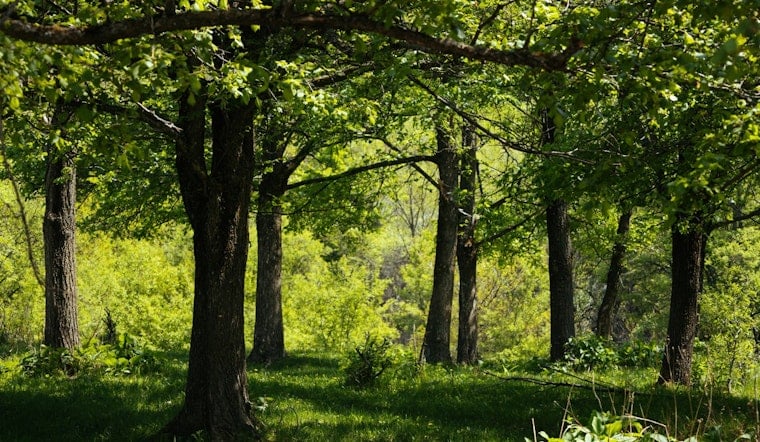
More than 1,100 acres of forest, wetlands and trails straddling Dover and Westwood will never be sold off for houses or retail development, after Hale Education finalized a conservation restriction locking the land into permanent public use. The nonprofit, which has run outdoor youth camps and educational programs on the property for generations, retains private ownership and day-to-day management of the land, but future owners are now barred from developing its trails, trees and wetlands for housing, retail or similar projects.
The deal, completed on August 21, closed through two distinct conservation restrictions: a 973-acre restriction spanning both towns and a separate 136-acre restriction in Dover adjacent to Powisset Farm, according to The Trustees of Reservations. The larger restriction marks the biggest single conservation project the organization has acquired in 54 years, per the same account. As MassLive reports, Hale Education Executive Director Aaron Morehouse said the organization wanted to avoid ever facing an emergency that would force it to sell land to a developer.
“The land had been viewed by many people as de facto protected,” Morehouse told the outlet, adding that he believes it should remain protected forever. That informal assumption is exactly what left the property vulnerable — without a legal restriction, a future financial crunch could have put the woodland on the market. Now, under the new agreement, the Trustees or a government agency must participate to maintain the restriction, and the land is guaranteed to stay open to the public, per MassLive's report.
How a Stalled Tax Ask Became a Private Philanthropy Win
The path to this month's signing wasn't straightforward. Hale originally sought $20 million in municipal funds from Dover and Westwood starting in 2019 to finance the conservation restriction, according to the Westwood Minute. But the organization halted those municipal negotiations in spring 2024 amid town governance delays and tax-impact concerns, pivoting entirely to private philanthropy, the paper reported.
That pivot paid off. Hale raised $38.5 million through its Campaign for Kids, Conservation, and Community, drawing contributions from more than 3,000 individual donors, foundations and corporations, the Westwood Minute reported. Much of that money will go toward an operational endowment, according to MassLive, and Hale has said it has no intention of changing its mission or ever selling the property.
Regulatory Sign-Off Cleared the Way
Getting there required unanimous municipal approval on both sides of the town line. The Dover Board of Selectmen voted unanimously to endorse the restrictions on June 9, followed by a unanimous vote from the Westwood Select Board on June 22, the Westwood Minute reported. Under Massachusetts General Laws Chapter 184, Sections 31 through 33, a conservation restriction functions as a permanent negative easement, and it doesn't become legally enforceable in perpetuity until it clears both local select board approval and sign-off from the state Secretary of Energy and Environmental Affairs, according to guidance from Mass.gov.
The agreement also carves out a 220-acre “program envelope,” where Hale retains the right to maintain, upgrade or add infrastructure supporting its outdoor camps and educational programs, even as commercial, residential or retail development remains permanently off the table, per the Westwood Minute. That flexibility matters for an organization that serves roughly 15,000 students through school partnerships during the academic year and hosts about 4,000 children annually across its summer camps, drawing participants from more than 75 communities, according to nonprofit data tracked by Cause IQ. The property maintains 20 miles of public trails supporting hiking, birdwatching, mountain biking and swimming, MassLive reported, and the conservation agreement also preserves native historic sites, including a rock quarry once used by tribes.
A Green Belt Bigger Than Central Park
Spanning more than 1,100 acres, Hale's conserved land is several hundred acres larger than New York City's 843-acre Central Park, making it one of the largest privately owned, publicly accessible conservation landscapes in southern New England, the Westwood Minute reported. The property sits adjacent to Noanet Woodlands and Powisset Farm, both protected Trustees properties, and Jennifer Dubois, the Trustees' vice president of land conservation, said the resulting protected land network totals more than 2,000 contiguous acres across Dover and Westwood, according to MassLive.
The Trustees of Reservations, described by MassLive as Massachusetts' largest land conservation nonprofit, owns 33,000 acres of protected reservations statewide and has helped protect 22,000 acres of Massachusetts forests, farms, wetlands and beaches altogether. Beyond trail protection, the newly preserved woodland safeguards critical regional hydrology, shielding wetlands that filter both the Charles River and Neponset River watersheds along with four ponds and climate-resilient forest, the Westwood Minute reported.
A Century of Public Access, Now Made Permanent
The site's roots as a public recreation ground stretch back to March 11, 1918, when Boston engineer Robert Sever Hale invited local Boy Scouts to camp on his private property — an arrangement that eventually led to the chartering of “Scoutland” in 1930 before it evolved into today's Hale Education, according to the organization's own history. Hale has kept the land open to the public for more than a century, and the conservation agreement now guarantees that year-round youth programming, summer camps and outdoor educational opportunities for local students will continue on the site.
For families nearby, the practical impact is straightforward. Kevin Burk told MassLive he plans to bring his 5- and 2-year-old children to the reservation, one more example of how a deal built on legal easements and municipal votes ultimately comes down to woods that will stay open for the next generation to explore.





