

























































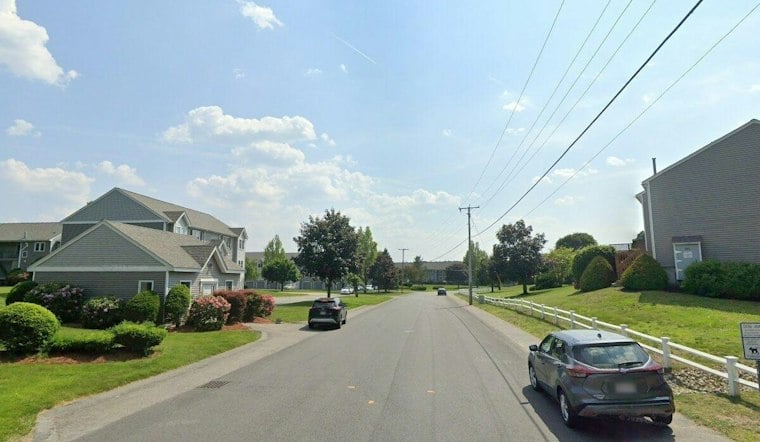
Dracut voters head back to Town Meeting Monday night to decide, for the third time in two years, whether to adopt the state's MBTA Communities Act zoning rules — a measure they have already voted down twice. The session starts at 7 p.m. at Dracut High School, where residents will weigh a proposal that identifies two specific condominium complexes as potential sites for multifamily housing.
Two Rejections, One More Try
Dracut Town Meeting rejected the MBTA Communities Act once at the November 2024 meeting and again at the annual Town Meeting in June 2025, according to the Lowell Sun. The Board of Selectmen voted 3-1 at its Aug. 11 meeting to put the issue before voters once more, marking the third attempt in two years, the paper reported in an earlier account of that meeting.
This time around, the proposal names two sites: Winding Brook Condominiums on Tennis Plaza Road and Cascade Condominiums on Route 113. If Town Meeting approves the measure, it would establish multifamily housing by right on those identified parcels — but the newspaper's report notes that actually developing the land would require the agreement of all condo owners to sell their units. An earlier Sun report in August described the needed consent differently, putting the threshold for developing the sites at somewhere between 90% and 100% of condominium unit owners, so the precise bar for redevelopment remains unsettled between the two accounts.
Grant Money and Legal Costs at Stake
Dracut Selectmen Chair Don Plummer has framed the vote in financial terms, telling the Sun that approving the law would reopen the town's access to grant money and save on litigation costs. Plummer is expected to urge Town Meeting voters to treat the decision as a business calculation for the town rather than a referendum on development itself.
Proponents of the law have also pushed back on a common objection, arguing that the measure is a zoning law rather than a housing law, and that multifamily housing is not synonymous with affordable housing, per the same report. The zoning rule requires no immediate housing development — it simply sets up the legal framework that would allow multifamily units to be built by right if landowners eventually choose to redevelop.
Dracut Among a Shrinking Group of Holdouts
Statewide, the MBTA Communities Act enables overlay zoning intended to eventually bring more multifamily housing to 177 eastern Massachusetts communities. As of the Sun's reporting, Dracut is among just eight eastern Massachusetts communities still rejecting the law, a number that has been dwindling as more towns fall in line.
Neighboring Tewksbury recently gave up its opposition, approving a new MBTA Communities district at a special Town Meeting last month after previously rejecting the law in an overwhelming May 2024 vote of 565-142. At that October session, Tewksbury approved the underlying bylaw 133-33 and the new district map by a vote of 155-5. Tewksbury Town Manager John Curran told the Sun the town had lost out on $1.7 million in grant funding as a direct result of its earlier noncompliance.
Wilmington, meanwhile, remains among the communities still opposing the law. Voters there rejected proposed zoning districts twice — first 288-154 in December 2024, then more narrowly 152-165 in May 2025 — and are now headed for their own third vote at a special Town Meeting later this month, according to the Boston Herald. That outlet reported that noncompliant communities across the state have begun reporting lost grant funding as a consequence of failing to pass the required zoning.
What the Law Actually Requires
Under Massachusetts General Laws Chapter 40A, Section 3A, an MBTA community must maintain a zoning ordinance or bylaw providing at least one district of reasonable size where multifamily housing is permitted as of right, with that housing required to be free of age restrictions and suitable for families. State officials have said noncompliant communities are ineligible for funding from certain Commonwealth sources as a consequence of failing to meet those requirements.
Monday's vote will determine whether Dracut joins the growing list of compliant towns or remains among the holdouts still weighing the tradeoffs between local zoning control and state grant eligibility.





