

























































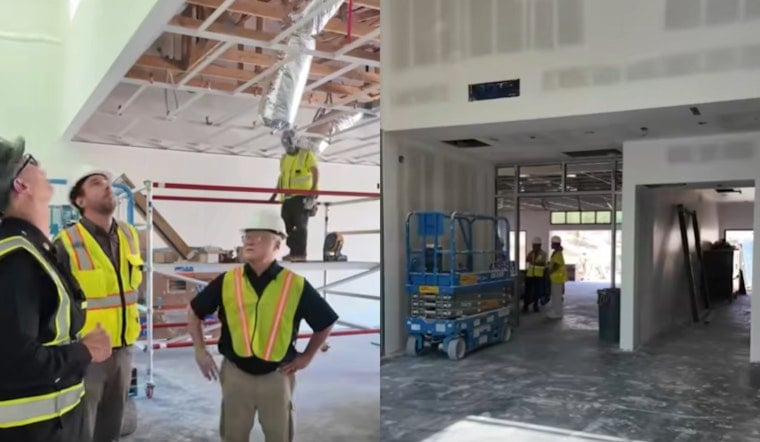
Crews finished the final concrete pour on the Alameda County Fire Department's new five-story training tower in Dublin on Monday, marking a major construction milestone for the long-planned regional facility. The tower is part of a centralized training center taking shape on a 5.2-acre parcel at 5053 Gleason Drive, next to an existing county fire station.
According to the Alameda County Fire Department, the tower will continue taking shape in the coming months as work progresses toward completion. The five-story structure spans roughly 5,500 to 5,741 square feet and is being built with live-fire burn rooms, roof simulation props, and confined-space rescue areas, according to Overaa Construction, the project's general contractor. An 8,000-square-foot classroom building rounds out the site, per the same account. The parcel was designated for public facility development within the Eastern Dublin Specific Plan area, according to the City of Dublin.
A Years-Long Path to Groundbreaking
The project traces back to March 2020, when county supervisors approved up to $20 million from East County Development and Infrastructure Improvement Funds to launch the effort, according to the Alameda County Board of Supervisors. The facility was added to the county's Capital Improvement Plan that year before advancing through design-build procurement. Site construction officially began following a groundbreaking ceremony on April 4, 2025, led by ACFD Fire Chief William McDonald and attended by regional leaders, with former Supervisor Scott Haggerty recognized for initially championing the project.
The scope and cost of the build have grown along the way. In April, the Board of Supervisors authorized an $895,392 change order, raising the total project contract with Overaa and Shah Kawasaki Architects to $26,226,261. The added funds cover major equipment, specialty components, and an upgraded wastewater capture system required to comply with Authority Having Jurisdiction environmental and utility regulations.
Replacing a Patchwork of Outside Training Sites
Before the Dublin site took shape, ACFD recruit academies had to rely on external or shared facilities to complete mandatory training modules. Recruits traveled to the Hayward Training Tower, San Leandro facilities, and even the San Francisco Fire Department Training Facility for multi-company live-fire exercises, according to the department. Consolidating that training into one Dublin campus means personnel serving a department that responds to more than 394,000 residents across 508 square miles will no longer need to travel outside the county for high-rise and live-fire drills.
ACFD's coverage area spans unincorporated Alameda County, five contract cities — Dublin, San Leandro, Union City, Newark, and Emeryville — plus Lawrence Berkeley National Laboratory and Lawrence Livermore National Laboratory. Centralizing training for a force that large has been a goal county officials have pursued since the project first landed on the Capital Improvement Plan.
Other Fire Stations Rising at the Same Time
The Dublin tower's progress lands amid a broader wave of ACFD capital projects, several funded through a different pot of money than the training center itself. Measure X, a $90 million bond voters approved in November 2020 to replace outdated fire stations in unincorporated Alameda County, assesses property owners about 1.6 cents per $100 of assessed value and is funding station rebuilds separate from the Dublin regional training center, which draws instead on county infrastructure funds and design-build contracts managed through the Board of Supervisors.
In Castro Valley, construction on the replacement Station 25 on San Miguel Avenue reached the foundation phase in July and August, with crews pouring footings and preparing concrete slabs following a June groundbreaking and earlier site soil remediation in May. Nearby, reconstruction of Station 7 in the Palomares Hills neighborhood advanced to interior sheetrock and electrical work this month, following an October 2025 groundbreaking. That 7,900-square-foot facility will replace an older station built in 1986.




