

























































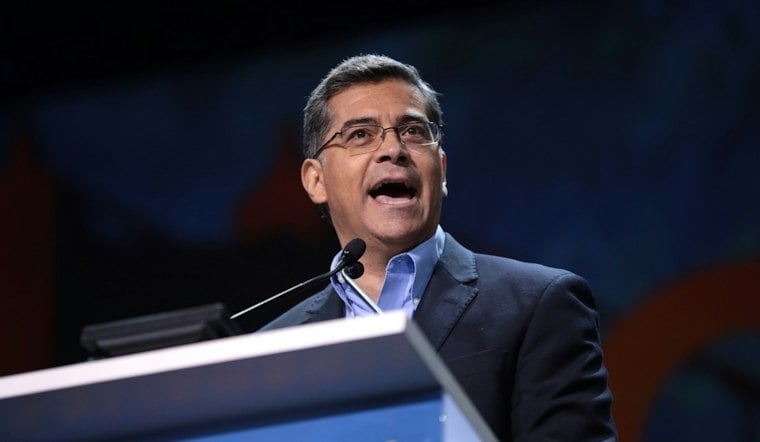
California gubernatorial candidate Xavier Becerra says a mileage-based fee on drivers should be on the table to help pay for the state's road and bridge repairs, including a contribution from electric-vehicle owners who currently skip the gas tax altogether. Becerra made the comments during a campaign stop, as California's long-running study of a pay-per-mile system heads toward a key legislative deadline.
Becerra: 'Everything Should Be on the Table'
Becerra, a Democrat running to replace Gov. Gavin Newsom, is a former California attorney general and U.S. health secretary, according to ABC7 News. Speaking about how to fund repairs, Becerra said, “Everything should be on the table,” as reported by KCRA. He specifically called out electric-vehicle owners, who do not pay the state's gas tax, asking, “Should people who drive electric vehicles, who don't need gas, pay for those roads to be repaired as well? Absolutely.”
Per the New York Post, Becerra made the remarks at a campaign event at Oakstop in Oakland on Tuesday. ABC7 News reports that Becerra has otherwise offered few specifics about the tax changes he would pursue as governor, though he has also floated higher taxes on wealthy Californians and new fees on corporations that fail to provide adequate health benefits to full-time workers, according to the Post. California's gubernatorial election is scheduled for November 3.
A Pilot Years in the Making
California has been testing mileage-fee concepts for years. The state's Road Charge Collection Pilot ran from August 2024 through January 2025, with the goal of testing whether a per-mile fee, called a Road Charge, could fairly and sustainably replace the gas tax, according to the state's Road Charge program. Participants in that pilot paid charges based on the miles they actually drove each month, the agency says, and the state separately ran a pilot involving more than 5,000 vehicles that logged over 37 million miles, per California Today.
The current pilot traces back to Senate Bill 339, passed in 2021, which directed California to implement a program to identify and evaluate issues tied to collecting road-charge revenue, according to California Legislative Information. A mileage-fee pilot program was also included in SB 1 back in 2018, the Post notes. The final report on the current Road Charge Collection Pilot is due to the Legislature by December 2026, the program's website states, and KCRA reports that California officials are expected to complete a related report by the end of this year.
Why the Gas Tax Is Shrinking
California currently relies mostly on gasoline and diesel taxes to build and maintain its roads and highways, but hybrid and electric vehicles use little or no gas and therefore pay much less in fuel taxes, per the Road Charge program's own materials. Caltrans has said maintaining state roadways costs roughly $8 billion to $9 billion a year, with Californians paying about $300 annually in average state gas taxes while electric-vehicle owners instead pay a flat $100 registration fee, according to ABC7's Bay Area affiliate.
The math gets starker looking ahead. California now has more than 1.2 million registered hybrid or electric vehicles, which the same ABC7 report says is driving gas-tax revenue down. The Legislative Analyst's Office projects that revenue could fall by up to $4 billion annually by 2035, while the Mineta Transportation Institute estimates the loss could reach between $4.8 billion and $12.1 billion by 2040, according to California Today. The California Transportation Commission separately projects the state will collect $31.3 billion less in fuel excise tax revenue over the next decade due to rising fuel efficiency and EV adoption, the outlet reports.
GOP Rival Warns of a Steep Price Tag
Republican Assembly member Carl DeMaio has outlined his own vision of a statewide mileage tax, pegging it at 6 to 9 cents per mile on top of existing gas and vehicle taxes, according to the Post. At the 6-cent rate, the Post calculates a driver covering 15,000 miles a year would pay an additional $900 annually — a jump DeMaio has compared to an 87-cent-per-gallon gas-tax increase, per the same report.
DeMaio has argued that California drivers already pay gas and car taxes for roads that are falling apart while that money gets diverted elsewhere, the Post reports. He has also warned that Democrats in the Legislature could advance a statewide mileage tax without putting it directly before voters, and cautioned that such a fee could disproportionately burden working-class Californians with long commutes, according to the same account.
California isn't alone in exploring this terrain. San Diego County officials considered a local mileage-fee proposal in 2021 but abandoned the effort after public opposition, the Post notes. Oregon already runs a live version of the concept: its OReGO program charges drivers two cents for every mile they drive, with revenue going to the State Highway Fund to maintain and improve roads and bridges, according to the Oregon Department of Transportation.





