

























































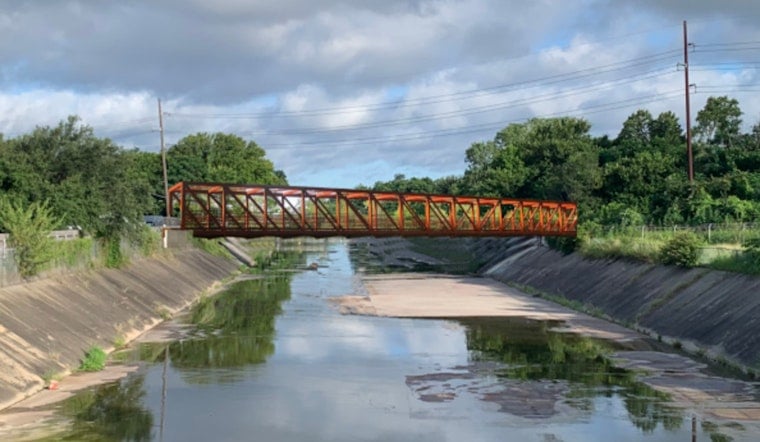
A steel bridge is rising over Boggy Creek in East Austin, and once it's finished, it will close one of the last missing links in a trail that neighborhood advocates have been pushing for since 2021. City crews began installing the shared-use trail segment and bridge in January, and Phase 5 of the MoKan Trail project is now underway, with officials expecting the work to wrap up by fall 2026.
The bridge itself is a 14-foot-wide pre-fabricated steel structure stretching from the intersection of Gunter Street and Sellers Street to Lyons Road, according to a project overview from the City of Austin. Phase 5 carries a price tag of $5.6 million, as reported by Community Impact. The Austin City Council authorized a construction contract with Muniz Concrete & Contracting, Inc. worth $3,421,877, with a total budget of up to $3,764,065 once contingencies are included, according to city council records.
Federal Dollars and Flood-Control Rules Shape the Build
Part of the funding trail runs through Washington. Phase 5 draws on $1 million in Community Project Funding that U.S. Rep. Lloyd Doggett secured through the Fiscal Year 2022 Federal Appropriations bill, on top of dollars from the city's 2020 Mobility Bond, per the same Community Impact report. Because the project taps federal transportation funding overseen by the Texas Department of Transportation, the solicitation also required a 5% Disadvantaged Business Enterprise participation goal for subcontractors, according to a contract listing reviewed by HigherGov.
Boggy Creek isn't just any waterway — it's an engineered flood-control channel, which meant the bridge needed sign-off from federal regulators before construction could begin. The U.S. Army Corps of Engineers issued a Section 408 permit allowing the project to modify the existing Boggy Creek Channel Improvement Project, clearing the way for the crossing to move forward.
A Decade-Old Gap, Nearly Closed
The need for this connection isn't new. City planners flagged the MoKan Trail gap in the 2014 Urban Trails Plan, and neighborhood leaders later pushed the corridor into the spotlight, successfully petitioning the city to designate it a Tier 1 high-priority trail in 2021. Once finished, the full MoKan Trail will stretch 1.5 miles, linking an existing bike path on Pedernales Street to the Southern Walnut Creek Trail system — the same trail system Hoodline once highlighted for its urban hikes.
The trail traces a section of the former Missouri-Kansas-Texas Railroad corridor, giving it its name. A private developer built a 0.25-mile stretch of the trail behind the Trailhead Apartments, running from Shady Lane to Springdale Road, which opened in January 2023 and currently includes a temporary route while the city works to acquire right-of-way from Union Pacific Railroad for a permanent, straight-through connection, per city background on the project.
Five Phases, Almost There
The city is building the remaining 0.75-mile section of the trail in five phases. Phases 1, 2, 3a, and 4 are already complete, and Phase 3b is in the design phase, with construction expected to begin in fall 2026. Springdale Road's crossing is also slated to receive additional safety improvements that same month.
The stakes extend beyond a short stretch of pavement. The MoKan Trail is meant to serve as a link in a proposed 30-mile regional trail loop connecting the Red Line Parkway, the Southern Walnut Creek Trail, the Northern Walnut Creek Trail, and downtown Austin, according to information from the U.S. House of Representatives. Locally, the new bridge and trail segment are expected to connect East Austin residents to destinations including Casa Marianella, the BikeTexas events space, Cepeda Branch Library, the East 7th Street H-E-B, and the planned CapMetro Green Line Pleasant Valley Transfer Station, per Bike Story Night.
For a project rooted in a decade-old planning document and years of neighborhood advocacy, the finish line is finally in sight. Once the bridge over Boggy Creek is complete this fall, East Austin will have one less gap standing between its neighborhoods and the region's growing trail network.





