

























































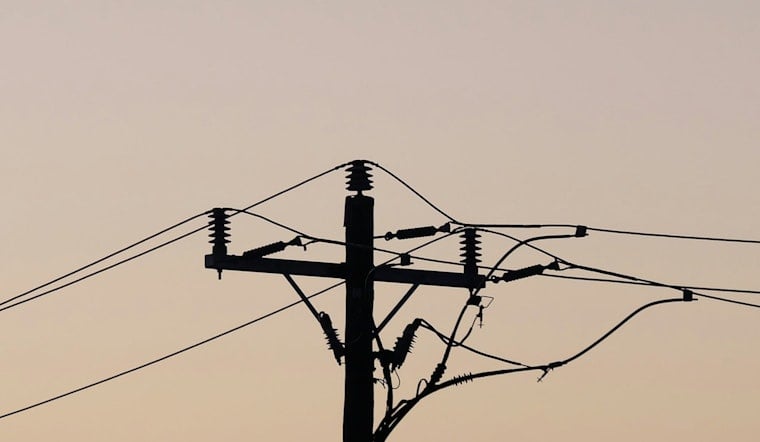
A fire tore through the area near 149th Street and Railroad Avenue in East Chicago on Tuesday morning, cutting power to more than 5,000 people just as much of Northwest Indiana was still trying to recover from the previous week's storms. Witnesses said their lights flickered before the blaze broke out, and some reported hearing a loud boom right before flames appeared.
Multiple homes across East Chicago were left without power Tuesday morning, according to CBS News Chicago. Residents told the outlet that NIPSCO power equipment appeared to be burning near the scene. As of Tuesday, NIPSCO had not confirmed whether the fire caused the fresh round of outages, and CBS News Chicago said it was still waiting on the utility to confirm both the cause of the fire and the reason for the additional East Chicago outages.
NIPSCO chief executive officer Vince Parisi offered a possible explanation, saying he believed a utility electrical pole may have caught fire following a possible transformer explosion. Parisi said the damage affected the company's transmission and distribution systems across its entire service footprint, a sign of just how strained the grid remains more than a week after it was pushed to its historic breaking point.
Gary Still Waiting as Restoration Lists Skip the City
The East Chicago fire landed at a particularly raw moment for the region. As of Monday, Gary still had 27,000 homes without electricity from the previous week's storms, and the city was notably left off NIPSCO's Tuesday-night power-restoration list. Gary Mayor Eddie Melton said some large service areas were still undergoing damage assessment that week, even as residents waited for fresh food, cold water, and ice.
NIPSCO said the majority of its Northwest Indiana customers would have power restored by Tuesday night, but that promise offered little comfort to Gary households still without basics more than a week after the storm first hit. The scale of the crisis traces back to August 11, when a derecho slammed the region with wind gusts reaching 99 mph at Gary/Chicago International Airport, spawning multiple tornadoes and knocking out power to over 301,000 customers, according to Northwest Indiana Business Magazine. Hoodline previously reported that the same storm system left one dead in a Portage home blast amid winds topping 100 mph.
Dyer Runs Its Wastewater Plant on Generators
Dyer, meanwhile, was starting its seventh day without power on Tuesday, and the town has relied on generators to keep critical infrastructure running, including a wastewater treatment plant. That kind of prolonged reliance on backup generators underscores how deep the outages have cut into essential services well outside the hardest-hit cities.
Per Power Grid International, the August 11 storm sequence marked the single largest power outage event in NIPSCO's history, affecting more than 60 percent of its electric customer base and generating a cumulative total of 338,000 customer outages through August 16. NIPSCO serves roughly 500,000 electric customers across 32 counties in Northern Indiana, and the outlet also reported that the utility's automated outage alert system collapsed during the initial peak of cleanup on August 11 and 12, leaving residents across multiple communities unable to get localized updates or restoration estimates.
Federal Help and State Disaster Funds Follow the Storm
The scope of the damage has already drawn in state and federal resources. On August 15, President Donald Trump approved a federal emergency declaration for Indiana authorizing FEMA to coordinate disaster relief, following Governor Mike Braun's mobilization of the Indiana National Guard to assist recovery efforts in Gary, Munster, and Hobart, according to a report from The Times of Northwest Indiana. Indiana officials had declared a state disaster emergency on August 13, two days before the federal relief authorization came through.
Indiana officials also announced on August 17 that eligible residents can apply for up to $5,000 from the State Disaster Relief Fund by calling 2-1-1 to cover immediate housing repairs needed to make storm-damaged primary residences habitable, per the same report from The Times of Northwest Indiana. NIPSCO has placed its electric operations into official emergency response mode through August 21, pausing non-emergency maintenance work and temporarily suspending customer disconnections for non-payment while more than 1,200 mutual assistance workers from neighboring states help local crews with repairs.
Safety Concerns and Rate Anger Complicate Recovery
Restoration work has not gone smoothly everywhere. Power restoration efforts in Gary were temporarily halted on August 15 after a NIPSCO utility vehicle was struck by gunfire overnight, prompting a police investigation and temporary security escorts for repair crews, the Times of Northwest Indiana reported.
Frustration over the outages has also collided with long-simmering anger over NIPSCO's rates. On August 14, the Gary Common Council unanimously passed a resolution rebuking NIPSCO over high utility costs, pointing out that NIPSCO's electric rates average $234 per 1,000 kWh, roughly 48 percent higher than utilities in Indianapolis or Southern Indiana, according to CBS News. That anger follows a first-of-its-kind regulatory rebuke: on August 6, state utility regulators partially denied a NIPSCO rate tracker request, marking the first such denial in decades under a policy pledge by Governor Braun to increase scrutiny of public utility cost increases, per WNDU.
The human toll of the broader storm outbreak has been severe. The Guardian reported that the multi-day Midwestern storm system caused at least three deaths across the region, including a 4-year-old child killed by a fallen tree in Jennings County, and prompted an official investigation into the fatal Portage home explosion. As East Chicago crews now sort through the cause of Tuesday's fire, the region remains caught between an unfinished storm recovery and mounting questions about whether the grid can hold up under the next one.





