

























































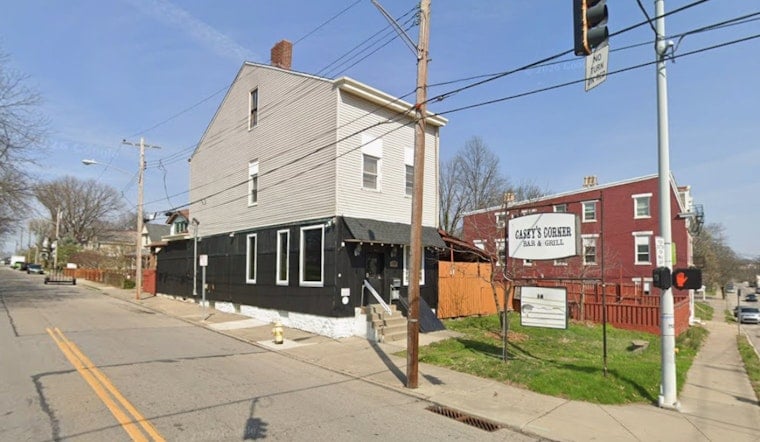
A 130-year-old corner bar in East Price Hill that once poured drinks as Paradise Lounge, Common Roots, and most recently Casey's Corner has a new purpose: growing food, teaching permaculture, and housing student interns. The Cincinnati Permaculture Institute took ownership of the property, along with two adjacent parcels, in March, marking the first time in its 18-year history that the organization has had a permanent physical home.
The nonprofit's acquisition, first reported by Axios, brought together three contiguous properties along Enright Avenue and West Eighth Street: the corner bar building itself, the Growing Value Nursery site at 824 Enright Ave. with its more than 100-year-old greenhouse, and a vacant lot known as the Icehouse. According to the Cincinnati Permaculture Institute, the group had leased space at the site for several years before buying it outright this year, and it voluntarily surrendered the building's liquor license as part of converting the space into an eco-hub.
The corner building at West Eighth and Enright was constructed in 1895 and spent decades as a neighborhood tavern before CPI stepped in, per the organization's own account. Growing Value, the nursery that will now have a permanent home on the site, has operated in the area for roughly 15 years and relocated to East Price Hill in 2021, according to Axios.
A Resiliency Hub Takes Shape
Howie Zuefle, who joined CPI's teaching team and took over as nursery manager in 2024, told Axios he hopes to turn the corner into a resiliency hub where people can gather, learn, and get their hands dirty. Zuefle pointed to the neighborhood's environmental history and its residents' habit of growing tomatoes and other food around their homes as a foundation the project can build on, Axios reported. He also said he has no rigid five-year plan for the space, preferring to let the project develop organically.
CPI plans to host workshops, potlucks, and music at the site, and may eventually offer tea and locally made goods downstairs, according to the same Axios report. The second-floor apartment above the former bar has been converted into dormitory-style housing, part of a new four-season residential permaculture design course the institute launched this year that can house up to four students at a time, per CPI's own materials. Interns living there can both learn from and contribute to the work happening on the property, Axios noted.
Following A Long Local Environmental Tradition
East Price Hill's environmental organizing did not start with CPI. Imago, an ecological education organization founded in 1978 by social workers Jim and Eileen Schenk, now maintains a 37-acre urban nature preserve near Enright Avenue, according to Soapbox. The Enright Ridge Urban Ecovillage, established in 2004 by 19 local residents, has since grown to roughly 200 homes across four dead-end streets dedicated to urban homesteading and green infrastructure, according to Cincinnati Magazine. CPI is connected to the ecovillage, per Axios, giving the new hub roots in a community that has been experimenting with these ideas for decades.
That legacy dovetails with citywide priorities. Roughly a quarter of Cincinnati's population lives in designated food deserts, and in March the city announced plans for three new neighborhood food hubs, including one in East Price Hill, according to WVXU. The station also reported that Cincinnati City Council's 2023 Green Cincinnati Plan set goals of reaching 100% carbon neutrality by 2050, cutting emissions 50% by 2030, and expanding urban tree canopy and community gardens citywide.
Money And Repairs Still Loom
Turning a century-old bar building into a nonprofit gathering space comes with costs. The property needs roof work and a new cooling system, according to Axios, and CPI is exploring grants and fundraising to cover those repairs. Without the commercial revenue a liquor license once provided, how the institute finances that structural work remains an open question.
Zuefle's food-forest experience gives the project some institutional muscle to draw on. In 2024 and 2025, he led grant-funded projects that designed and installed urban food forests alongside 27 neighborhood “Food Champions” across Cincinnati, according to CPI's own account of his work. The East Price Hill hub represents a bet, as Axios put it, that this property's next chapter can put down roots — even as the neighborhood around it continues to shift, from new business openings along Warsaw Avenue to recent public safety concerns nearby.





