

























































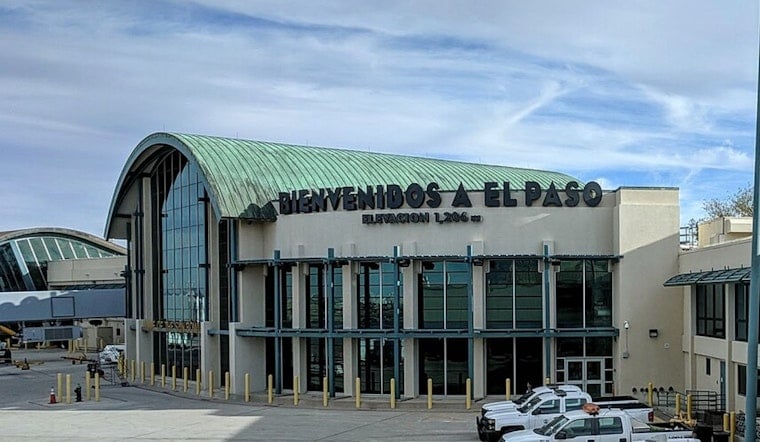
Crews at El Paso International Airport are tearing out old asphalt and pouring new concrete at a tricky five-way taxiway junction, part of a $26.8 million federal project aimed at eliminating a runway safety risk that has concerned aviation officials for years. The work targets pavement near Taxiway J, Taxiway G, and the commercial terminal apron, where overlapping travel paths created what airport officials call a known hazard for aircraft moving across the field.
The project, funded by the Federal Aviation Administration, is formally known as the Five Node Intersection Remediation, according to the City of El Paso. The city says the FAA's Runway Safety Action Team had flagged the five-node area as a critical hotspot precisely because so many aircraft travel paths converge there, raising the odds of a runway incursion. As reported by the El Paso Times, the current phase of construction is focused on ripping out aging asphalt and replacing it with concrete designed to hold up under heavier, more frequent traffic.
Local firm Jordan Foster Construction was selected to carry out Stage 1 of the remediation work, and the El Paso City Council approved a change order in February that set the contract total at $22.85 million, per the city's own records. That change order also aligned airfield signage and taxiway designations with updated FAA advisory standards, addressing not just pavement durability but the labeling pilots rely on to navigate the field correctly.
A Piece of a Much Larger Airport Overhaul
The taxiway fix is only one slice of a much bigger investment plan. The airfield project sits inside a broader $316 million Capital Improvement Program for 2025 and 2026 approved by the El Paso City Council, according to Government Market News. That program allocates $160 million toward airfield safety, $78 million toward non-aeronautical commercial development, and $77 million toward terminal modernizations.
Airfield work is happening alongside major landside development, too. The city broke ground in May on a 250-acre Advanced Manufacturing District at the airport, backed by a separate $25 million federal grant to build facilities for aerospace and defense technology companies, according to a city announcement. The campus is being co-developed with the University of Texas at El Paso, an effort intended to plug local suppliers into national defense supply chains, per reporting from the National League of Cities.
Record Traffic Behind the Push for Safety Upgrades
The urgency behind the taxiway overhaul traces back to just how busy the airfield has become. El Paso International Airport set an all-time annual passenger record in 2024, serving more than 4 million travelers across 97,737 total flight operations, according to Federal Aviation Administration data. It marked the first time in the airport's nearly 100-year history that annual passenger volume topped four million.
Traffic eased the following year slightly, with the airport logging 3,838,519 passengers and 94,499 aircraft operations in 2025, a 4.9% dip from the prior year's record, per the same federal data. Even with that pullback, ELP remains the primary commercial air hub serving West Texas, Southern New Mexico, and Northern Mexico, underscoring why federal officials have continued steering safety dollars toward the field.
More Federal Money and Modernization on the Horizon
This is not the airport's first recent infusion of FAA cash. The agency previously awarded $10.6 million to El Paso International Airport in July 2024 under the Bipartisan Infrastructure Law to build a new general aviation apron and rebuild existing pavement that had exceeded its operational lifespan, according to GP RADAR.
Federal lawmakers are also weighing a separate fix for the airport's air traffic control tower. Legislation introduced in December 2025, known as the El Paso ATC Tower Modernization Act, would authorize federal Treasury funding to replace the airport's aging tower, according to Codify Legal Publishing. El Paso was home to the nation's first 130-foot control tower back in 1968, a structure the bill's backers say now needs a full modern replacement.
Airspace around the airport carries its own built-in complexity that adds weight to the safety-focused spending. The FAA notes that El Paso International Airport sits just 3.5 miles north of the U.S.–Mexico border and under two miles south of Biggs Army Airfield, a proximity that can lead pilots to confuse Runway 4/22 at Biggs with Runway 4/22 at ELP. That tight, overlapping airspace is part of why close attention to ground movement and taxiway clarity carries extra stakes here.
The taxiway remediation also follows other recent capital projects at the airport, including a solar canopy that now shades two parking lots with 5,200 photovoltaic panels generating 2.9 megawatts, enough to cover roughly 22% of the facility's annual power needs. Together, the projects paint a picture of an airport trying to keep pace with both its record crowds and its aging infrastructure at the same time.





