

























































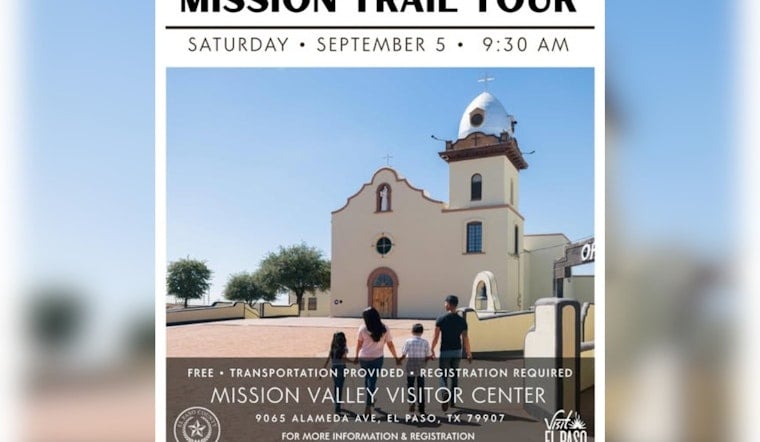
Three churches built centuries apart, connected by a single 9-mile stretch of Socorro Road, will open their doors to a free guided tour on September 5. The outing, organized with participation from El Paso County, starts at 9:30 a.m. at the Mission Valley Visitor Center and takes riders past the region's three active historic missions and other iconic landmarks along the way.
According to the City of Socorro, Texas government, Visit El Paso announced the free guided summer tour to showcase the stories, culture, and heritage of El Paso's Mission Valley. The tour meets at the Mission Valley Visitor Center at 9065 Alameda Ave., and organizers are offering complimentary shuttle transportation for the day, though participants can also choose to follow along in their own vehicles. Riders coming from downtown El Paso can request transportation upon request, and registration is required ahead of time, with questions directed to [email protected].
The visitor center itself sits across the street from the oldest stop on the route. The El Paso Mission Trail Association, a non-profit staffed by volunteers, runs the center seven days a week and works to educate visitors and preserve the corridor's historic sites.
A Church Older Than the United States
The tour's first stop, the Ysleta Mission, traces back to 1680, when Spanish colonizers and Native American refugees fled New Mexico after Indigenous tribes rose in the Pueblo Revolt. Dedicated in 1682, it is recognized as the oldest continuously active Catholic parish in Texas, according to the Conventual Franciscan Friars. The mission was built by the same Indigenous community whose descendants still live nearby today: the Ysleta del Sur Pueblo, also known as the Tigua Tribe, gained federal recognition as a sovereign Native nation in 1987 and remains one of only three federally recognized Native American tribes in Texas, per the Bullock Texas State History Museum.
Further down Socorro Road sits the Socorro Mission, whose current structure dates to around 1840, built to replace an 18th-century church that a Rio Grande flood washed away in 1829. The National Park Service notes that the mission's six-foot-thick adobe walls hold up decorative cottonwood ceiling beams, known as vigas, that were hand-carved by Piro Native American artisans back in 1691 and salvaged for the rebuild.
From Military Garrison to Outlaw Lore
The trail's easternmost stop, the San Elizario Presidio Chapel, has a different origin story altogether. It began in 1789 as a Spanish military presidio named San Elceario, built to defend northern frontier settlements, and the current chapel structure went up in 1877. San Elizario also served as the original county seat of El Paso County starting in 1850, and it's home to the Old El Paso County Jail, where outlaw Billy the Kid famously broke out his associate Melquiades Segura in 1876 without firing a single shot, as previously reported by Hoodline in its coverage of a recent San Elizario cultural event. San Elizario eventually lost its county-seat status to Ysleta and then to El Paso after being bypassed by the railroad in 1881.
Local historical societies also point to an even earlier chapter near San Elizario: an April 30, 1598, Thanksgiving mass and feast held by Spanish explorer Don Juan de Oñate and local Manso Indians, which occurred 23 years before the Pilgrims' gathering at Plymouth Rock, according to the Texas Almanac. The event marked survival after a grueling 50-day desert expedition and the formal Spanish claim known as La Toma.
Part of a Much Larger Historic Route
The 9-mile Mission Trail along Socorro Road, known as FM 258, is itself a segment of something far bigger. It represents part of El Camino Real de Tierra Adentro National Historic Trail, a 404-mile U.S. historic route that Congress designated on October 13, 2000, and which historically stretched 1,600 miles from Mexico City to Santa Fe, per the Bureau of Land Management.
All three churches remain active houses of worship today, privately owned by the Catholic Diocese of El Paso and supported by local parish congregations, with regular services still held at each site. Each is also listed on the National Register of Historic Places, according to Visit El Paso.
The tour arrives as El Paso County has separately rolled out a technical assistance and marketing grant program aimed at small businesses along the Mission Trail corridor, an effort Hoodline detailed in its report on the county's arts and small-business initiatives. The grants are meant to stimulate commerce along Socorro Road alongside the growing heritage tourism drawn by sites like these. It remains to be seen how many visitors the free September tour will attract, or how much the grant funding has helped shop owners along the route so far.


