

























































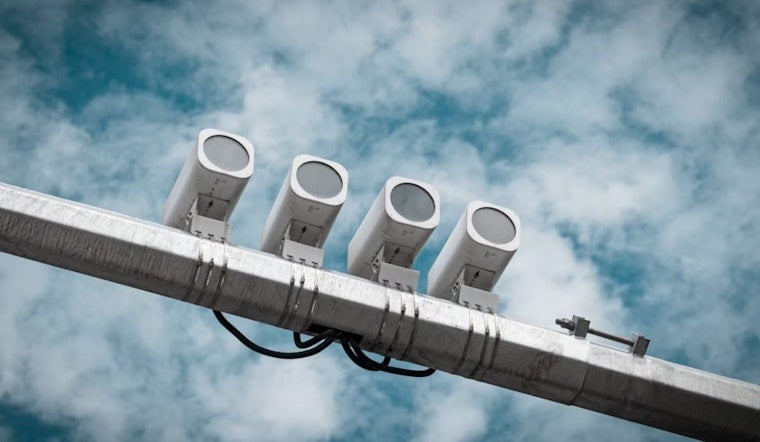
El Paso police are running about 150 automated license plate reader cameras across the city, clustered along Interstate 10, U.S. 54, Montana Avenue, Joe Battle Boulevard, Mesa Street and near the University of Texas at El Paso, yet there is no public map showing exactly where they all sit. Large sections of the city, including most of downtown and long stretches of the Border Highway, have no cameras at all, leaving a patchwork of surveillance rather than blanket coverage.
The cameras, made by the industry-leading company Flock Safety, started going up around El Paso in May 2025, according to the El Paso Times. El Paso police spokesperson Stephanie Shields told the paper the department does not maintain a public map of camera locations, even though the city council authorized the deployment of more than 150 of the devices. The rounded black boxes, usually mounted on roadside poles and topped with a small solar panel, are able to capture a car's plate number, make, model and color, along with details like bumper stickers and body damage, per the same report.
City leaders debated ending the program entirely earlier this year. On March 3, El Paso's city council voted 6-2 to keep the Flock Safety contract in place, according to DeFlock El Paso. Weeks later, on April 28, the city administratively renewed the contract using $693,334 in state grant money and $138,666 in city tax dollars, and added a requirement that future grant applications not be written to exclusively name Flock Safety as the vendor.
Who Pays For It, And Who's Watching
The cameras arrive at essentially no direct cost to El Paso's police budget. The Motor Vehicle Crime Prevention Authority, which the Texas Department of Motor Vehicles operates, awarded a grant covering the entire cost of the department's Flock cameras, according to the El Paso Times. That money traces back to Senate Bill 224, passed by the Texas Legislature in 2023, which raised the annual fee insurers pay per motor vehicle year of insurance to $5, with a portion earmarked for catalytic converter theft detection and vehicle crime prevention, per the Texas Comptroller and the Texas Department of Insurance. The El Paso Police Department's auto theft task force has received more than $2,023,000 in Motor Vehicle Crime Prevention Authority grants, per Texas DMV records cited by the El Paso Times.
Not every agency in the region has opted in. The El Paso County Sheriff's Office confirmed in a February 2026 public records response that it does not subscribe to Flock Safety or participate in its network, according to Gigafact. The sheriff's office also did not immediately respond to the El Paso Times' questions about its use of the technology, and Hector Bernal declined to answer questions about his agency's use of the cameras. That leaves ALPR deployment within the county effectively restricted to municipal police departments, including Horizon City, which contracted for three Flock cameras in November 2024, and Socorro, which runs seven license plate readers through separate vendor contracts, per Gigafact.
Investigators Say The Cameras Have Cracked Cases
El Paso police say the technology has already paid off in serious investigations. The department used Flock cameras to identify a vehicle leaving the scene of a fatal shooting, and footage from the cameras helped investigators identify a suspect in a far east El Paso murder case, according to the El Paso Times. El Paso County Constable's Office Precinct Three also highlighted two cases in which people with outstanding warrants were arrested with help from the cameras, and county constables say they work with El Paso police on investigations using the technology.
Shields told the El Paso Times the system functions as a controlled investigative tool rather than mass surveillance, and said officers are not using the cameras to track community members. She noted that camera placement follows activity hot spots, echoing earlier comments from officer Peter Pacillas in August 2025 that cameras are posted near regional command areas based on where crime activity clusters. Police in El Paso have used license plate reader technology in some form since 2006, per the department, and department policy requires that any search of camera data be tied to a legitimate investigative purpose and connection to a case, with no court-issued warrant needed to run a search.
Privacy Rules On Paper, But No Public Map
El Paso's police department has built a Flock Safety transparency portal outlining safeguards, including retention limits, data ownership protections and oversight measures. According to that portal, department policy explicitly bars using camera data to monitor First Amendment-protected activity, for immigration enforcement, or for civil code enforcement, and the city retains full ownership of the data collected. Camera information is automatically deleted after 30 days unless it has been preserved as evidence in an active investigation, per the department's policy as reported by the El Paso Times.
That 30-day window sits above the new industry baseline. Flock Safety announced on Wednesday that it is shortening its standard default retention period from 30 days to seven days across its national network, automatically purging non-investigative records unless they are preserved under an active case number, according to research published by the American Civil Liberties Union. The ACLU says vehicle information captured nationwide is uploaded into a database searchable by any law enforcement agency with a Flock contract, and that the cameras record and catalog every car that passes into view, not just vehicles connected to crimes. The organization's research found Flock operates more than 120,000 readers across 49 states, yet fewer than 1 percent of all scanned plates nationwide are ever linked to an active crime investigation, warrant or stolen vehicle report.
A Statewide Backlash Is Spreading
El Paso's continued use of the cameras runs against a growing current elsewhere in Texas. Austin allowed its Flock contract to expire after an audit found more than 20 percent of police plate searches lacked documented justification, and San Marcos's city council voted against renewing its contract in late 2025, a decision Hoodline covered in a council stalemate that killed Flock. Austin, San Antonio and Flagstaff have all removed or declined to renew Flock cameras, citing community concerns and vandalism among the reasons, according to the El Paso Times.
The pushback has only intensified in recent days. On August 6, Lago Vista's city council voted unanimously to immediately terminate its Flock Safety contract over privacy and surveillance concerns, while Burnet County sheriff's officials removed all 11 of their fixed Flock cameras earlier this month after repeated vandalism, according to KVUE. In public testimony this month, attorneys with the Texas Civil Rights Project urged Texas local governments to reject ALPR networks entirely, citing audit records in major Texas cities showing nearly 300,000 searches conducted without any recorded justification or case number.
Civil rights organizations have raised broader concerns that the networks violate constitutional protections, and DeFlock, a crowdsourced tracking project that relies on community members reporting camera sightings, shows nearly 400 Flock and similar cameras spanning from Las Cruces to Tornillo, according to the group's own data. DeFlock does not include information from private companies or government agencies, meaning its count reflects only what volunteers have documented. Other companies making similar readers include Motorola Solutions, Leonardo US Cyber and Security Solutions LLC, and Genetec, per the El Paso Times, underscoring that Flock Safety is not the only vendor operating in this space even if it remains the dominant one.
For now, El Paso residents curious about where the cameras sit near their own routes have no official map to consult, only the scattered locations acknowledged by police and the crowdsourced entries compiled by outside groups. Along Interstate 10 alone, there are more than 20 cameras between the Texas-New Mexico line and far east El Paso County, with at least 25 more along U.S. 54 and more than 15 on Joe Battle Boulevard, according to the El Paso Times. In West El Paso, the intersection of Redd Road and Resler Drive alone has four cameras pointing in four directions, a level of concentration that residents can currently learn about only through news reporting and volunteer-run trackers rather than any city-published map.





