

























































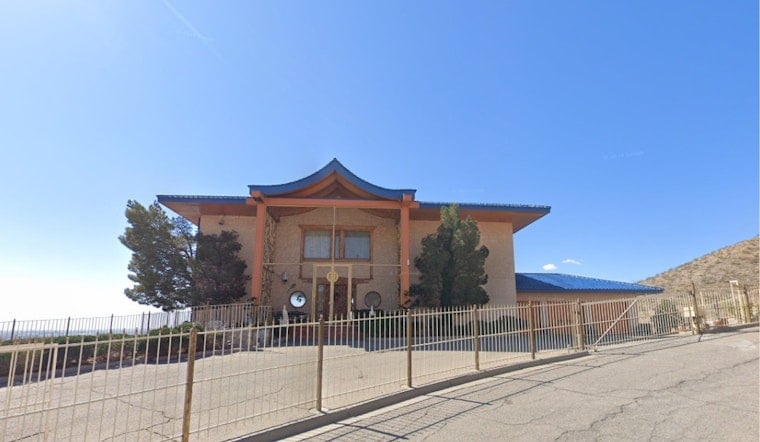
For years, drivers gazing up at the Franklin Mountains from central El Paso have spotted it: a sprawling estate with blue tile roofing perched near the Star on the Mountain, sparking rumors about secret tunnels and hidden rooms. Now the 7,410-square-foot mansion at 2300 Red Sky Lane finally has a public price tag and a name attached to the mystery — the Farah House, listed for $1.925 million.
The listing, first reported by KLAQ El Paso, comes from Cap Rate Real Estate Group and puts the property at roughly $260 per square foot, according to HAR.com. The gated home sits on a 0.83-acre lot spanning two platted properties in El Paso's Highlands subdivision, just off Scenic Drive near the iconic Star on the Mountain landmark. Built in 1986, the three-level residence includes four bedroom suites, six bathrooms, a library, a wine cellar, a theater lounge, an executive office, a fitness room, and panoramic terraces, per the listing.
A House Built Into the Mountain Itself
The Farah House isn't just perched on the hillside — it's anchored into the Franklin Mountains with massive steel columns and reinforced concrete, according to KLAQ's reporting. Inside, the finishes reflect serious money: Italian marble floors, German granite, custom woodwork, gold inlays, silk-lined walls, and blue roof tiles imported from Japan. A resort-style pool and spa round out the grounds, and the home was once featured on the cover of El Paso's The City Magazine in its Spaces edition, per HAR.com.
Local lore around the house has only grown with its visibility from the valley below. Stories passed around El Paso describe secret rooms, strange controls, hidden pathways, and even tunnels supposedly leading into the mountain itself, KLAQ notes. One detail that's actually documented: a massive marble dining table was reportedly lowered into the house by crane during construction, too large and heavy to be carried in through any door.
The Woman Who Built It
The mansion was designed for Virginia H. Farah, whose family name is inseparable from El Paso's industrial history. Farah Manufacturing began in October 1920 when Lebanese immigrants Mansour and Hana Farah opened a 1,250-square-foot shop on San Francisco Street, where seamstresses sewed blue chambray work shirts for 35 cents each, according to the Texas State Historical Association. After federal prison labor undercut shirt prices in the 1930s, the company pivoted to blue denim work pants, eventually growing into Texas's second-largest employer and El Paso's largest civilian employer, with 11 plants — five of them in El Paso — and up to 9,500 workers worldwide.
That growth came with a defining reckoning. From May 1972 to March 1974, roughly 4,000 Farah Manufacturing workers, about 85 percent of them Chicana women, staged a historic strike and national boycott over low wages and strict production quotas, according to the Texas State Historical Association. The boycott reportedly cost the company an estimated $20 million in lost sales before CEO Willie Farah recognized the union and signed a contract in 1974 — a pivotal moment in American labor and civil rights history. Farah Incorporated later stopped operating as an independent company after being acquired by Tropical Sportswear International in 1999, with the brand name eventually landing at Perry Ellis International, per the El Paso Museum of History.
Grief, Faith, and a Foundation
Virginia Farah's own story carries its share of sorrow. She was widowed at 33 when her husband, James Farah, then president of Farah Manufacturing, died suddenly in 1964; James had been the elder son of company founder Mansour Farah and had directed the company's administrative operations starting in 1937. Virginia later outlived both of her sons, according to the Texas State Historical Association.
The daughter of Orthodox priest Father Nicholas Husson, Virginia Farah channeled her faith into philanthropy. She established the Virginia H. Farah Foundation as a nonprofit in 1983, initially funding scholarships at UTEP, and fully endowed it through a testamentary gift after her death in June 1991, directing its grantmaking toward projects supporting the Orthodox Christian Church worldwide, according to the Virginia H. Farah Foundation.
The Bodyguard Who Confessed to Killing JFK
Perhaps the strangest chapter tied to the Farah name involves a man Virginia Farah once employed as a bodyguard: Charles Harrelson, who was later convicted of murdering federal judge John H. Wood Jr. On September 1, 1980, Harrelson was taken into custody following a six-hour standoff with law enforcement near Van Horn, Texas, while high on cocaine, hallucinating FBI agents, and threatening suicide, according to the Texas State Historical Association. Virginia Farah was brought in to help negotiate his surrender.
During the standoff, Harrelson drew national attention by claiming he had assassinated President John F. Kennedy in addition to Judge Wood, though federal investigators later discounted any involvement in the Kennedy assassination, per Wikipedia. Harrelson was convicted in federal court in December 1982 and sentenced to two consecutive life terms. He was also the father of actor Woody Harrelson.
Today, the mansion he once guarded as a bodyguard's former employer stands quietly for sale above the city, its blue roof tiles still catching the eye of anyone driving through central El Paso. Whoever buys the Farah House will be taking on more than marble floors and mountain views — they'll be inheriting a piece of El Paso history that stretches from a 1920s shirt shop to a hostage standoff in the West Texas desert.





