

























































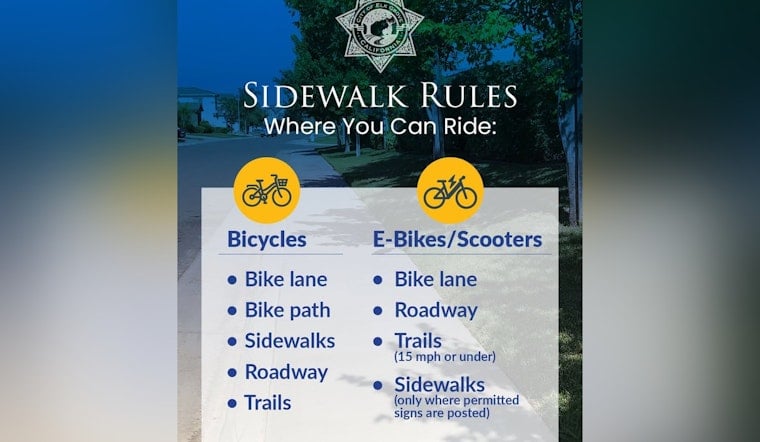
Elk Grove is moving toward a major overhaul of how e-bikes and motorized scooters can be used on its streets, sidewalks and trails, after the city recorded a sharp jump in crashes involving the devices. Bicycle-related collisions in Elk Grove climbed from 51 in 2023 to 110 in 2025, and the Elk Grove Police Department has logged a significant increase in calls for service mentioning e-bikes and scooters, according to the city. The Elk Grove City Council is now set to weigh in on a proposed policy that would ban the devices from most public sidewalks, restrict which e-bikes can use local bike paths, and boost penalties for violations.
As reported by Abridged, PBS KVIE's public affairs outlet, the draft ordinance would still allow regular bicycles on sidewalks, preserving a longstanding city rule, but it would bar e-bikes and motorized scooters from most sidewalks while carving out exceptions on some public sidewalks if extra signage is installed. Any e-bike riders permitted on those designated sidewalks would be required to yield to pedestrians. The policy would also ban bikes capable of producing more than 750 watts from the city's separated bike paths, along with gasoline-powered bikes, while allowing some gasoline-powered and high-powered bikes to use roadside bike lanes instead.
City staff have framed the shift as a balancing act. A city staff report said e-bikes and scooters provide mobility and environmental benefits, but that increased use has created new safety considerations the city must address. The proposal would also prohibit reckless riding, unauthorized racing, trick riding and other unsafe riding behaviors, and it would give city authorities the power to impound e-bikes used in violation of the new rules, with the potential for additional impoundment fees layered on top of other penalties.
A Reversal From the City's E-Bike Push
The proposed crackdown marks a notable turn for a city that, not long ago, was actively encouraging residents to buy and ride e-bikes. Elk Grove used $200,000 in federal grant funding to launch an e-bike lending fleet in late 2024 as part of its Climate Action Plan, a program that logged more than 1,600 miles in its first six months, according to CBS Sacramento. The city also offered local vouchers worth up to $1,000 toward e-bike purchases around the same time.
Even as it promoted adoption, Elk Grove had already begun tightening enforcement on the ground. The Elk Grove Police Department and Elk Grove Unified School District launched a joint safety campaign at middle and high schools in January, running a 30-day education phase before shifting to zero-tolerance enforcement against unsafe e-bike and scooter riding, as Hoodline previously reported. That campaign followed targeted patrols around school bike racks after a noticeable rise in community complaints and traffic incidents involving youth riders, per the Elk Grove Citizen.
The Legal Line Between E-Bikes and E-Motos
Much of the debate hinges on distinguishing standard e-bikes from far more powerful devices sometimes marketed to look like ordinary bicycles. Under state regulations that took effect January 1, California Vehicle Code Section 312.5 classifies electric two-wheelers exceeding 750 watts or 28 mph as off-highway electric motorcycles, or e-motos, banning them from public roads and requiring off-highway vehicle registration, according to the California Highway Patrol.
Research is backing up the push to focus enforcement on those over-powered devices rather than standard e-bikes. A December 2025 study commissioned by the California Legislature and conducted by the Mineta Transportation Institute found that over-powered, illegal devices drive most safety concerns, and that conventional pedal bicycle injuries actually resulted in nine times more emergency room visits statewide than e-bikes in 2023. Researchers cautioned lawmakers against overly broad bans on standard e-bikes, urging a narrower focus on e-motos instead.
Separately, under California Vehicle Code Section 21207.5, Class 3 electric bicycles capable of pedal assistance up to 28 mph are banned by default on off-street bike paths and multi-use trails unless a city explicitly passes an ordinance permitting them, according to the San Mateo County Harbor District. That framework leaves trail access inconsistent from one California city to the next, since it hands local agencies wide discretion over path rules.
Regional Districts and Neighbors Have Already Acted
Elk Grove's proposal follows a wave of similar moves across the Sacramento region. San Juan Unified has barred K-8 students from using higher-level electric bikes, mandated helmets for students who do ride e-bikes, and now requires students with e-scooters to hold a driver's license. In West Sacramento, Washington Unified has banned younger students from using e-bikes capable of exceeding 20 mph.
Sacramento County has also moved to stiffen penalties on its trails. Effective June 12, the county updated its regional park ordinances to escalate violations for riding high-powered e-bikes, e-motos and motorized dirt bikes in protected areas of the American River Parkway, turning some infractions into potential misdemeanors carrying fines or jail time, according to Sacramento County Regional Parks. The Board of Supervisors acted after unauthorized trail construction and high-speed riding caused environmental damage and safety risks.
Nearby Rocklin has seen its own campus fallout from the trend. A school district ban on throttle-equipped e-bikes thinned campus bike racks there in early 2026, after local police data showed 68% of the city's 2024 bicycle collisions involved e-bikes, with 13 of 17 injury crashes involving juveniles, as Hoodline reported in March.
State Lawmakers Racing Toward an August Deadline
Elk Grove's local rulemaking is unfolding alongside a flurry of activity in Sacramento at the state level. California legislators must pass bills and send them to Gov. Gavin Newsom's desk by August 31, and several e-bike-related measures are in the mix. Assembly Bill 1557, introduced in January, would cap electric bicycle motors at 750 watts of peak power and reclassify higher-output devices as mopeds or motor-driven cycles subject to DMV registration and driver licensing.
Other pending bills could let cities set their own e-bike speed limits, require license plates for certain e-bikes, or mandate that manufacturers provide additional disclosures to buyers. Assembly Bill 1569, which already awaits a decision from Newsom, would require e-bike education for children who park their bikes at school. Meanwhile, Senate Bill 1167, reviewed by legislative committees in May, seeks to implement the Mineta Transportation Institute's recommendations by clarifying that two-wheeled, powered bicycle-shaped devices exceeding 750 watts or 28 mph fall outside legal e-bike classifications. The Metropolitan Transportation Commission has endorsed that bill as a way to preserve active transportation goals while curbing dangerous high-speed devices on multi-use paths.
Locally, the groundwork for Elk Grove's ordinance was laid over the summer. On July 20, the city's Trails Committee held an advisory meeting to review draft municipal code amendments regulating e-bikes and personal transportation devices, with city staff presenting the draft text to community stakeholders before forwarding recommendations to the City Council, according to the City of Elk Grove. The full City Council is now expected to weigh in on the stricter rules for e-bikes and personal transportation devices.




