

























































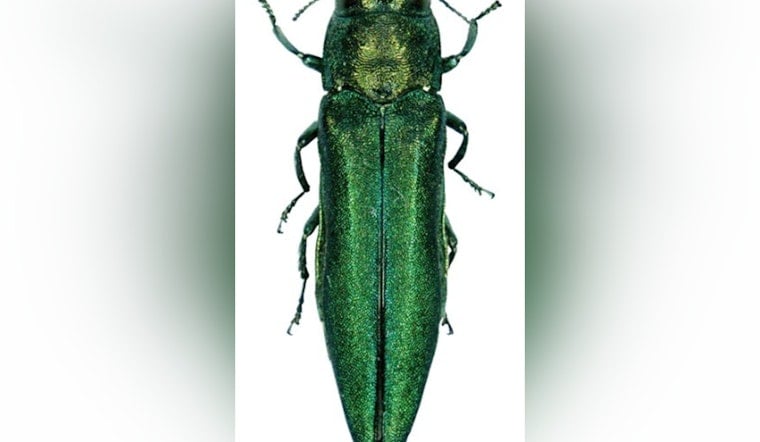
Oregon forestry officials have confirmed the emerald ash borer in Salem and Beaverton for the first time, marking a significant expansion of the invasive beetle's footprint across the Willamette Valley. The confirmations came in July, and the destructive insect has also turned up along the Banks-Vernonia State Trail, the first Oregon state park where it has ever been found.
The new detections push the known range of the beetle to five Willamette Valley counties, according to KPTV. Forestry officials say the emerald ash borer is now present in Washington, Clackamas, Multnomah, Yamhill, and Marion counties, and a permanent quarantine covering those same five counties restricts the movement of firewood from hardwood trees as well as parts of ash, olive, or white fringetree. Beyond Salem and Beaverton, the beetle was also found for the first time this year at Bethany Lake Park in Rock Creek and at the Oregon Garden in Silverton, while Jackson Bottom Wetlands Preserve has a suspected detection still awaiting official state confirmation.
A Beetle That Kills Nearly Every Host Tree
Kat Bethea, an emerald ash borer specialist with the Oregon Department of Forestry, said any ash tree can be infested, including native Oregon ash as well as non-native street, park, and yard trees, per the same KPTV report. That warning carries weight given how the pest behaves once it settles in: in areas where the emerald ash borer becomes established, it kills more than 99 percent of host ash trees within three to six years, according to the Tualatin Soil and Water Conservation District. The larvae feed on the inner bark and phloem, carving S-shaped galleries that block a tree's ability to move water and nutrients.
The stakes extend well past dead street trees. Oregon ash, the Pacific Northwest's only native ash species, is a critical riparian tree that shades streams to keep water temperatures low enough for threatened salmon and trout, according to the Center for Invasive Species Prevention. Losing that streamside canopy across Willamette Valley watersheds can raise water temperatures and worsen erosion, putting additional pressure on already-vulnerable fish populations.
From Forest Grove to a Statewide Problem
Oregon's outbreak began in Forest Grove in 2022, where the beetle was first detected in the state. State contractors later removed 215 infested ash trees across 36 private and public properties during a winter dormant season and provided grant-funded replacement trees, according to the Oregon Association of Nurseries. Nationally, the emerald ash borer has killed more than 100 million ash trees across more than 30 states since it was first detected near Detroit, Michigan, in 2002, making it the most destructive forest insect pest in U.S. history, per research published in Oxford Academic.
Traps set in spring 2026 helped surveyors pinpoint the newest infestations. Forestry officials are urging residents to report potential sightings and prefer reports that include a clear photo to assist with identification, KPTV reports. Sightings can be reported online at oregoninvasiveshotline.org or by calling 1-866-INVADER.
Cities Scramble to Protect High-Value Trees
Salem has halted new ash plantings and begun pre-emptive removals of unhealthy trees while starting insecticide injections to protect roughly 1,200 high-value ash trees, according to KPTV. The city has inventoried nearly 4,000 public ash trees as it works to get ahead of the infestation. That treatment approach mirrors the state's broader containment strategy: Oregon forestry officials are managing the outbreak through the Slow Ash Mortality, or SLAM, framework, which combines trunk injections of systemic emamectin benzoate with girdled trap trees to concentrate and suppress beetle populations, according to research posted on PDXScholar.
Beaverton has taken a similar path, inventorying 2,000 street trees and treating 600 of them so far, with the tree treatments funded by a grant. Because ash, olive, and white fringetree all belong to the Oleaceae family and can host the beetle, Oregon's quarantine restrictions extend beyond ash to cover cultivated olive trees and white fringetrees as well, according to the Oregon Department of Agriculture.
Steep Penalties and Seasonal Trimming Limits
Violating Oregon's permanent quarantine rules, such as moving restricted wood or nursery stock outside quarantined counties, can bring civil penalties of up to $10,000 per violation under Oregon Administrative Rule 603-052-1075, according to the City of Lake Oswego. To keep adult beetles from emerging and spreading during their active flight season, state guidelines also restrict the felling or pruning of ash, olive, and white fringetrees between April 1 and September 30.
To manage infested wood without violating those same quarantine boundaries, state and local agencies have deployed portable air curtain incinerators that burn infested ash trees on-site at high temperatures, destroying wood-boring larvae while curbing smoke pollution, as reported by the Forest Grove News-Times. Oregon's multi-agency EAB Task Force also maintains an interactive public map at OregonEAB.com, letting property owners check confirmed detections and gauge their proximity to infested trees, according to the Oregon Department of Forestry.





