

























































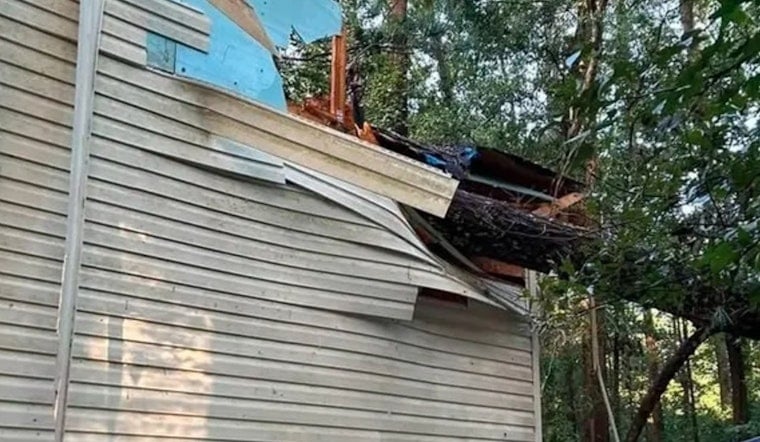
A pine tree roughly 18 inches wide crashed through the roof of a Monroe, Georgia home during overnight storms nearly two weeks ago, tearing a massive hole into the house and crushing the bedroom of a disabled, non-verbal girl named Mckenna. She survived the collapse without injury, but her family has been displaced ever since, still searching for a new place to live while managing her medical needs from wherever they can find shelter.
The tree came down during a bout of severe weather that hit northwest Walton County, according to the Walton County Emergency Management Agency, which reported that overnight storms dumped 2 inches of rain in a short burst and brought 17 mph winds to the area, downing nine trees across the county. One of those trees, the 18-inch pine, slammed directly into the Monroe home, according to the agency's report. County emergency officials confirmed that no injuries resulted from the storm damage overall, even as the collapse caused long-term displacement for the family living there.
Debbie Genn, who lived in the home with her daughter, son-in-law, and three children, told FOX 5 Atlanta that the family heard a very large crash during the storm. Mckenna's aide was in her room at the time the tree came through the roof, and Jeremiah Holliday said everyone in the household survived the collapse without injury. What kept Mckenna from serious harm, according to the family, was a safety panel built into her bed that prevented the ceiling from collapsing directly onto her.
A Bed Designed to Protect
Enclosed safety beds like the one credited with shielding Mckenna are built specifically for children with disabilities who need protection from nocturnal injuries. Devices such as Cubby Beds and The Safety Sleeper use tensioned fabric canopy walls, heavy-duty frames, and zippered safety panels, according to research published by PubMed Central, which notes the panels are engineered in part to keep falling objects from striking a sleeping child directly. The beds are frequently prescribed for children with pediatric neurodisabilities to support both sensory regulation and physical safety.
For the Holliday family, the home was more than a structure. Jeremiah Holliday said its destruction has been emotional because his marriage and family life have been centered there, and the family has lived in the home since their children came home from the hospital. Mckenna's parents said the sudden displacement disrupted her routine and complicated the ongoing management of her medical needs and doctor appointments, a burden Genn echoed in describing how the family must now juggle those appointments while displaced.
Where the Family Goes Next
The family's current lodging remains unclear, and it is not yet known where they are staying as they search for a new place to live. The total cost of the storm damage also remains unknown. The family has set up a GoFundMe campaign to help cover expenses as they try to rebuild, and Mckenna has experienced emotional distress after losing her home, according to the family's account.
Whether the family can recover repair costs from an insurer may hinge on a legal doctrine unique to Georgia. Under the state's fallen tree responsibility rules, a healthy tree that topples onto a home during a storm is generally treated as an “Act of God,” meaning the owner of the damaged property, not the tree's original owner, bears financial responsibility for repairs and cleanup, according to Flint, Connolly & Walker, LLP. That responsibility can shift only if the property owner had prior written notice or visible evidence that a tree was dead, diseased, or structurally decayed before it fell, according to Davis & Associates, which notes that written warnings or arborist evaluations serve as primary evidence of negligence in Georgia courts. It remains an open question whether the pine that hit the Holliday home showed any such prior signs, or where exactly it stood before the storm.
Rising Costs Compound the Blow
Georgia homeowners filing storm claims do have some protections. State law allows policyholders to claim up to a 50% penalty plus attorney fees if an insurer denies a valid claim in bad faith after 60 days, per the Property Insurance Coverage Law Blog, though officials advise documenting all damage with photographs before cleanup begins. Those protections come as Georgia homeowners face a steep rise in premiums, with U.S. Treasury data cited by the Atlanta Journal-Courier showing statewide home insurance costs surged roughly 40% between 2020 and 2025 amid compounding severe weather losses and rising construction costs.
The financial strain lands hardest in Monroe itself, where the 2024 median household income was $44,656 and the poverty rate stood at 33.8%, according to U.S. Census Bureau estimates, well below Walton County's overall median household income of roughly $76,500. For a family already managing a disabled child's medical needs, out-of-pocket deductibles and temporary lodging costs can compound quickly. The American Red Cross of Georgia offers displaced families temporary emergency lodging, financial grants for essential supplies, replacement of lost prescription medications, and disaster mental health counseling, with caseworkers helping build longer-term recovery plans.
Part of a Rough Summer for Storms
This is not the first time Monroe has been hit hard this summer. In July, a localized downburst downed multiple trees along Alcovy Street and Ammons Bridge Road, blocking roads and damaging nearby residential structures, with emergency crews spending hours clearing the debris. Damaging thunderstorm winds strike north and central Georgia an average of 19 days per year, with activity peaking in July and August, according to the National Weather Service, which has recorded more than 500 wind damage events in the region during July over a 40-year span. Hoodline previously reported on hail and howling winds slamming Monroe in July, part of a pattern of severe weather that has repeatedly battered trees and homes across the region this season.





