

























































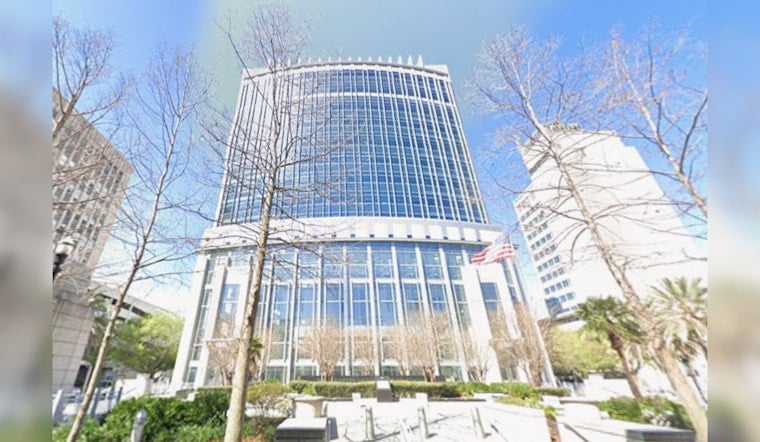
Federal, state and local law enforcement officials are set to announce charges Monday against members of a violent drug trafficking organization operating in Northeast Florida, with U.S. Attorney Gregory W. Kehoe leading a press conference at the United States Courthouse on Hogan Street in Jacksonville at 1:30 p.m. Officials plan to announce the unsealing of a federal indictment tied to the organization, though the group's name, alleged drug quantities and total number of defendants have not yet been made public.
According to News4JAX, the announcement will bring together Kehoe with Jacksonville Sheriff's Office Undersheriff Shawn Coarsey, Nassau County Sheriff's Office Undersheriff Jon Hooper, and Drug Enforcement Administration Assistant Special Agent in Charge Christopher Whitley. News4JAX plans to stream the announcement live. As U.S. Attorney for the Middle District of Florida, Kehoe oversees a district covering 35 counties and more than 11.5 million residents, according to the U.S. Department of Justice, with division offices in Jacksonville, Tampa, Orlando, Ocala and Fort Myers.
A Pattern of Coordinated Federal Crackdowns
Monday's announcement follows a string of recent federal actions across the region. Just days earlier, on August 5, Kehoe announced federal drug conspiracy charges against five people operating a fentanyl and cocaine trafficking ring in Pasco County, an investigation carried out under Executive Order 14159's Homeland Security Task Force initiative that involved the FBI, Homeland Security Investigations, the DEA, the U.S. Postal Inspection Service and local sheriff's deputies, per the department's own announcement. That kind of joint federal-local messaging is a familiar strategy for Kehoe. In July 2025, he hosted a similar joint press conference in Jacksonville to announce federal indictments against a local gang and drug trafficking organization, a tactic designed to signal that federal prosecution resources are backing up local police efforts.
Northeast Florida's Cartel-Linked Drug Pipeline
Northeast Florida has repeatedly been the target of major multi-agency counter-narcotics operations in recent years. In January 2025, the Jacksonville Sheriff's Office and its regional partners wrapped up Operation Jacob's Ladder, a long-running investigation that dismantled a Jacksonville drug ring with ties to Mexico's Gulf Cartel, seizing over 1 million lethal doses of fentanyl, 74.5 kilograms of cocaine, 13 firearms and $212,000 in cash, per an earlier Hoodline report on the Jacob's Ladder bust.
Just last summer, five people from Jacksonville and Sumterville pleaded guilty in federal court to running a multi-kilogram fentanyl trafficking organization that moved cartel-supplied narcotics from Mexico through Houston and into Duval and Clay Counties via commercial flights, according to court documents cited by News4JAX. Prosecutors said the ring's leader coordinated border drug transactions using a contraband cellphone while already serving time in federal prison.
Locally, Jacksonville Sheriff's Office narcotics detectives executed an apartment search last month on North Main Street that turned up roughly 4 kilograms of suspected fentanyl, a firearm and more than $60,000 in cash, leading to two arrests connected to a broader trafficking probe, Hoodline reported at the time in its coverage of the North Main Street raid. Under Florida law, possessing or distributing 28 grams or more of fentanyl is treated as a severe trafficking offense.
What Federal Conspiracy Charges Could Mean
Whatever the specifics of Monday's indictment turn out to be, the legal exposure for those charged is likely to be steep. Federal conspiracy charges under 21 U.S.C. § 846 carry the same statutory penalties as if a defendant had completed the underlying drug distribution offense, even without proof that person ever physically handled the drugs, according to the Law Offices of Michael Lowe. Prosecutors need only prove an agreement to violate drug laws, not an overt act of distribution.
Federal sentencing guidelines set out in 21 U.S.C. § 841 mandate minimum prison terms of 10 years up to life for trafficking 400 grams or more of fentanyl or 5 kilograms or more of cocaine, per the United States Sentencing Commission. Smaller thresholds, including 40 grams of fentanyl or 500 grams of cocaine, still trigger a mandatory five-year minimum. Anyone convicted would serve that sentence without the possibility of parole, since federal parole was abolished for offenses committed after November 1987 under the Sentencing Reform Act, according to the law firm Boyle & Jasari — leaving federal inmates limited to earning at most 54 days per year of good conduct credit toward their sentence.
These kinds of prosecutions are typically run through the Organized Crime Drug Enforcement Task Forces program, a prosecutor-led model that pools resources across the DEA, FBI, ATF and HSI alongside local sheriff's offices, per the Department of Justice. Key details of Monday's case — including the trafficking organization's name, any cartel affiliations, the specific drugs and quantities alleged, whether firearms or violence factor into the charges, and the total number of co-defendants — remain unknown until officials unseal the indictment at the Hogan Street courthouse.





