

























































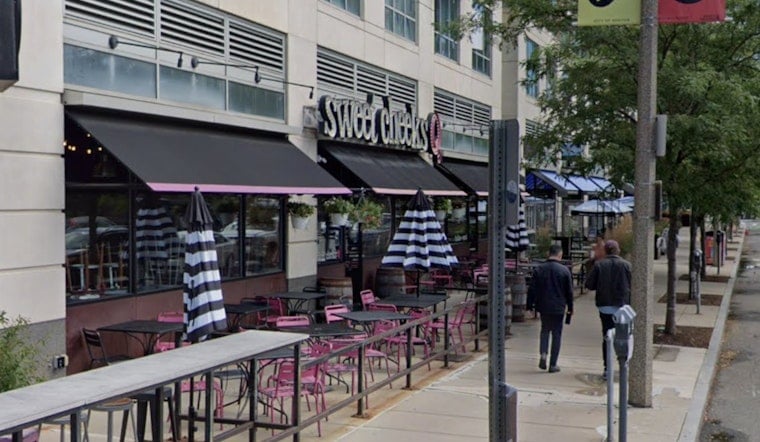
Sweet Cheeks Q, the barbecue joint that helped kick off Fenway’s dining boom 15 years ago, will serve its last plate on November 24, and sister restaurant Fool’s Errand is closing later this year too. Chef Tiffani Faison announced she will not renew the lease on Sweet Cheeks Q, ending a run that made the Boylston Street spot one of the neighborhood’s longest-tenured restaurants.
Faison broke the news in a report from Boston.com, which first detailed the closures of both Sweet Cheeks Q and Fool’s Errand, the latter of which shares a liquor license with its barbecue neighbor. Sweet Cheeks Q employs about 45 people, and Faison plans to move them into other restaurants under her Big Heart Hospitality group, according to the outlet. She told Boston.com she is actively searching for a new location to reopen Sweet Cheeks Q elsewhere, though nothing has been finalized.
The closures mark the end of Faison’s 15-year run as an owner-operator in the Fenway Triangle, the 700,000-square-foot mixed-use development built by Samuels & Associates that helped spark the neighborhood’s post-2010 dining revival. Sweet Cheeks Q was one of the project’s earliest anchor restaurants, and Faison went on to own and operate four concepts within the development over the years, per Boston.com.
A String of Fenway Departures for Faison
This is not Faison’s first exit from the neighborhood. Her Southeast Asian restaurant Tiger Mama, which opened four years after Sweet Cheeks Q, closed in 2021, followed by Italian spot Orfano in 2022, and the Fenway location of her pizza parlor Tenderoni’s in June 2024 — a closure Hoodline reported at the time. Tenderoni’s food hall counter at High Street Place remains open even as its original Fenway storefront is long gone.
Sweet Cheeks Q had recently been named the city’s best barbecue restaurant in Boston Magazine’s 2026 Best of Boston awards, according to Boston.com, and Faison herself has a national profile that predates her Fenway ventures — she rose to prominence as runner-up on the first season of Bravo’s Top Chef in 2006 and has since picked up four James Beard Award nominations for Best Chef: Northeast between 2018 and 2022, per her Wikipedia biography.
Faison Points to Rent, Food Costs and Tariffs
Faison told Boston.com that restaurant costs have become prohibitive, pointing to rising food prices, higher fuel charges tied to the closure of the Strait of Hormuz and expensive gas, and tariffs she now pays on imported goods. She called the current restaurant environment unsustainable, and said she hopes Boston Mayor Michelle Wu will hear small business owners’ frustrations, according to the outlet.
Faison also said she wants policy support for local restaurateurs similar to affordable-housing requirements, and she advised diners to visit their favorite restaurants on slow nights — even suggesting that showing up on Monday evenings can be the difference in keeping a restaurant afloat, per Boston.com’s reporting.
Faison Joins a Wider Wave of Boston Closures
Faison is far from alone. Colin Lynch, Heather Kennaway Lynch and Jefferson Macklin of Traveler Street Hospitality declined to renew leases on three South End restaurants — Bar Mezzana, No Relation and Shore Leave — citing affordability, a decision Hoodline covered when it was announced in late July, with all three set to close on January 1, 2027. That group also closed its Allston pizzeria FiDO in June 2026 after less than a year in business.
Fenway itself has seen a string of long-running restaurants exit the neighborhood this year, including Regina Pizzeria’s March departure after 13 years on Boylston Street and Woody’s Grill & Tap’s May shutdown after nearly three decades on Hemenway Street. Departing owners in both cases cited rising rent, utility costs, and debt burdens as primary drivers, according to Hoodline’s earlier reporting. Boston Globe food critic Devra First wrote in an August analysis that the city’s independent restaurant industry has reached a tipping point, driven by soaring rents, fluctuating ingredient costs, high licensing fees and thin profit margins.
Liquor Licenses and Landlord Moves
Part of the financial squeeze traces back to Massachusetts’ Prohibition-era liquor license quota, which has pushed secondary-market prices for unrestricted all-alcohol licenses in Boston as high as $600,000. City and state leaders approved hundreds of free, non-transferable neighborhood liquor licenses in 2024 and 2025 to try to ease that burden on local restaurateurs.
Not every Fenway dining story this year has ended in closure. Samuels & Associates, the neighborhood’s dominant landlord, stepped in this past January to take over operations of the 27,000-square-foot Time Out Market food hall just one day before its scheduled shutdown, preserving space for more than a dozen local vendors, Hoodline reported at the time. It remains an open question whether the developer will pursue a similar rescue — or bring in national chains — for the Boylston Street space Sweet Cheeks Q is leaving behind.
Faison's Pivot Toward Food Halls
Faison’s broader company, Big Heart Hospitality, now employs about 130 people across its concepts, which include Charming Gardener, The Temp Agency, Bubble Bath, Dive Bar and Tigerbaby, according to Boston.com. Several of those newer concepts reflect a shift toward lower-overhead food hall stalls rather than standalone restaurants: Tenderoni’s, Dive Bar, Bubble Bath and Tigerbaby all operate out of High Street Place in Downtown Crossing, which was voted the No. 1 food hall in the country in USA Today’s 2026 readers’ poll, as Hoodline reported in April.
Faison has kept other Big Heart Hospitality developments under wraps for now, per Boston.com, even as she continues to search for a new Sweet Cheeks Q location. Fool’s Errand’s closing date later in 2026 has not yet been set, and it is unclear whether Boston officials will introduce commercial rent or tax relief measures for independent restaurateurs facing the same pressures Faison described.





