

























































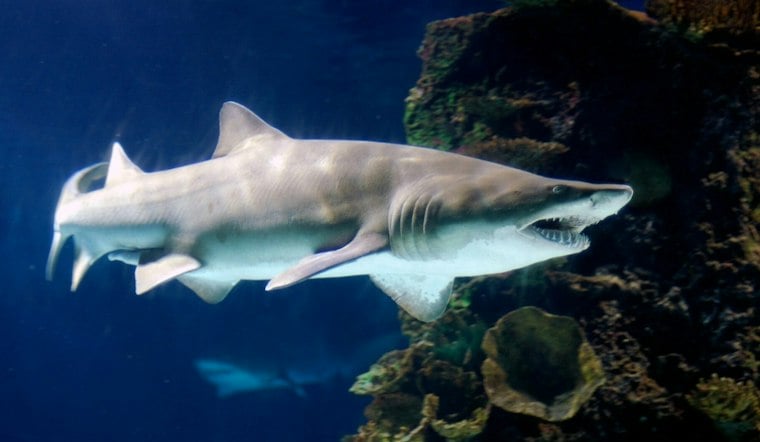
Every summer for nearly a decade, researchers have slipped into a sheltered inlet of Boston Harbor to hunt for something most people would rather avoid: sand tiger sharks. The sharks keep coming back, drawn by calm water, plentiful prey, and the absence of bigger predators, and this year the team tagged four new juveniles to add to a growing tracking effort.
The work is led by Ryan Knotek, a New England Aquarium researcher, and Emily Jones, both of whom work for the Anderson Cabot Center for Ocean Life, according to WBUR. Jones told the station the inlet is sheltered, lacks large sharks, and offers steady prey, making it an ideal spot for young sand tigers to grow before they venture into open water. The station reports the research team has tagged and tracked juvenile sand tiger sharks in Boston Harbor for almost ten years, watching the same population of young sharks return as the weather warms each year.
A Species Still Recovering From Decades of Overfishing
Sand tiger sharks were nearly wiped out along the East Coast, with the population dropping more than 70% before federal and state regulations banned fishing them starting in the late 1990s, WBUR reports. NOAA Fisheries formally added the species to the federal prohibited Atlantic shark list in 1997, banning all retention, landing, and sale after historical declines exceeding 70 percent, according to NOAA Fisheries. Knotek said protections lasting nearly two decades are associated with a recovery in sand tiger shark numbers, the station reports.
That recovery remains fragile. The International Union for Conservation of Nature lists sand tiger sharks as critically endangered globally, per the station's report, and the National Aquarium notes the group estimates global populations have declined more than 80% over a 74-year evaluation period due to commercial bycatch and slow reproduction. Part of the problem is biological: female sand tigers give birth to only one or two pups every two to three years because of an unusual process called intrauterine cannibalism, in which the first embryo to hatch in each uterus consumes its smaller siblings and unfertilized eggs, according to CBS News.
How the Tagging Actually Works
To catch the sharks, researchers rely on frozen pogies, a favorite food of sand tigers, as bait, per the same account. Once a shark is hooked, it receives an acoustic transmitter inserted through a small belly incision, which allows researchers to track it going forward, the article notes. Receivers positioned around the harbor detect the transmitter signals and record which animal passed by and when.
The New England Aquarium monitors about a dozen of these receivers scattered throughout Boston Harbor, and the resulting data helps scientists figure out how to support the sharks, according to the station's reporting. The project has tagged about two dozen sharks since 2023, including the four juveniles caught this year. Knotek said a shark tagged the previous year was detected nearby within the last half hour during a recent outing, a small but telling sign that the same animals keep returning to the same patch of water.
Why the Harbor Became Hospitable Again
Boston Harbor's transformation into a viable nursery for marine life traces back to the $3.8 billion Boston Harbor Clean-up Project, completed in 2001, which built the Deer Island Wastewater Treatment Plant and a 9.5-mile deep-water outfall tunnel under federal court order, according to the Massachusetts Water Resources Authority. Deer Island now treats wastewater from 43 Greater Boston communities before it reaches Massachusetts Bay, restoring a harbor once considered one of North America's dirtiest ports.
Researchers along the East Coast use the same shark-tracking technology and share data about shark habits and threats, WBUR reports. That cooperative approach involves researchers sharing shark-tracking data. Anglers along the East Coast released 66 million sharks in the last decade, including 1.2 million prohibited species.
Warming Waters Are Reshaping the Whole Picture
The International Union for Conservation of Nature estimates that a third of shark species globally face extinction risk, according to WBUR's reporting. Ocean water is warming because of climate change, and sand tiger sharks depend on suitable temperatures to regulate their own body heat, moving between regions as the seasons shift. North Atlantic temperatures are now among the highest ever recorded, and sharks are traveling farther north than they used to, the station reports.
Marine research shows the Gulf of Maine and surrounding North Atlantic coastal waters have warmed faster than 99% of the global ocean, altering where prey species live and pushing southern coastal species to expand their range northward into New England, according to Common Dreams. Juvenile sand tiger sharks occupy shallow estuarine and coastal nursery habitats between Massachusetts and North Carolina during late spring and summer.
Jones said shark health serves as an important indicator of the wider ocean's condition, since sand tigers function as apex predators within their ecosystem, WBUR reports. Despite their fearsome look, with exposed, needle-like teeth and prominent snouts, sand tiger sharks are docile, slow-moving animals that feed mainly on small bony fish, rays, and squid and pose little threat to humans, according to Wonders of Wildlife. The species is also the only known shark capable of surfacing to gulp air and store it in its stomach, achieving neutral buoyancy that lets it hover almost motionless while hunting prey in shallow bays like Boston Harbor.





