

























































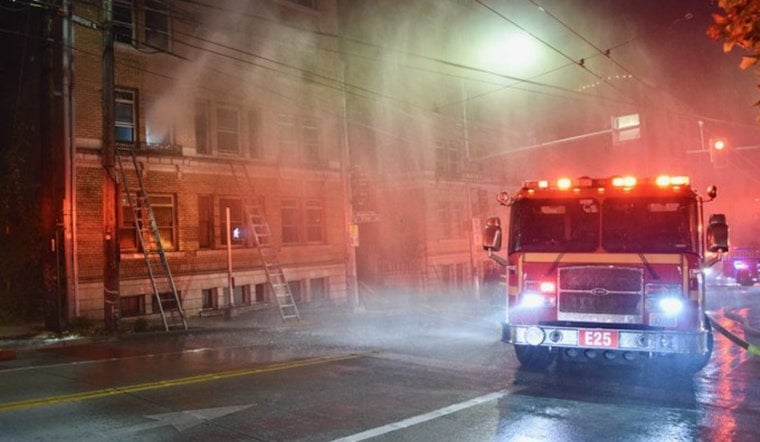
Firefighters converged on a five-story apartment building in the 1600 block of East Madison Street Monday morning after crews reported flames visible on the second floor and smoke filling the hallway outside the units. Engine and ladder crews worked simultaneously to search the building and put water on the fire as the situation unfolded.
According to the Seattle Fire Department, firefighters positioned on the second floor reported smoke in the hallway while crews pushed to knock down the fire and clear the building of occupants. The department's post did not specify whether residents needed to be rescued or displaced, and the extent of damage to the structure remains unclear.
The block sits at the heart of one of Capitol Hill's more historically significant commercial and residential strips. The address at 1605 E. Madison St., known as The Olympian, was designed in 1913 by architect William P. White and is listed on the City of Seattle's historical site inventory as eligible for landmark status, according to the Seattle Department of Neighborhoods. The Neoclassical building is known for its buff brick cladding and terra cotta detailing.
A Block Anchored by a Longtime Grocery Co-op
The same block has for decades been home to Central Co-op, a community-owned natural foods grocery that has operated at 1600 E. Madison St. for over four decades, per CHS Capitol Hill Seattle News. The co-op signed a 20-year lease extension for the property in 2015, cementing its place as one of the corridor's key commercial anchors.
Monday's response comes amid a string of fire activity along the East Madison corridor this summer. Six weeks earlier, on July 14, Seattle Fire crews battled a major commercial structure fire in the 2700 block of East Madison Street that destroyed third-floor offices and caused an estimated $1.5 million in damage, a blaze Hoodline covered in Central District office fire coverage. Investigators in that case determined that overheated electrical wiring sparked the fire.
Fire Activity Piles Up Amid Dry Conditions
Just three days before Monday's call, on August 28, Seattle Fire crews responded to a structure fire at an unoccupied apartment building under renovation at 17th Avenue and East Thomas Street on Capitol Hill, successfully confining the damage to the exterior entryway, the same outlet reported. The back-to-back responses arrive as Seattle and King County remain under a Stage 2 Burn Ban, imposed on August 7 due to dry summer weather and elevated regional wildfire danger. Fire crews had already responded to more than 350 brush and outdoor fires since Memorial Day, according to the fire department's own tracking.
Fires in multi-story apartment buildings along the Madison Street corridor carry particular weight for longtime residents. In March 2024, a 122-year-old, four-story building on Madison Street that housed 75 low-income apartments and Vito's lounge was demolished after sustaining severe, unrepairable fire damage from multiple blazes, following scuttled plans to shore up the 1902 structure. And in June 2022, a 3-alarm fire in a four-story apartment building in the 800 block of Madison Street critically injured three residents, forcing firefighters to use ground ladders to rescue upper-floor occupants trapped by heavy hallway smoke — a scenario that echoes the smoke conditions crews reported on the second floor Monday.
Standard Tactics for Smoke-Filled Hallways
Seattle Fire's standard operational protocols for multi-story apartment fires call for engine and ladder companies to conduct simultaneous interior water application and primary search and rescue in upper-floor hallways, emphasizing rapid search and smoke ventilation when crews report hallway smoke like that seen Monday. The 2022 Madison Street fire required more than 100 firefighters and 17 engines to bring under control.
The 1600 block itself has changed considerably in recent years. The corridor underwent major streetscape and transit reconstruction for the $133 million RapidRide G Line, which opened for bus rapid transit service in September 2024 and added dedicated red bus lanes and center boarding platforms, according to the Seattle Department of Transportation. Average weekday boardings on the line along Madison Street grew to 6,113 riders per day by May 2025, per Seattle Transit Blog, underscoring how much foot and bus traffic now moves through the block where firefighters staged their response. As of Monday, the cause of the fire and the full extent of any damage had not been determined.





