

























































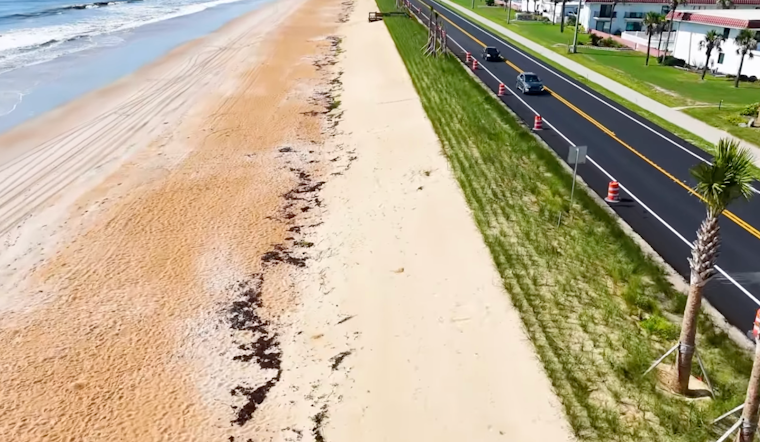
A 2.5-mile seawall now runs beneath the sand along State Road A1A in Flagler and Volusia counties, the final piece of a $117 million effort to keep the region's most storm-battered coastal highway from washing into the Atlantic. The wall is complete but invisible, tucked under nearly 238,000 tons of sand, native plants, and newly planted palmetto trees that now cover the length of the project.
A Wall You'll Never See
According to WFTV, the buried seawall stretches along the coastline in Flagler and Volusia counties, with a north section running from South Central Avenue in Flagler Beach to just north of Highbridge Road in Volusia County, and a southern section extending from Marlin Drive to Sunrise Avenue in Ormond-by-the-Sea. The Florida Department of Transportation has reported that the project is now complete after more than two years of construction, per the same outlet's report. Shoreline erosion, worsened by hurricanes and nor'easters, had threatened the roadway for years before crews broke ground.
The wall relies on a secant pile design built with glass fiber-reinforced polymer rebar instead of traditional steel, a choice engineers say gives it a maintenance-free service life of more than 100 years in saltwater, according to research published by the American Composites Manufacturers Association. Steel corrosion is typically what causes seawalls to fail in coastal environments, making the corrosion-resistant material central to the project's long-term design.
Two Counties, One Contractor
FDOT split the work into two contracts spanning county lines, according to project records posted on CFLRoads: a $21.4 million segment in Flagler County and an $82.5 million segment in Volusia County, both built by primary contractor Superior Construction Company Southeast. Construction began in late March 2024 after being expedited on the recommendation of the S.R. A1A Resiliency Strike Team, a multi-agency coalition that included FDOT, the Florida Department of Environmental Protection, the U.S. Army Corps of Engineers, Flagler County, Volusia County, and the City of Flagler Beach, per the same CFLRoads reporting.
The project was catalyzed by back-to-back storms in late 2022 — Hurricanes Ian and Nicole — which caused widespread dune loss, seawall collapses, and pavement undercutting along A1A, according to the Florida Department of Environmental Protection. Nicole struck as a rare late-season hurricane just weeks after Ian, compounding the damage to a road already weakened by years of erosion. Before the 2022 storm season, state coastal researchers had classified 22.2 miles of Volusia County shoreline and extensive stretches of Flagler County as critically eroded, a designation reserved for shoreline recession that threatens public infrastructure or wildlife habitat.
Building on a 2019 Pilot
This wasn't the state's first attempt at hiding a seawall beneath the beach. FDOT tested a 1-mile GFRP secant pile buried seawall in Flagler Beach back in 2019, built after Hurricane Matthew tore out major stretches of A1A's northbound lanes in 2016. That pilot proved the design could protect the road while staying hidden beneath natural sand, according to research presented by the Florida Shore and Beach Preservation Association, and it laid the groundwork for the far larger project now finished.
Project crews replaced 28 beach walkovers as part of the work and rebuilt the dunes above the buried wall with fresh sand placement. Native plants and palmetto trees were added to help stabilize the shoreline and strengthen the dune system on top of the concrete below. Final dune shaping and plant installation on completed sections were temporarily paused in late 2025 to protect active sea turtle nesting sites until hatchlings had emerged, according to Flagler County, since East Central Florida's beaches host critical nesting grounds for loggerhead and green sea turtles.
A Lifeline for Barrier Island Residents
The stakes go beyond scenery. A1A serves as the sole hurricane evacuation route for thousands of barrier island residents in Flagler and Volusia counties, where narrow land profiles leave the roadway directly exposed to unbroken ocean waves, according to engineering firm DRMP. The same firm noted the project was delivered using a progressive design-build contract model, letting engineers adjust dune slopes and riprap placement in real time as beach contours shifted across three hurricane seasons of construction.
The buried wall isn't working alone. It's designed to complement a separate 50-year federal storm risk management project from the U.S. Army Corps of Engineers, which broke ground in June 2024 to place 1.3 million cubic yards of offshore sand along 2.6 miles of Flagler Beach, according to the USACE Jacksonville District. The seawall keeps the road bed from collapsing during major storms, while the Army Corps's sand nourishment work helps maintain public beach space above it — though that sand covering remains vulnerable to storm scour and will require periodic renourishment under strict sea turtle protection rules.
Hoodline has previously covered other FDOT coastal infrastructure fights along A1A, including a contentious hearing over a proposed roadway revamp in Ponte Vedra. For Flagler and Volusia counties, though, the newly finished buried seawall marks the end of a different chapter: turning emergency post-storm patchwork into a permanent, largely invisible line of defense meant to outlast the next century of hurricanes.


