

























































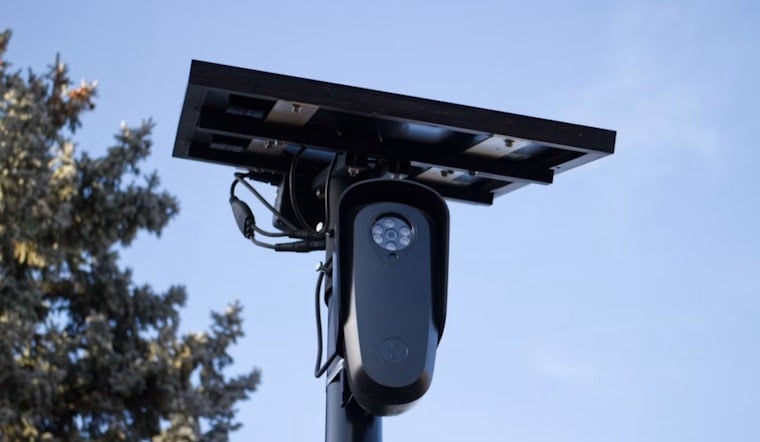
Flock Safety, the company behind roughly 400 license-plate reader cameras scattered across San Francisco, has quietly obtained a California private investigator license — a move legal experts say has less to do with catching criminals and more to do with protecting the company in court. The license, granted under a former Sacramento County police officer named Seth Cimino, comes as Flock faces canceled contracts, vandalized cameras and a wave of privacy-violation lawsuits nationwide over the past year.
Cimino, who has worked at Flock since March 2023, is listed as the qualified manager on the company's license and applied for it himself, according to The San Francisco Standard. His prior police service counted toward the 6,000 hours of investigative experience California requires for licensure, a threshold set by the Bureau of Security and Investigative Services, which also mandates a state written exam and background checks through the California Department of Justice and FBI. Cimino had no prior California private investigator license application or license before this one, the Standard reported.
In his application, Cimino described his Flock work as being a licensed private investigator and a consultant developing strategic crime-reduction solutions with police agencies across the western United States, per the application cited by the Standard. He currently works as an operations delivery associate and investigator focused on theft and vandalism cases against Flock, the outlet reported. The license itself allows Flock employees to conduct investigative work under his oversight, giving the company what the Standard described as wider latitude to investigate crimes.
A License Born From Legal Pressure
The California move follows a rockier regulatory history in Texas, where the Texas Department of Public Safety issued Flock a cease-and-desist order over alleged violations of the state's private-security licensing law. A subsequent state investigation concluded in March 2026 that Flock had operated as an unlicensed private security business in Texas from 2019 to 2024, resulting in a $500 penalty — the maximum statutory fine for first-time offenders, according to the Houston Chronicle. Texas ultimately granted Flock a private security license three months after the cease-and-desist order.
California's Private Investigator Act defines private investigators as people paid to obtain information about crimes, individuals' identities or habits, stolen property, fires, incidents, or evidence for legal proceedings — though the law exempts attorneys, law enforcement officers and insurance companies from licensure requirements. Companies contracting with law enforcement, like Flock, are subject to those licensure rules, the Standard noted. A Department of Consumer Affairs spokesperson, which oversees private-investigator licensing, said the agency could not determine whether unlicensed practice occurred without a formal investigation.
Attorneys See A Legal Shield, Not A Crime-Fighting Tool
Robert Frommer, an attorney involved in litigation over Flock's technology, said the company's business model obtains information to track people's movements. He suggested a recent Supreme Court ruling limiting geofence warrants may have contributed to Flock's push to obtain the license. That ruling, decided June 29, 2026, in Chatrie v. United States, found 6-3 that police acquisition of historical location data from tech providers constitutes a Fourth Amendment search requiring a warrant supported by probable cause.
Ramzi Abadou, the attorney representing San Francisco plaintiff Michael Moore, went further, saying he believes Flock may have obtained the license to fend off lawsuits and that it could serve as an end run around the Fourth Amendment issues raised in ongoing litigation against the company. Moore alleged Flock cameras tracked his daily movements in violation of his privacy rights, but Abadou dropped that lawsuit pending the outcome of a related case in Norfolk, Virginia.
That pause followed a January 2026 ruling from U.S. District Judge Mark S. Davis, who found in Schmidt v. City of Norfolk that Norfolk's network of 176 Flock cameras did not violate Fourth Amendment privacy rights — though the court explicitly warned that ALPR surveillance could become unconstitutionally intrusive if expanded further, according to Courthouse News Service. The Institute for Justice had sued Norfolk over Flock's alleged constitutional violations involving illegal search and seizure, and Davis previously rejected Flock's own bid to intervene as a co-defendant in that case, ruling in May 2025 that the company's attempt to join the litigation was untimely.
Two Views On What The License Actually Does
Jonathan Hofer offered a different read, saying the license could let Flock present itself in court as a regulated surveillance company with government approval. He added that a private investigator license could shield Flock as it expands sales beyond police departments or faces claims of exceeding the terms of its law-enforcement contracts. Frommer and Abadou, by contrast, frame the license primarily as a legal defense against privacy claims rather than a genuine expansion of investigative services.
Flock has contracts nationwide and, according to Hoodline's prior reporting, operates more than 80,000 AI-powered license-plate reader cameras across 49 states, serving over 5,000 law enforcement agencies and 1,000 corporate clients. The company has done business in California since 2019, and its San Francisco network — roughly 400 cameras totaling 483 license-plate readers across the city — has operated since 2024.
Bay Area Fallout Continues
The scrutiny has already cost Flock business locally. The Santa Clara County Board of Supervisors voted 3-2 in February to prohibit the Sheriff's Office from contracting with Flock across cities including Saratoga, Cupertino and Los Altos Hills, citing concerns over federal immigration agency access to license-plate data, according to KQED. Federal agencies had improperly accessed Santa Clara County's Flock license-plate data, and unauthorized outside-agency searches of San Francisco's own Flock data led SFPD to cut those agencies off from its network in June.
Stanford University ended its Flock contract over privacy and safety concerns, announcing in August it would replace the network with Genetec Cloudrunner, a vendor built for single-institution data use rather than shared regional networking, the same outlet reported. In Contra Costa County, Brentwood is reviewing whether an HOA's Flock contract violated rules barring cameras from public streets. Activists elsewhere have staged guerrilla actions removing or covering Flock cameras over privacy and safety concerns, while civil libertarians argue that surveillance technology deployment by federal immigration authorities and local law enforcement is unconstitutional.
Facing this pressure, Flock announced new protections against police misuse last week, saying it will reduce the retention period for movement data and lock out users who appear to be abusing its system. The company's national policy update cut its standard default data retention period for license-plate reader footage from 30 days down to seven days. Whether those changes — or the new private investigator license — will satisfy courts and critics remains an open question as litigation over Flock's surveillance network continues to unfold nationwide.


