

























































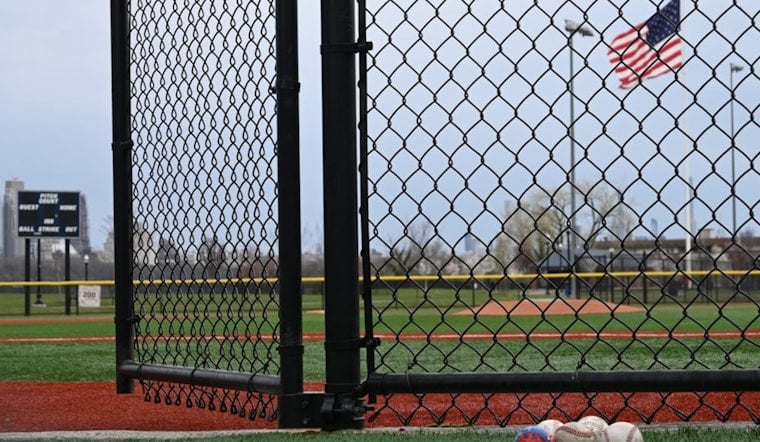
Ridgewood High School will not host a single home football or soccer game this fall after flooding damaged Stadium Field and a neighboring campus field on August 27, leaving the turf surface unable to pass a required safety test. Superintendent Mark Schwarz said flood waters carry debris and silt onto the fields, where the silt deposits and hardens, stripping the turf of the shock absorption student-athletes need to safely play.
The closure means the Ridgewood football and soccer programs are locked out of their home turf for the entirety of the 2026 season, according to WABC-TV. Max Abdrobo said students are not allowed to play on the damaged field, explaining that the flooding prevents students from playing and training there at all. Ridgewood High School sits in Ridgewood, New Jersey, right along the Ho-Ho-Kus Brook, a waterway that has repeatedly overflowed onto the campus's synthetic fields in recent years.
Why the Silt Makes the Turf Dangerous
Floodwaters leave fine silt, dried mud and leaves on the synthetic surface, rendering it unusable, according to News 12 New Jersey. Shock-absorption testing for synthetic athletic fields is governed by ASTM F1936 standards, which cap impact acceleration at 200 G's, per the ANSI Blog.
Stadium Field and Stevens Field had both passed routine safety inspections in April 2026, months before the late-August storm runoff coated them in silt, the Ridgewood Blog reported. Maintenance crews attempted deep cleaning and decompaction work on the turf before a third-party GMAX re-test, but the fields failed anyway, leaving them closed indefinitely.
A Recurring Problem Along the Brook
This is not the district's first encounter with flood-damaged turf. In July 2025, overflow from the Ho-Ho-Kus Brook caused more than $50,000 in damage to the same two fields, forcing emergency repairs and another round of GMAX safety re-testing before the 2025 fall season could begin, the outlet's report noted. Two years earlier, repairing flood-damaged turf at the high school cost local taxpayers roughly $25,000 out-of-pocket per field because district insurance did not cover the full cost of repeated restorations, according to CBS News.
Replacing the fields outright is now projected to cost more than $1 million, per WABC-TV's reporting. Federal lawmakers in 2024 authorized the U.S. Army Corps of Engineers to conduct a formal flood control study along the Ho-Ho-Kus Brook and the Saddle River after three major flooding incidents struck the area within four months, CBS News reported. A 2024 flood-mitigation report titled Resilient Ridgewood, produced by Columbia University graduate students, went further, recommending that the district replace the artificial turf at Stadium and Stevens fields with natural grass and underground retention basins to absorb floodwaters. School administrators have countered that natural grass cannot hold up under the prior level of use.
Players and Officials React
For the students who play on Stadium Field, the loss cuts deeper than logistics. Ridgewood senior nose guard Thomas Bryan told WABC-TV that Friday night games are energetic events with the band, cheer team and packed stadium, and this year's football athletes will not experience a single home game at Stadium Field in front of the high school. Sophomore Nico Schilt said soccer is a key part of high school life and that the situation made him sad.
Village officials and neighboring schools have stepped in to help fill the gap. Neighboring fields create logistical challenges of their own, but neighboring schools have offered their fields to Ridgewood teams, and Ridgewood Village Manager Keith Kazmark said the village will continue working with school officials to support and accommodate student athletes. The Village of Ridgewood has also offered its own municipal parks and recreation fields to help absorb the displaced practices and youth sports leagues, according to the Ridgewood Blog. Despite the disruption, the Ridgewood football team plans to bring its energy wherever it plays this season.
A Decade of Scrutiny Over the Turf
A Decade of Scrutiny Over the Turf Questions about the artificial turf's interaction with the flood-prone brook are not new. In 2012, the New Jersey Department of Environmental Protection investigated resident complaints that the turf and surrounding fencing were aggravating local drainage, ultimately ruling that the school district was in full compliance with state flood hazard permits, according to Patch. More than a decade later, the underlying tension between synthetic turf, stormwater runoff and flood risk remains unresolved, even as the district leans on borrowed fields to get its athletes through the 2026 season. Water years 1970-2001 from USGS station #01390500, Saddle River at Ridgewood, were used for a fecal-coliform standard curve. The U.S. Geological Survey has digital flood-inundation maps for a 6-mile reach of Hohokus Brook that estimate the area and depth of flooding. Village records show that Ridgewood has adopted floodplain-management regulations through Ordinance Number 3865. The Village of Ridgewood has also launched an online portal for residents to document prior flood events with details and photos, according to the village.





