

























































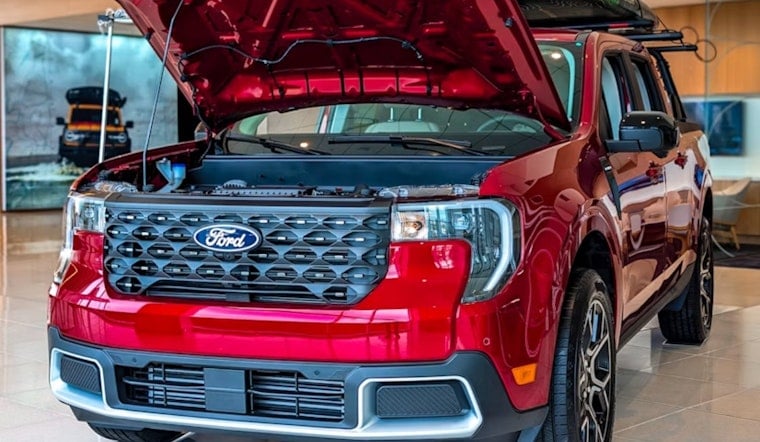
A federal safety petition filed by a single Albuquerque truck owner has triggered a formal review of roughly 82,040 Ford Maverick Hybrid pickups after he says his braking failed and caused a crash last September. The National Highway Traffic Safety Administration opened defect petition DP26007 to examine claims of intermittent loss of antilock and regenerative braking in the 2024 model year hybrid pickup, a review that could eventually force Ford to expand a recall or could end in a formal denial.
The petition traces back to Darwin Lewellyn Pitts, who bought his 2024 Maverick Hybrid in November 2024 and has since sued Ford Motor Co. in federal court, according to The Detroit News. Pitts says braking problems began in January 2025, with his vehicle experiencing brake pedal pulsation, shuddering and inadequate stopping. He filed his federal petition on July 7, 2026, a date that differs slightly from the July 20, 2026 receipt date reported elsewhere for when regulators logged the filing, according to The Brake Report.
According to Pitts's account, the braking issue persisted through four repair attempts, with two of those dealership visits happening before the collision itself. He has said he applied the brakes to avoid a vehicle crossing his path, and that the truck simply did not stop, resulting in a crash on September 25, 2025. His lawsuit states he sustained bodily injury, including chest-muscle injuries requiring medical treatment, and that his vehicle suffered front-end damage. Combined, the truck spent more than 50 days out of service, the same report notes.
What NHTSA Found — and Didn't Find
As of late August, the Pitts complaint represents the only failure report NHTSA has on file for the 2024 Maverick Hybrid tied to this issue, and initial summaries attached to the petition's opening showed no death or injury reports logged with the agency, per Dow Jones Newswires. That single-incident record does not diminish the legal weight of the filing, however. Under federal law, specifically 49 U.S.C. § 30162, any member of the public can force NHTSA to conduct a technical review by filing a defect petition, and the agency must ultimately either open a full investigation or publish a denial explanation in the Federal Register.
Opening a petition is not itself a finding of a defect, nor an order to recall — it starts a technical review that determines whether NHTSA proceeds to a full engineering investigation. If the agency ultimately grants the petition, it could order Ford to file a recall covering the roughly 82,040 trucks at issue. A key thread in the filing concerns whether Ford's 2024 model year Maverick Hybrid was improperly left out of earlier brake-control software recalls; an NHTSA filing states that the 2024 model year was in fact excluded from those related Ford recalls.
A Company Already Under a Federal Microscope
The scrutiny lands on a company that is no stranger to regulators. In November 2024, NHTSA hit Ford with a $165 million civil penalty — the second-largest in the agency's 54-year history — after the automaker failed to timely recall vehicles with defective rearview cameras and gave incomplete safety information, according to the agency's own announcement. Of that total, $65 million was paid upfront, with $55 million deferred.
That penalty came bundled with a consent order placing Ford under an independent federal monitor for at least three years — oversight that regulators can extend into a fourth year — and requiring the company to re-evaluate all of its recall decisions from the prior three years to verify they were properly scoped, according to Insurance Journal. Ford remains under that independent monitor today, with oversight covering its recall processes, data analytics and compliance. It's the backdrop that makes Pitts's exclusion claim about the 2024 model year carry extra weight: the company is already supposed to be double-checking its own scoping decisions.
Maverick's Recent Recall History
This isn't the first braking-related headache for the Maverick line this year. Back in February, Ford issued a recall covering roughly 4.38 million vehicles, including 2022–2026 Maverick trucks, after an integrated trailer module software glitch was found capable of cutting off trailer braking functions — a recall Hoodline covered at the time. That earlier campaign, NHTSA Campaign 26V104000, touched multiple Ford truck and SUV models beyond just the Maverick.
Ford's recall volume overall has been climbing sharply. The company issued more than double the recalls this year of any other automaker, and broke its own annual record for recalls issued in 2025, tallying a company record of 137 recalls by late November of that year, according to Benzinga's reporting via TradingView. Ford has said its quality-process transformation is yielding results, and CEO Jim Farley has reportedly pressured executives to trim billions of dollars from warranty bills; the company also hired a former NHTSA official to help improve its recall processes and quality-control systems. Even so, Ford still ranked top among mass-market automakers in J.D. Power's initial quality study this year, a data point the automaker points to even as recall issues persist.
Part of a Wider Industry Reckoning
The Maverick petition isn't happening in isolation. Concurrent with its opening in late August, NHTSA also launched separate brake-defect probes into more than 1.16 million General Motors and Honda vehicles over electronic brake-by-wire system failures, with GM's probe centered on potential spindle fractures in its e-boost brake systems, per the same Benzinga report. Regulators appear to be widening their focus on electronic and software-controlled braking systems across the industry, not just at Ford.
For now, the open question is what NHTSA's technical review turns up: whether the single Pitts complaint reflects a broader, undetected pattern in the 82,040 affected Maverick Hybrids, or whether the agency ultimately concludes the exclusion of the 2024 model year from earlier software fixes was justified. Neither Ford's culpability nor the safety defect itself has been determined — the review that will decide that is only just beginning.





