

























































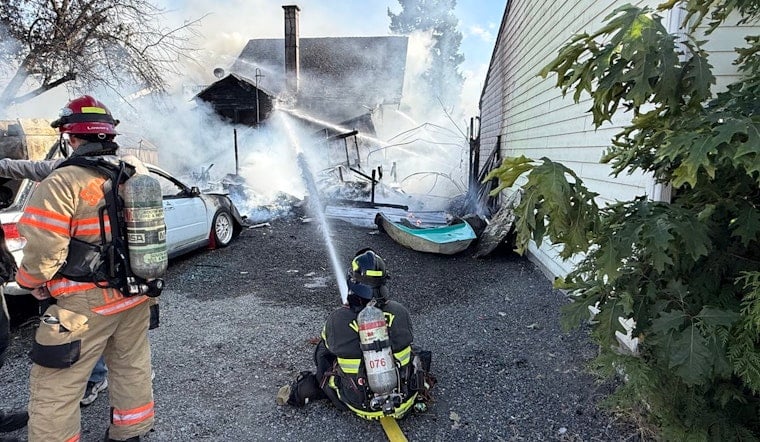
A residential fire in the 400 block of 1st Street NE in downtown Auburn escalated to a 3-alarm response Saturday night, drawing crews from four separate emergency agencies to the scene. Valley Regional Fire Authority, Puget Sound Fire, South King Fire & Rescue, and King County Medic One were all reported on location as the fire grew in scale.
The response was announced in a post from South King Fire, which described the incident simply as a three-alarm residential fire in the 400 block of 1st Street NE. That stretch of downtown Auburn sits just blocks from Valley Regional Fire Authority's headquarters station at 1101 D Street NE, according to the agency, and the area is a mix of single-family homes, apartment buildings, and local commercial properties.
Why So Many Agencies Showed Up
The simultaneous presence of four distinct agencies is standard practice in South King County, not a sign of anything unusual about this particular fire. Fire departments in the region operate under a Zone 3 automatic aid agreement dispatched through Valley Communications Center in Kent, a system that routes the closest available units to an emergency regardless of city boundaries, per the Office of the Washington State Auditor. Valley Com, established in 1976, coordinates dispatch for 22 public safety agencies across South King County.
Valley Regional Fire Authority, the lead agency covering Auburn, was formed on January 1, 2007, after voters approved consolidating the Auburn and Pacific fire departments along with Algona's fire service. The authority now protects roughly 99,000 residents across 34 square miles from five stations, according to Valley Regional Fire Authority.
Mutual Aid Partners Bring Regional Muscle
South King Fire & Rescue, formally King County Fire Protection District No. 39, serves nearly 150,000 residents across 41 square miles that include Federal Way, Des Moines, unincorporated areas, and Auburn's West Hill, maintaining more than 160 personnel across seven stations. Puget Sound Fire, which covers Kent, Covington, SeaTac, Maple Valley, and Tukwila, frequently sends apparatus into South King County during major multi-alarm incidents and coordinates closely with both Valley Regional Fire and South King Fire through Valley Com.
King County Medic One provided advanced life support at the scene. The paramedic service is run directly by Public Health – Seattle & King County under the region's two-tiered emergency medical system, in which fire department EMTs handle initial basic life support while KCM1 supplies advanced care through eight to nine front-line medic units stationed across South King County.
What a Three-Alarm Call Typically Means
A 3-alarm designation in South King County signals an expanded regional response, typically bringing more than a dozen engines, ladder trucks, command staff, and support units to a scene. A previous 3-alarm residential fire in Auburn in November 2021 displaced approximately 60 residents and required 11 engines and three ladder trucks to control, according to Valley Regional Fire Authority. When fires of that scale displace residents, regional protocols typically bring in the American Red Cross Northwest Region and transit agencies such as King County Metro to provide temporary shelter and support.
It remains unknown how many residents, if any, were displaced by Saturday's fire, whether any injuries were reported, or what caused the blaze. Fire investigators have not yet released a cause. This is at least the third such multi-agency residential fire response Hoodline has covered in Auburn this year, following a similar mutual-aid effort in June and joint brush fire response along SR 167 in July.
Downtown Auburn has also been in the middle of major infrastructure work throughout 2025 and 2026, with the city upgrading underground utilities and surface infrastructure along 1st Street NE and surrounding corridors, according to the City of Auburn. The dossier does not indicate whether that construction affected emergency access to Saturday's fire scene. Washington's regional fire authorities, including Valley Regional Fire Authority, operate under Title 52 RCW, which authorizes them to levy property taxes and fire benefit charges to fund multi-jurisdictional response capacity and Community Risk Reduction programs aimed at preventing structural fires.



