

























































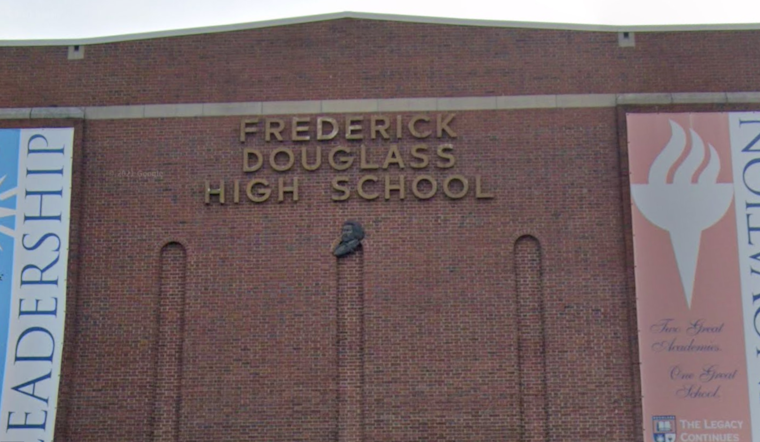
Frederick Douglass High School has reopened in West Baltimore following a two-year, $118 million renovation that added a new gym and pool, modernized science classrooms, and a renovated auditorium while preserving the landmark 1924 building at its core. Students began learning inside the newly reopened building this month, capping a construction process that displaced the historic school from its Gwynns Falls Parkway home for two years.
The project, first reported by WBAL News Radio, transformed a campus that has anchored West Baltimore's Black educational history since the 19th century. Frederick Douglass High is considered the second-oldest high school in the nation established to educate African American students, according to the station's report, and it now shares its renovated facilities with Joseph C. Briscoe Academy, a Baltimore public school serving grades 6-12 that provides specialized therapeutic services and small student-teacher ratios, according to Baltimore City Public Schools. Briscoe Academy helps students build self-regulation skills before transitioning back into traditional school settings.
The renovation also added career and technical education classrooms alongside the new gym, pool, and modernized science labs, giving students access to facilities that didn't exist in the original structure.
A Landmark Building Gets New Life
Frederick Douglass High School traces its roots to 1883, when it was founded as the Colored High and Training School — one of only two Baltimore high schools open to Black students before legal desegregation, with Dunbar High serving students on the city's east side, according to Baltimore City Public Schools. The school was renamed in 1925 to honor abolitionist Frederick Douglass when it relocated to its current Gwynns Falls Parkway site.
That 1924 Late Gothic Revival building, designed by architects Joseph Evans Sperry and Spencer E. Sisco, is listed on the National Register of Historic Places, according to ISI Demolition. It was Maryland's first public high school built specifically for Black students, and the renovation preserved its exterior masonry, roof, and windows even as three new structural additions rose around it to house a dedicated Briscoe Academy wing, new entrance points, a specialized mock courtroom, a health suite, and a 1,000-seat auditorium, per Baltimore City Public Schools.
The school's alumni rolls include civil rights attorney and U.S. Supreme Court Justice Thurgood Marshall, a member of the Class of 1925 who later argued Brown v. Board of Education before becoming the nation's first Black Supreme Court Justice, and jazz singer and bandleader Cab Calloway, Class of 1928, according to Baltimore City Public Schools.
Two Years in a Swing Space
During construction, Frederick Douglass students and staff were temporarily relocated to the Northwestern Building in West Baltimore as a swing space, according to Baltimore City Public Schools. The district coordinated MTA transit passes and staggered bus schedules to get students to the temporary site throughout the two-year process.
The project reached this scale after the Maryland Stadium Authority generated $60 million in project savings and $65.6 million in bond transaction proceeds within Baltimore's 21st Century School Buildings Program, expanding the program from 28 to 29 planned school modernizations, according to the Maryland Stadium Authority. With Frederick Douglass now reopened, the district has completed 27 of the 29 modernizations planned under the program, a joint effort between Baltimore City Public Schools and the Maryland Stadium Authority.
A Model for Statewide School Construction
The program's track record in Baltimore helped inspire Maryland's statewide Built to Learn Act, which authorized the Maryland Stadium Authority to issue up to $2.2 billion in debt for public school construction projects across the state, according to the agency's financial review. The law requires matching funds from participating local education agencies, extending Baltimore's modernization model to districts statewide.
The campus has also drawn philanthropic investment beyond the renovation itself. Its athletic grounds include Brooks Robinson Field, a youth sports field built by the Cal Ripken Sr. Foundation, which has constructed more than a dozen youth sports facilities across the Baltimore region, according to Baltimore Magazine. Hoodline previously covered a campus beautification event at the school in 2018, when volunteers repainted walls and restored school logos on the grounds.




