

























































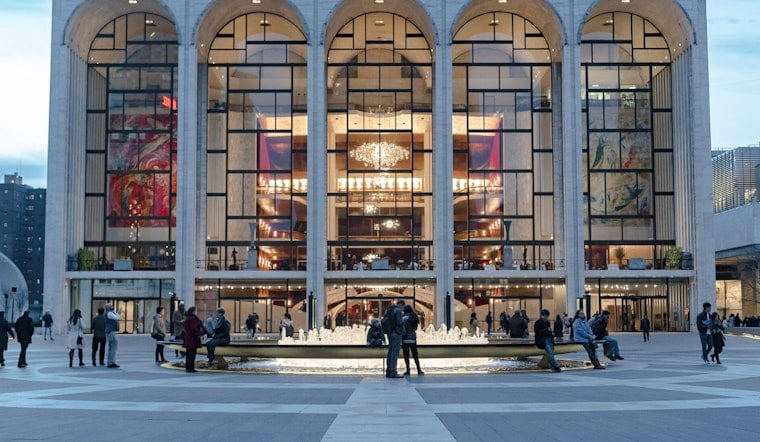
Free opera is coming back to Lincoln Center's Josie Robertson Plaza next month, and this time it's an even bigger production than usual — five operas spread across six nights, all screened on a giant outdoor cinema setup, with zero tickets or reservations required to get in.
The Metropolitan Opera's Summer HD Festival, now in its 17th edition, runs September 2 through September 7, according to Time Out. The open-air event screens performances pulled from the Met's Live in HD broadcast catalog, projected on a giant screen for anyone willing to grab a spot on the plaza. Each night offers roughly 2,500 seats, first-come first-served, and every presentation includes full open captions.
What's Playing This Year
The lineup opens September 2 with Act I of Richard Wagner's Tristan und Isolde, continuing with Acts II and III the following night. That new staging, directed by Yuval Sharon in his Metropolitan Opera debut, was originally transmitted live to cinemas in March, according to Lincoln Square BID. Featured vocalists include soprano Lise Davidsen and tenor Michael Spyres, as reported by OperaWire.
Vincenzo Bellini's I Puritani screens September 4 at 7:30 pm — the only night that doesn't follow the festival's usual 8 pm start time — with Lisette Oropesa starring, per OperaWire. Pyotr Ilyich Tchaikovsky's Eugene Onegin follows on September 5 at 8 pm.
A Reverse-Orpheus Tale and a Puccini Classic
September 6 brings Gabriela Lena Frank's El Último Sueño de Frida y Diego, which reunites Frida Kahlo and Diego Rivera on the Day of the Dead. The opera, with a libretto by Pulitzer Prize-winning playwright Nilo Cruz, premiered at San Diego Opera in October 2022 before its Bay Area premiere at San Francisco Opera the following June as a multi-company co-commission, according to San Francisco Opera. Isabel Leonard and Carlos Álvarez star in the roles, per OperaWire's reporting.
The festival closes September 7 with Giacomo Puccini's La Bohème, presented in Franco Zeffirelli's production depicting 19th-century Paris. All five operas and six nights are completely free, with no advance tickets or reservations of any kind.
Getting In, and What Happens if It Rains
Security protocols this year require Josie Robertson Plaza to be cleared two hours before each screening, with attendees let back in through designated access points an hour before showtime on a first-come, first-served basis, per Lincoln Square BID. Screenings will go on in the rain, but the Met will cancel a night's presentation if there's thunder, lightning, or high winds — and there are no makeup dates scheduled for anything canceled.
The Live in HD program that supplies the festival's footage dates back to December 2006, when General Manager Peter Gelb launched it with a 100-minute, abridged English-language adaptation of Mozart's The Magic Flute, according to LEADERS Magazine. Since then, the series has sold more than 31 million tickets worldwide, broadcasting to over 2,200 movie screens across 70 countries on six continents, the magazine reports. The roughly 2,500 free seats offered each night on the plaza amount to about 65% of the Metropolitan Opera House's main indoor seating capacity of 3,800 patrons, per EL PAÍS English, which notes the Met's opera house is the largest repertory opera house in the world.
Free Programming Amid Financial Strain
The festival's free, un-ticketed format arrives even as the Met faces real financial headwinds. In March, Moody's downgraded the company's credit rating to Caa1, citing a structural operating deficit and more than $120 million in draws from its endowment over recent years, as Hoodline previously reported. Local government support has continued in parallel: in June, Manhattan Borough President Brad Hoylman-Sigal allocated $500,000 in discretionary capital funding to the Met to upgrade its stage fly system, part of a $50 million borough-wide push for cultural infrastructure that Hoodline also covered.
None of that institutional turbulence changes what's happening on the plaza next month. For six nights, New Yorkers can walk up, find a seat among roughly 2,500 others, and watch world-class opera without spending a dime — a tradition Gelb's cinema strategy helped make possible nearly two decades ago.




.jpg)