

























































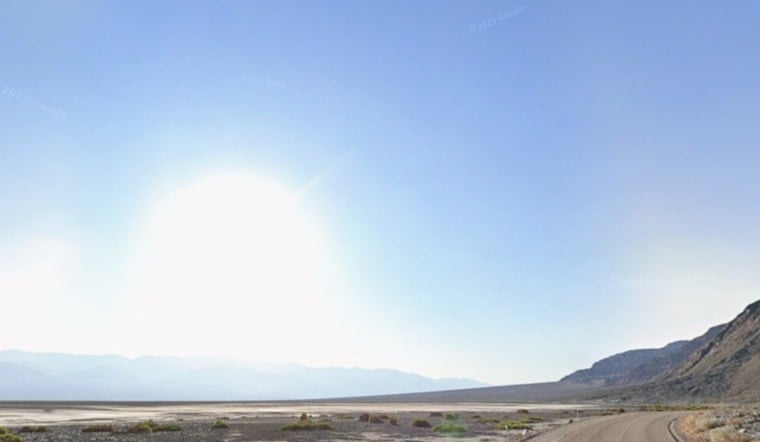
A 68-year-old French tourist died after becoming stranded in Death Valley National Park and attempting to walk for help in temperatures that reached 116 degrees. Pierre Michel Formosa and a companion had driven onto West Side Road when their vehicle became stuck in mud near Queen of Sheba Mine Road, according to officials, setting off a desperate trek across open salt flats that ended in tragedy.
As reported by the Las Vegas Sun, Formosa and his companion left their disabled vehicle and walked across the salt flats toward Badwater Road after getting stuck. Formosa could not continue after walking about 1.3 miles, the outlet reported, while his companion pressed on toward the road and eventually received help from a passing motorist. The companion then reported the situ2ation at the Furnace Creek Visitor Center shortly after 2 p.m.
National Park Service rangers and an Inyo County Sheriff's deputy began a search-and-rescue operation around 2:13 p.m., and a California Highway Patrol helicopter joined the search shortly after. Crews found Formosa about 1.5 miles from Badwater Road, and he was pronounced dead at the scene. The Inyo County Coroner will determine the cause and manner of death, per the Las Vegas Sun's report.
A Route Known for Hidden Mud Traps
West Side Road is a 36-mile unpaved, day-use-only route running parallel to Badwater Road along the western edge of Death Valley, and it requires high-clearance vehicles to navigate safely, according to the National Park Service. The road follows a historic 20-mule-team wagon route that sits entirely below sea level, and summer traffic along it is extremely rare given the conditions. Flash flooding from the remnants of Hurricane Hilary in August 2023 damaged more than 1,000 miles of roads throughout the park and washed out West Side Road, leaving sections muddy and undergoing repairs into early 2025, the park service notes.
That storm damage helps explain why unpaved valley floor roads can retain hidden mud beneath a dry-looking crust, even when the surface appears passable. A similar hazard played out in July 2023, when two lost visitors following GPS directions drove off West Side Road and got stuck in mud nearly a mile onto the salt flats, forcing them to walk miles along Badwater Road until one required emergency hospital treatment for heat illness, the park service has said.
Ground Heat That Can Exceed 200 Degrees
Death Valley's danger comes not just from air temperature but from what the ground itself does to a person on foot. While the park recorded the world's highest ambient air temperature of 134 degrees Fahrenheit in July 1913, ground surface temperatures at Furnace Creek reached a record 201 degrees Fahrenheit in July 1972, according to the National Park Service, which notes that ground temperatures routinely run 40 to 80 degrees hotter than air temperatures. Physical exertion on that kind of surface can rapidly lead to severe heat illness or death within just one to two miles, the Las Vegas Sun reported.
The park has seen this pattern before. In July 2021, a 68-year-old Washington state hiker died from heat exposure in 118-degree temperatures while attempting a 12-mile round-trip hike across the salt flats between Badwater Road and West Side Road, the same identical age and a nearly identical route to Formosa's fatal walk this week. Park officials say Death Valley National Park routinely experiences summer temperatures exceeding 120 degrees, and that heat kills between one and three people annually in the park, according to a park statement cited by the Sun.
Park Officials Urge Visitors to Stay With Their Vehicles
Mike Reynolds said, according to the Sun's reporting, that this is a heartbreaking reminder of how quickly conditions here can turn dangerous. Park officials advise visitors to remain on paved roads during extreme heat, to avoid hiking at low elevations, and to stay with a disabled vehicle when possible, since a stranded car can provide shade, shelter, and a more visible target for search crews.
Officials also urge travelers to plan their routes and check road and weather conditions in advance, to tell someone where they are going, to bring a satellite communicator or emergency beacon, and to carry at least a gallon of water per person per day. Death Valley National Park covers roughly 3.4 million acres across California and Nevada, making it the largest national park in the contiguous United States, yet cellular service is unavailable across the vast majority of its remote terrain, according to the park service. That gap leaves stranded visitors unable to call 911 directly in most of the park, dependent instead on satellite devices or long walks to paved roads and developed nodes like Furnace Creek.
A Recurring Toll Even in a Dangerous Season
Formosa's death is not an isolated incident this year. Park history shows a motorcyclist died from heat exposure in the Badwater Basin area in 2024, when Death Valley recorded a high of 128 degrees; four other people received treatment at the scene and another rider was hospitalized, according to the park's own account. Death Valley rangers say they respond to overheated visitors several times a week during summer months.
Search-and-rescue operations across this stretch of desert fall under the authority of the Inyo County Sheriff's Department, which relies on volunteer rescue personnel and regional aerial assistance from agencies like the California Highway Patrol across a 10,000-square-mile county territory stretching from Mount Whitney to Death Valley. Extreme summer heat can also complicate air rescues, since hot air reduces helicopter rotor lift at low elevations, sometimes forcing ground ambulances to move heat victims to cooler or higher ground before an airlift can happen, according to a report from BGR.
International travelers, including visitors from France, make up a significant share of Death Valley's summer crowds despite the severe heat warnings, according to Fodor's Travel, which notes that California's national parks generated $3.2 billion in local visitor spending in 2023. Summer remains one of the park's busiest seasons for foreign tourists, even as officials continue to warn that desert conditions here can turn fatal within a matter of miles.





