

























































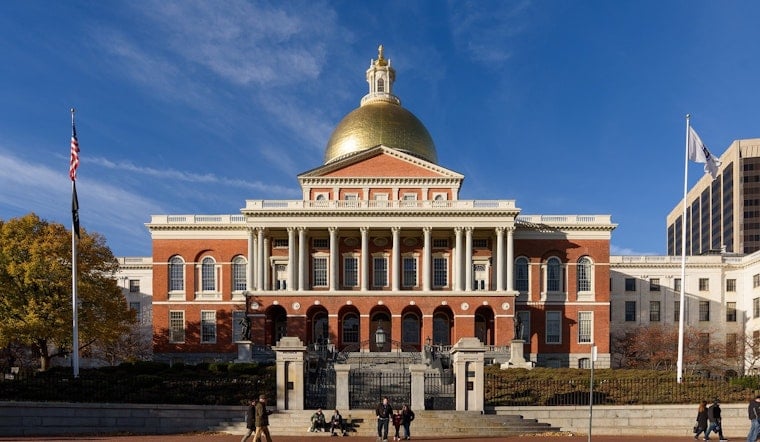
With Massachusetts voters already casting early ballots ahead of the September 1 primary, the state's top election official says the marquee U.S. Senate matchup between Sen. Ed Markey and Rep. Seth Moulton isn't the race likely to get people to the polls. Secretary of the Commonwealth William Galvin said the lopsided Democratic primary, in which statewide polling has shown Markey leading by double digits, will not be enough on its own to entice a larger-than-normal number of voters this cycle.
Galvin made the comments during a visit to an early in-person polling site in West Roxbury, which he described as pretty busy, according to The Boston Globe. As of Friday, roughly 245,000 Democratic ballots and about 45,000 Republican ballots had been cast statewide, according to figures from Deb O'Malley cited in that report. Galvin's office had received nearly 700,000 requests for mail-in ballots heading into the primary, with a return rate approaching 50 percent.
The Markey-Moulton contest is one of two statewide primaries on the ballot this year, alongside a competitive Republican gubernatorial primary between former medical device company executive Mike Minogue and former MBTA chief administrator Brian Shortsleeve. Galvin said that race, too, will fall short of drawing outsized turnout, and noted that many voters — especially those unenrolled in either party — simply skip primaries altogether. The Globe's report notes that Galvin expects Democratic primary turnout to exceed 700,000 votes, while Republican turnout typically ranges from 250,000 to 300,000 votes.
Polling Shows a Wide Gap in Both Statewide Races
A UMass Amherst/WCVB poll conducted August 5 to 12 found Markey holding a 28-point lead over Moulton, 60 percent to 32 percent, among likely Democratic primary voters, with Markey's job approval sitting at 82 percent. A separate Suffolk University/Boston Globe survey of 500 likely primary voters found more than 52 percent would choose or lean toward Markey. Moulton's campaign has disputed the polling, arguing that recent primary surveys have historically proven inaccurate, as previously reported by Hoodline in its coverage of AOC's endorsement boxing in Moulton.
On the Republican side, Minogue led Shortsleeve 53 percent to 26 percent among likely GOP primary voters in a separate UMass Amherst poll, though both candidates trailed Democratic Governor Maura Healey by roughly 20 points in hypothetical general-election matchups. Minogue and Shortsleeve have both struggled with name recognition statewide. The Massachusetts Democratic Party released ads targeting Minogue this month, which prompted Shortsleeve to accuse state Democrats of meddling in the Republican primary to boost the candidate he argues they view as easier for Healey to beat in November, according to Shortsleeve's campaign.
Markey and Moulton held their final televised debate this week before early voting concludes. During that debate, Moulton apologized for past comments regarding transgender student-athletes, an issue Markey had raised against him on the campaign trail; Moulton said he supports transgender rights, per footage of the exchange carried on C-SPAN.
Local Contests Expected to Carry More Weight
Galvin said it's typically local races, not the top-of-the-ticket contests, that drive early voting in Massachusetts. In Suffolk County, voters will decide whether incumbent District Attorney Kevin Hayden advances to November, as he faces former U.S. Attorney Rachael Rollins and attorney Linda Champion in the Democratic primary. Hayden paid a $5,000 civil penalty to the State Ethics Commission this month for violating state conflict-of-interest laws, an episode that has shadowed the race even as Boston Mayor Michelle Wu — who backed a different candidate in the 2022 district attorney election — has endorsed Hayden this time around.
In Middlesex County, incumbent prosecutor Marian Ryan faces a challenge from David Solet, a former employee of her own office. And in the 8th Congressional District, 24-year incumbent Rep. Stephen Lynch is defending his seat against progressive attorney and former gubernatorial aide Patrick Roath, a race that echoes the generational-change argument playing out in the Senate primary, per Ballotpedia. Lynch was first elected in a 2001 special election after working as an ironworker, while Roath has picked up endorsements from Boston municipal officials and teachers' unions. State Senate contests are also on the ballot, including a race involving Belmont's William Brownsberger and a Boston campaign from Democratic candidate Daniel Lander.
Deadlines and Voting Options Before Tuesday
Early in-person voting for the state primary runs through Friday, and Galvin has recommended that voters holding unmailed ballots bring them to an early voting site or an official election dropbox rather than risk the mail. That's because Massachusetts primary elections have no grace period for late-arriving mail-in ballots — they must be in the possession of local election officials by 8 p.m. on September 1, the day of the primary, regardless of when they were postmarked.
Under the state's VOTES Act, which established universal no-excuse mail voting and expanded early in-person voting when it was signed into law in June 2022, municipal election commissions are authorized to begin the advance unsealing, processing, and tabulation of returned mail-in ballots starting Monday, ahead of Primary Election Day, according to the City of Cambridge. Results remain sealed until polls close on September 1 even as clerks work through the volume beforehand.
Galvin himself faces no Democratic primary challenger this year as he runs for a record ninth four-year term overseeing Massachusetts elections, a role he has held continuously since taking office in January 1995. Whatever the final turnout numbers show, Galvin's read on this cycle is consistent with what Hoodline has tracked throughout the campaign, including Bernie Sanders' and Michelle Wu's endorsements of Markey — that a wide polling gap at the top of the ticket may say less about who Massachusetts voters send to the polls than the down-ballot fights in their own backyards.



