

























































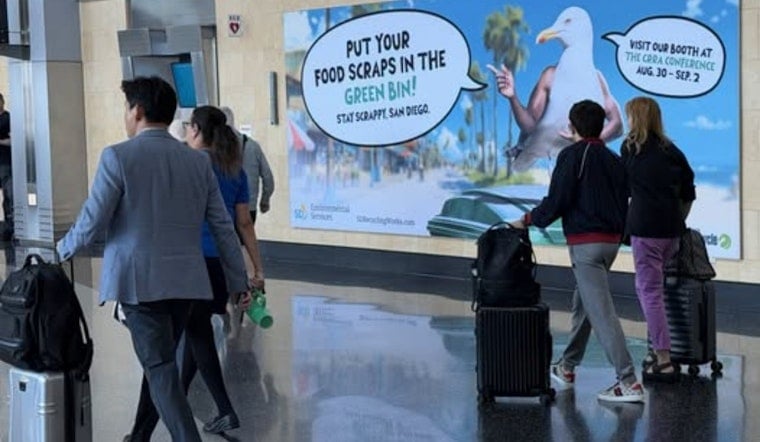
Travelers walking through Terminal 2 at San Diego International Airport this week are getting an unusual welcome: a cartoon seagull named Gary, urging them to put their food scraps in the green bin. The city debuted the mascot in a social media post as part of a campaign timed to a major recycling conference landing in town, blending airport branding with a statewide push to keep organic waste out of landfills.
According to a City of San Diego post on Facebook, Gary the seagull is described as an avian ambassador at the airport who reminds travelers to recycle organic waste, with a simple catchphrase attached to his campaign artwork: “Put your food scraps in the green bin!” The seagull is greeting attendees arriving for the California Resource Recovery Association's Annual Conference, a four-day gathering running from Sunday through Wednesday at the Sheraton San Diego Resort, according to the California Resource Recovery Association, which is marking its 50th year under the theme “Rooted in California Values.”
The conference is expected to draw more than 800 recycling and sustainability industry leaders, according to the city's Facebook post, and the City of San Diego is listed as a partner sponsor of the event. City Councilmember Stephen Whitburn is scheduled to welcome conference attendees to San Diego on behalf of the city, and the Environmental Services Department has scheduled four representatives to speak at the gathering, per the same post. The city's messaging frames the moment simply: conference attendees are coming together to shape the future of zero waste.
Why the Seagull Is Talking About Green Bins
Gary's appearance at Terminal 2 is not just conference branding — it doubles as reinforcement for California's Senate Bill 1383, which mandates that local jurisdictions statewide slash landfilled organic waste by 75% relative to 2014 levels and requires mandatory curbside organics collection, according to the City of San Diego. The law targets a stubborn climate problem: organic waste decomposing in landfills generates roughly 20% of California's total methane emissions, a pollutant 84 times more potent than carbon dioxide over a 20-year span, per RecycleSmart. Food scraps, yard trimmings, and food-soiled paper make up roughly 40% of everything discarded in landfills across San Diego County and the state, according to the County of San Diego.
San Diego's residential green bin program has scaled quickly since its rollout to more than 200,000 households. The city diverted 194,310 tons of organic waste in 2024, up from 142,297 tons the year before, per city data. That material is processed at the Miramar Greenery through 70-day windrow composting cycles, where microbial digestion pushes temperatures to between 140 and 165 degrees Fahrenheit to kill weed seeds and pathogens, and the finished compost is given away free to San Diego residents.
The Airport's Own Zero Waste Push
San Diego International Airport has its own longer-running composting effort, separate from the citywide green bin rollout. The airport began diverting organic waste to commercial composting facilities in 2014, starting with concession coffee grounds before expanding to pre-consumer and post-consumer food scraps from terminal restaurants operating under a Green Concessions certification program, according to a case study from the US EPA. The airport is now working toward a 2019 Zero Waste Plan that targets a 90% landfill diversion rate, a 10% cut in discarded material per passenger, and third-party zero-waste certification by 2035.
Getting residents and travelers to sort correctly has proven to be the harder half of the equation. Last August, the city ran a two-week “Follow the Compost Pile” pilot, partnering with the East County Transitional Living Center to employ people experiencing homelessness to manually pull plastic and metal contaminants out of green bin loads at the Miramar Greenery, as Hoodline previously reported. Plastic bags and other non-compostable trash have been known to damage grinding machinery at the facility, underscoring why the city keeps leaning on mascots, pilot programs, and public messaging rather than treating the green bin rollout as a finished project.
A Statewide Food Recovery Effort Runs Alongside Composting
SB 1383 also requires commercial food businesses to donate edible surplus food before it can be composted, a mandate that recovered 231,766 tons of unsold commercial food statewide in 2024 and has provided more than 1.08 billion meals to Californians in need since the requirement took effect in 2022, according to CalRecycle. That pairing of methane reduction with food security is part of the backdrop for the conference Gary is welcoming attendees to this week, even as the city's Environmental Services Department continues promoting sdrecyclingworks.com and its booth at the conference as ways to keep residents engaged with sorting rules at home.




