

























































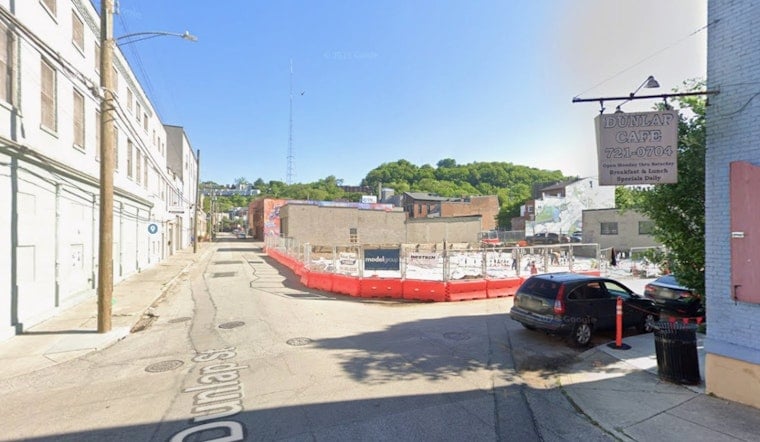
Over-the-Rhine Community Housing will hold a ribbon-cutting ceremony Thursday for Gloria's Place, a new 44-unit permanent supportive housing community built on a former parking lot at 2000 Dunlap St. near Findlay Market. The $14.9 million project pairs long-term affordable apartments with round-the-clock services meant to help residents who have experienced chronic homelessness find stability and address physical and mental health needs.
“Gloria's Place is exactly the type of supportive housing that the community needs to reduce homelessness,” Kevin Finn said in comments included in a media release, as reported by WKRC. The four-story building was designed by New Republic Architecture and constructed by Model Group, and according to Over-the-Rhine Community Housing, it combines a single secured entry point with 24-hour front desk staffing, case management offices, space for visiting medical professionals and a community kitchen.
Andy Hutzel called the development “the gold standard for serving the community's most vulnerable homeless individuals,” per the same WKRC report. Gloria's operating model follows Housing First principles, offering permanent apartments without requiring prior sobriety, an approach the nonprofit first established more than a decade ago at the Jimmy Heath House in Over-the-Rhine, the organization notes.
A Year of Legal Delays Before Groundbreaking
Getting to opening day wasn't simple. A Hamilton County judge in December 2023 dismissed a lawsuit that had challenged a Cincinnati City Council zoning variance allowing 44 units instead of 14 at the Dunlap Street site, according to WVXU. That yearlong dispute delayed construction and drove up costs as inflation and interest rates climbed, illustrating how zoning fights over supportive housing in urban neighborhoods often draw legal challenges from nearby landowners.
The project's $14.9 million budget was ultimately assembled from a mix of low-income housing tax credits, state and local housing funds, Federal Home Loan Bank of Cincinnati support, and private philanthropy, per WKRC. That capital stack included a $900,000 Affordable Housing Program grant the Federal Home Loan Bank of Cincinnati awarded in 2024 through member institution Stock Yards Bank & Trust Company. Hamilton County also requested the federal release of $1 million in HOME Investment Partnerships American Rescue Plan funds from HUD in February to help close the gap.
Homelessness Rising as Federal Aid Expires
Gloria's Place arrives as Hamilton County grapples with a documented rise in homelessness. Data released by Strategies to End Homelessness in March 2025 showed a 7.5% increase in the county's homeless population over two years, with unsheltered homelessness doubling as pandemic-era federal relief expired, the same WVXU account found. Ohio also faces a statewide shortfall of roughly 266,000 affordable rental units for extremely low-income households, with Cincinnati alone short an estimated 50,000 units, according to 2026 National Low Income Housing Coalition data reported by Hoodline.
Over-the-Rhine Community Housing, founded in 1978, now manages more than 750 housing units across over 120 buildings citywide, having grown out of the merger of earlier community initiatives RESTOC and Over the Rhine Housing Network. Gloria's Place is one piece of a broader development pipeline for the nonprofit, which is also partnering on the $21 million MidLine project in nearby Clifton Heights to add 57 income-restricted apartments along the Vine Street corridor.
Part of a Larger North OTR Investment Wave
The new supportive housing community also fits into a much larger transformation underway in northern Over-the-Rhine. Gloria's Place opens alongside a broader $100 million North OTR revitalization push led by 3CDC, which includes the $47 million Findlay Community Hub slated to open near Findlay Market in January 2027. Together, the projects reflect concurrent investments in parks, health facilities and housing across the neighborhood.





