

























































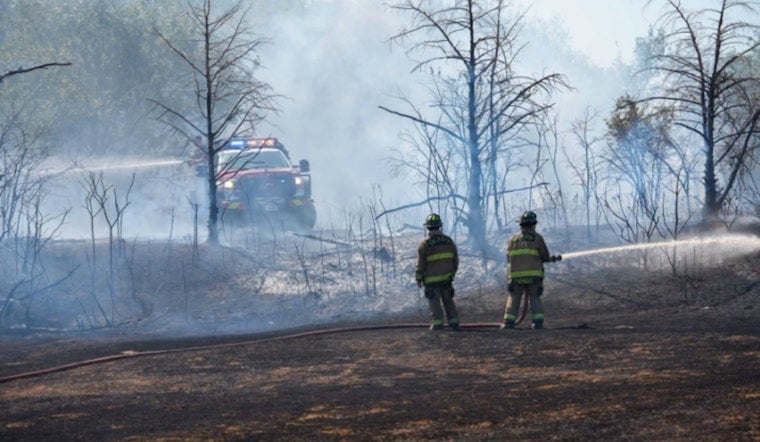
A fast-moving grass fire tore across roughly two acres near NE 25th Street and Highland in northeast Oklahoma City on Monday morning, racing north toward a church and a second structure before crews managed to stop it just short of both buildings. No injuries were reported, and firefighters also kept the flames from spreading into a nearby heavily wooded area thick with cedar trees.
Oklahoma City Fire Department crews responded to the blaze and worked to contain and extinguish it before it could reach either building, according to KFOR. The station reports the fire threatened two structures, including a church, as it moved quickly northward through dry grass. Firefighters ultimately stopped the flames before they reached either building.
The wooded area that crews protected contains multiple cedar trees, a detail that carries real weight for firefighters battling grass fires in the metro. Eastern Redcedar foliage is packed with volatile chemical oils that ignite easily, and the trees act as a ladder fuel, letting a ground-level grass fire climb into the canopy and shower burning embers onto whatever sits nearby, according to Oklahoma State University Extension research. That dynamic significantly raises the odds of a roof or building catching fire once flames reach cedar-heavy terrain.
A Metro Baked Dry by Flash Drought
Monday's fire landed in the middle of what has become one of the driest Augusts on record for central Oklahoma. Oklahoma City recorded its second-driest August on record this year as a rapid flash drought gripped the metro, per KOCO 5 News. Persistent triple-digit heat rapidly drained soil moisture across the area, turning ordinary lawns and vacant lots into ready fuel.
That drying has kept the fire department busy all month. OKCFD responded to more than 65 grass fires across the metro during just the first 12 days of August, department figures show. Officials continue to urge caution with any outdoor activity that could throw a spark and ignite dry vegetation.
Burn bans remain in effect across four counties in the Oklahoma City area, including Oklahoma, Cleveland, Canadian and Pottawatomie counties. Under state law, county boards of commissioners can declare emergency burn bans for up to 14 days at a time, and doing so requires documented concurrence from a majority of the county's municipal and rural fire chiefs, according to the Oklahoma Department of Agriculture, Food and Forestry. Violating one of those bans is a misdemeanor under Section 16-26(B) of Title 2 of the Oklahoma Statutes, carrying a fine of up to 500 dollars, up to a year in jail, or both.
Part of a Pattern Across the Metro
Monday's blaze is the latest in a string of grass fires that have threatened Oklahoma City structures this month. A fast-moving grass fire along the NW 10th Street corridor closed Interstate 40 and destroyed a nearby structure earlier in August, according to KWTV News 9. Days later, a fire fueled by 106-degree heat wiped out one Oklahoma City home and damaged two more, and a separate blaze near a Nicoma Park school damaged two structures amid the same drought conditions.
Cedar trees are more than a local nuisance during fire season. The invasive Eastern Redcedar costs the Oklahoma state economy roughly 500 million dollars annually while serving as a major accelerant in wildfires statewide, per estimates from the Oklahoma Conservation Commission, a legacy of decades of fire suppression that let the trees spread unchecked across Oklahoma grasslands. Oklahoma Forestry Services has leaned on federal State Fire Capacity grants to fund mechanical fuel thinning and prescribed burning in wildland-urban interface zones, creating fuel breaks meant to give firefighters a better shot at defending homes when grass fires ignite near populated areas.
The risk is not confined to Oklahoma City. The U.S. Forest Service issued a wildfire risk alert for national forests in Arkansas and Oklahoma on August 28, warning that persistent heat and dry vegetation meant routine ignitions could rapidly escape containment. Nationally, the National Interagency Fire Center reported the wildland fire preparedness level remained at Level 5 as of Monday, with more than 52,000 wildfires having burned over 8.2 million acres so far this year, 166 percent of the ten-year average for burned acreage.


