

























































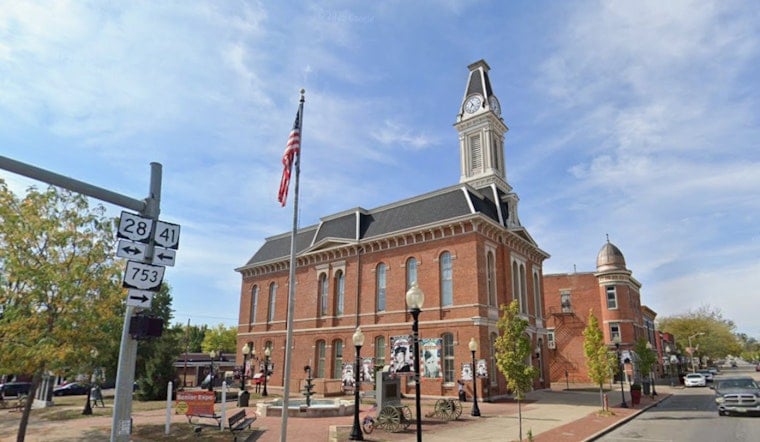
Greenfield's only court handled nearly 1,000 cases last year, and now residents are organizing to keep it open as Highland County officials quietly weigh whether to shut it down. The Highland County Court's Madison Township Division, tucked on the second floor of the village's municipal building at 300 Jefferson Street, has become the center of a brewing fight over rural access to justice versus county-level cost-cutting.
Highland County commissioners have not published a formal proposal, deadline, or decision regarding the court's future, according to facts reported by the Scioto Valley Guardian. But commissioners Brad Roades, Terry Britton, and David Daniels are gathering data from the Supreme Court of Ohio as they consider whether operating one of the state's few remaining part-time county courts still makes sense. A grassroots campaign called Save Our Court has since launched among Madison Township residents specifically to keep the Greenfield division open.
The timing is tied to a judicial transition. Highland County Court Judge John W. Judkins, who has practiced law in Highland County since 2009, won the May 5, 2026 Republican primary for an open Common Pleas Court seat after longtime Common Pleas Judge Rocky Coss announced his retirement. Judkins defeated James A. Roeder for his current judicial seat in November 2024 and is set to leave the county court bench when he assumes the Common Pleas general division judgeship in February 2027, a transition that has opened the door for commissioners to reconsider the Greenfield court's future.
Judge Warns of Bench Warrants and Missed Court Dates
On Thursday, Judkins issued a formal public statement opposing any court closure, according to The Times Gazette. He warned that forcing residents to make a 34-mile round trip to Hillsboro for minor traffic infractions would lead to missed court dates, bench warrants, and arrests for low-income residents who lack reliable transportation. Judkins said closing the Greenfield court would impose disproportionate burdens on local residents, noting nearly one-fifth of them live at or below the federal poverty line.
That poverty concern is borne out in the numbers: Madison Township has an 18.3 percent poverty rate and a per capita income of $30,097, and 172 residents there qualified for court-appointed counsel in 2025. Judkins also pointed to strain on the county's probation department, saying the officer stationed at the Greenfield facility carries the highest individual caseload of any probation officer in the county, on top of the small claims, civil garnishments, and eviction cases the facility processes.
Village Leaders Demand a Seat at the Table
During an August 5 Highland County Board of Commissioners meeting, Greenfield Village Council Chairwoman Amie Ernst formally requested that village officials be included in any consolidation talks. Ernst emphasized that local court access has been instrumental in reducing drug activity and crime in the area, per reporting from The Times Gazette. She also cited 2020 Census data showing Madison Township's population of 6,422 is nearly identical to Hillsboro's population of 6,481, an argument that northeastern Highland County represents a distinct population hub entitled to its own judicial services.
Greenfield Police Chief Jimmy Oyer, who has led the department since 2016, has also come out against removing the only court serving Madison Township. The arrangement is unusually close: a Greenfield police officer only has to travel one flight of stairs to reach the court, since the department's headquarters sits directly below the courtroom in the same municipal building. Greenfield police filed 623 of the 777 criminal and traffic charges the court handled in 2025, accounting for roughly 80 percent of the division's caseload.
What the Numbers Show
According to figures cited by the Save Our Court campaign, the Highland County Court handled 976 total cases in 2025, including 349 criminal cases, 428 traffic cases, and 199 civil cases, among them 17 evictions. The court also processed nearly $17,000 in online payments through n-Court and handled $209,350 overall in 2025, per the campaign's accounting. Of that, $64,360 was returned to Highland County and $22,790 was distributed to other state and local agencies, leaving a net cost of $120,454 that the campaign says represented just 0.18 percent of Highland County's $66.8 million budget. The court's operations cost $184,814 from the county general fund in 2025, campaign figures show.
If those cases shifted to Hillsboro Municipal Court, the impact could be significant there too. Campaign estimates cited in the seed reporting project the civil docket would increase by 22 percent, the traffic docket by 16 percent, and the criminal caseload by roughly 26 percent. Hillsboro Municipal Court currently sits about 17 miles from Greenfield, and under Ohio Revised Code Section 1901.02, it already holds jurisdiction over every part of Highland County except Madison Township.
Legislature, Not Commissioners, Holds the Final Say
That statutory detail matters because it limits what county commissioners can actually do on their own. County courts in Ohio exist only in territories not covered by municipal courts, so expanding Hillsboro Municipal Court's jurisdiction to absorb Madison Township would require the Ohio General Assembly to amend the Revised Code, not simply a commissioners' vote. Save Our Court organizers are asking commissioners to publicly state the statutory mechanism and timeline for any decision, publish a fiscal analysis of closure, and hold a public work session in Greenfield. The campaign is also seeking support from state Senator Shane Wilkin and state Representative Bob Peterson.
The court itself handles misdemeanors, traffic cases, evictions, and civil claims of $15,000 or less, and includes a 14-person felony jury courtroom. Judkins, whose term as county court judge runs through December 31, 2030 before his transition to Common Pleas, previously served from 2021 to 2024 as a part-time prosecutor and assistant law director for the Chillicothe Municipal Court. For now, the fight over Greenfield's courthouse sits alongside other signs of change in the small village, which recently received $343,730 in state brownfield assessment grants from Governor Mike DeWine's administration to evaluate historic industrial sites, according to earlier Hoodline reporting. Whether the courthouse stays open now rests with commissioners still gathering data, and ultimately, with lawmakers in Columbus.





